When should you make your first sales hire, and how do you get it right?
Your calendar is overflowing, you are still closing every deal yourself, and everyone keeps telling you it is time to "put a salesperson on it." Maybe they are right. But this is the hire startups get wrong most often, and it usually goes wrong before the first interview.
A first sales hire succeeds on three conditions, all of them set before the job post goes out: selling yourself long enough to own a repeatable process, choosing a founding AE profile built for ambiguity over a big-company senior, and running the first 90 days as a transfer of the way you sell, not as a routine onboarding. The right moment shows up as evidence, a dozen customers signed outside your network, a documented pitch, a win rate that stabilizes across your own demos.
Here are the proofs, the profile, the costliest mistakes and the first 90 days.
What is a founding sales hire?
A founding sales hire, often called a founding AE, is the first rep a startup brings in to take over selling from the founders. The term spread with Peter Kazanjy's book Founding Sales, the reference on founder-led selling. This hire does not step into a working sales engine, they build one while selling, with no finished playbook, no dedicated manager and a product that still moves. It is a different job from being an AE on an established team, and hiring for it follows different rules.
When should you hire your first sales rep?
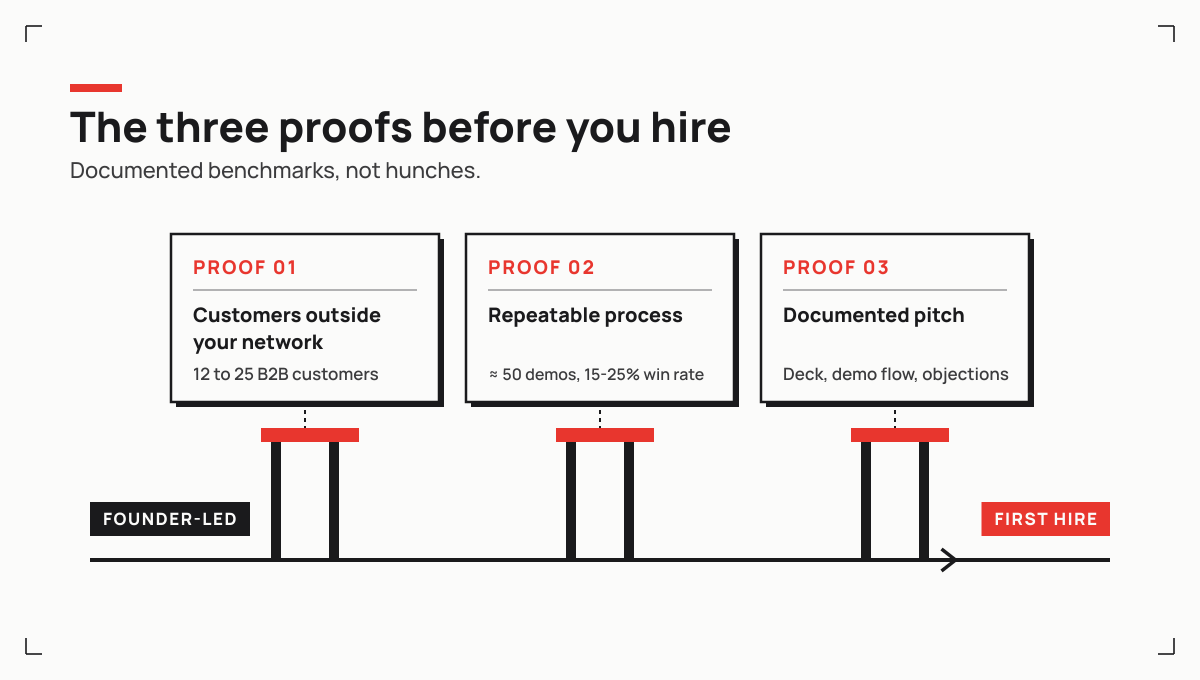
Hire when you hold three proofs, not when you run out of time.
| The proof | The documented benchmark | The trap |
|---|---|---|
| Customers signed outside your network | At least a dozen, closer to 25 in B2B according to First Round's panel of early sales hires | Ten customers who are your friends prove nothing |
| A repeatable process | Around 50 demos run yourself, a win rate stabilized between 15 and 25%, Peter Kazanjy's benchmark as reported by Dock | Not being able to tell how your last five deals got signed |
| A transferable pitch | A written deck, a documented demo flow and your objection answers, because founder sellers notoriously skimp on documentation | A pitch that only lives in your head |
The trigger, meanwhile, is prosaic. Opportunities squarely in your ICP pile up uncalled because you ran out of bandwidth. When balls start hitting the floor, hiring stops being premature.
Hiring before those proofs is, in the words of Mike Molinet, co-founder of Branch, running an experiment with three unknowns, the person, the process and the product. If the numbers disappoint, you cannot tell which one to blame.
Should you hire one rep or two?
Two, if your funding allows it. That is Jason Lemkin's classic recommendation, and the logic is experimental, not budgetary. With a single underperforming rep, you cannot tell whether the problem is the person, the process or the product. Two hires selling in parallel, each with their own style, give you a real A/B test. What works for both comes from the product, what only works for one comes from the person.
It is a luxury reserved for funded teams. If you can only afford one, be generous on variable comp for the first year. A first rep who earns good commissions early stays, while an unreachable target by month three manufactures a resignation.
Who should you hire, and who should you avoid?
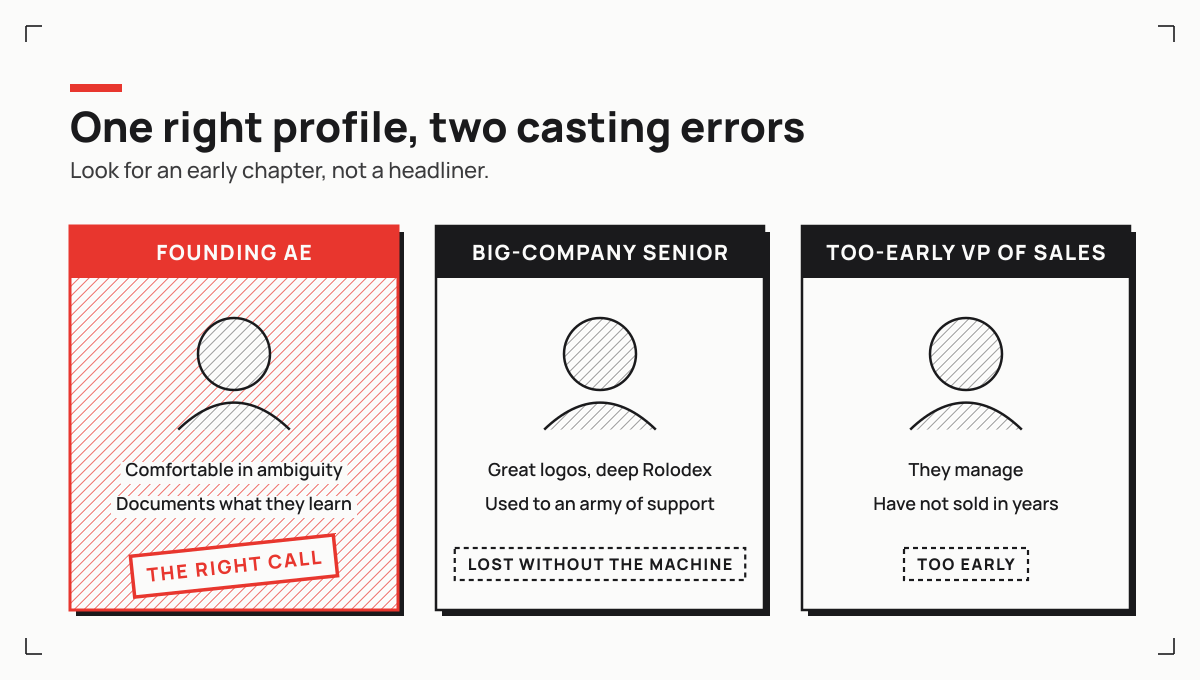
Look for an early-chapter profile, not a late-stage headliner.
| The profile | What defines them | The verdict |
|---|---|---|
| The founding AE | Comfortable in ambiguity, generates their own pipeline, documents what they learn, has worked in a small team | The right call in the vast majority of cases |
| The big-company senior | Great logos, deep Rolodex, used to an army of support, SDRs, marketing, legal | They can no longer sell without the machine, the most common mistake according to First Round |
| The VP of Sales hired to "add structure" | They manage, they have not sold in years | Nobody to manage at this stage, they arrive one or two hires too early |
Two criteria matter more than industry background. The first is mindset. Look for curiosity, flexibility and customer empathy over domain expertise, because your ICP can still pivot. The second is motion. Someone who has sold the way you sell, same cycle, same ticket size, same buyers, adapts faster than the industry insider who sold differently. And keep First Round's phrase in mind, a missionary rather than a mercenary. The mercenary leaves the day they realize the commission machine does not exist yet.
One last point of method. The best reps are never candidates, they are beating quota where they are. Recruiting a founding AE is outbound work, across your network and your investors' network, started months before the need.
Why do first sales hires fail so often?
Because they almost never fail at the interview stage. They fail at the handoff. Meka Asonye, the First Round partner behind the reference piece on this hire, observes that the batting average on first revenue hires is especially low, with sub-one-year tenures depressingly common. And a failed first hire does not just cost a salary. It costs the botched deals, and six to twelve months of traction lost while your runway is counted in quarters.
The mechanism is almost always the same. The way you sell, the objection diagnosis, the price line held, the follow-up that unlocks a demo, exists nowhere but in your head. The new hire gets a Notion, three call recordings and plenty of encouragement, then rebuilds everything from scratch. Three months later the numbers disappoint, and you conclude it was a casting error when it was a handoff error. Before hunting for the perfect rep, ask what you concretely have to hand over.
How do you structure the first 90 days?
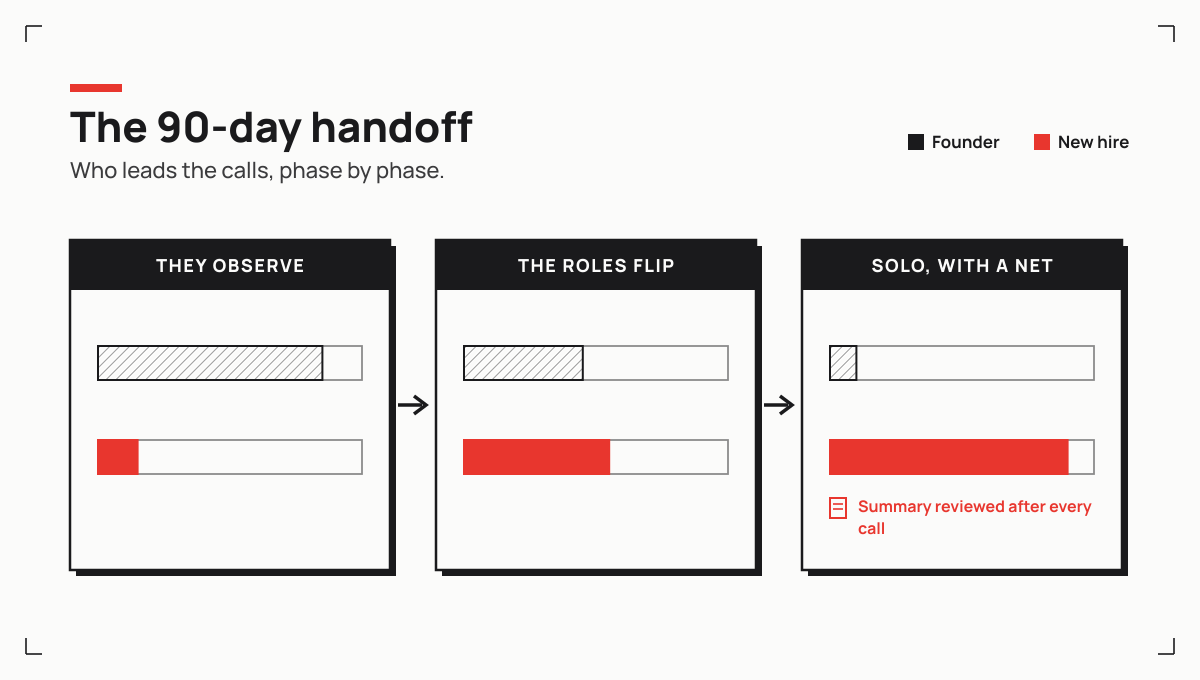
Treat the first 90 days as a transfer through real calls, not as product training. Three phases, with lengths that scale to your cycle:
- They sit in your calls. You run the sale, your hire observes, preps the meetings and owns the follow-ups. The rep keeps the machine moving while the founder still delivers the pitch, the setup Jacquelyn Goldberg describes from her days as PebblePost's first sales hire.
- The roles flip. They lead, you listen, and every call gets debriefed while it is hot, what was said, what could have been. This is where your playbook actually transfers, objection by objection.
- They fly solo, with a net. Every call produces a summary you read, and a weekly review replaces your presence.
Two benchmarks to close. Count roughly one full sales cycle before true autonomy, Mike Molinet's rule of thumb, so a six-week cycle means a six-week ramp and nine months mean nine months. And grade the first weeks on learning speed rather than pipeline, because a rep rushing to close before understanding your buyers burns at-bats you cannot afford to lose.
How do you transfer your way of selling without joining every call?
The bottleneck of the handoff is you. Your knowledge only transfers when you are in the call, and you cannot be in every call. That is exactly why you are hiring.
That is the problem Midcall works on during your first hire's calls. Midcall knows your company, your offers, your competitors and your prospects' technical questions, and coaches your founding AE live during their discovery and demo calls. The right move arrives prompted at the right moment, one line at a time, only when the confidence threshold is met. The help is personalized, a hire who struggles with objections gets more support there, another will get it on closing. Every call produces a summary and a score, and a dashboard aggregates their strengths and their work areas. You watch the graft take without sitting in the meetings, and your debrief runs on facts, not on their retelling. Midcall is a young product and I will not promise you a hiring success percentage. What I do see is that juniors coached live ramp much faster, and the founder gets their weeks back without losing visibility.
When do the second rep and the sales manager arrive?
Each next hire has its moment. The second rep comes as soon as the first proves your process transfers, or alongside them if you chose the pair. The manager only comes once there is a team to run. Your role then shifts to the coaching cadence, and the project becomes collective, raising the team's close rate rather than one individual's. You never fully leave selling, big deals need a founder's weight for a long time. But if every deal still requires you one full cycle after the hire, the handoff never happened.
The hire is only the first step. What happens in the ninety days that follow is covered in our guide to sales onboarding, where ramp is actually won.
Edward, co-founder of Midcall. Former AE, co-founder of Meteor, a B2B prospecting agency. I write about what actually happens on sales calls, and what the best teams do with it.
Frequently asked questions
How many customers should you have before your first sales hire?
The documented benchmark sits between a dozen and twenty-five B2B customers signed outside your personal network, according to First Round's panel of early sales hires. It is a benchmark, not a rule. An enterprise product needs fewer, a self-serve product needs more.
Should your first sales hire be junior or senior?
Neither a complete beginner nor a big-company senior. The right profile has a few years of SaaS sales, time spent in early stage, and the habit of generating pipeline without marketing support. Mindset matters more than industry background, with curiosity, flexibility, the discipline to document what they learn and a genuine desire to build.
Should the founder stop selling after the first sales hire?
No, and certainly not overnight. The transfer happens in stages. The hire observes your calls, then leads them in front of you, then sells alone with a regular review. Even after that, a founder remains the decisive weapon on strategic deals.
Should you hire a VP of Sales or a rep first?
One or two reps first, the VP of Sales later. A VP hired before the team has nobody to manage and has not sold in years. You pay a premium for structure with nothing to structure yet. In the right order, the founder proves the sale, one or two founding AEs prove the process transfers, then a manager scales the team.
How long until you know the hire is working?
Count roughly one full sales cycle to judge on numbers, the normal length of a ramp. Before that, judge on learning signals, the quality of their calls, how fast they absorb your objection answers, the way they move deals forward. That is what call summaries let you track without waiting for the quarter's verdict.
See the live AI coach on one of your calls.
15 minutes. We plug Midcall into a real scenario from your team, you decide.