What is sales onboarding, and how do you ramp reps faster?
Sales onboarding is how you turn a new hire into a rep who can win deals, as fast as possible and without wrecking your pipeline while they learn. The standard is a 30-60-90 day plan, but the number that matters is not the calendar, it is how quickly a rep gets good on real calls. And that is won on the calls themselves, not in the slide deck.
What is sales onboarding?
Sales onboarding is the structured process of taking a newly hired rep from day one to the point where they can consistently sell on their own. It covers four things, your product and market, how you position value, your sales motion and methodology, and the tools and CRM. It is not the same as HR onboarding, which handles payroll, contracts and company culture. Sales onboarding is about revenue, and its whole purpose is to shorten the time between a rep's first day and their first closed deal, without that rep burning good opportunities while they find their feet.
Why does sales onboarding decide ramp, and revenue?
Because ramp is expensive, and weak onboarding pays for it twice. The first cost is time, since a new rep is on salary long before they carry quota. Ramp varies sharply by role, and commonly cited 2026 benchmarks put an SDR at two to three months, a mid-market AE at four to six, and an enterprise AE at six to nine before they reliably hit target.
The second cost is quieter and usually bigger, the deals a green rep loses while they learn. A junior who mishandles a discovery, fumbles a real objection or lets a deal go dark is not running a harmless drill, they are burning a real opportunity a competitor is happy to take. Across a ramp that is not one lost deal, it is several, and a single mid-market deal can be worth more than a rep's whole onboarding budget. Slow, sloppy ramp is not an HR line item. It is lost revenue.
What does a 30-60-90 day sales onboarding plan look like?
The 30-60-90 plan breaks the first three months into three phases, each with its own goal.
Days 1 to 30, learn. The rep absorbs the product, the ICP, the messaging and the methodology, sets up the CRM and tools, and shadows real calls. The goal is understanding, not output.
Days 31 to 60, apply. The rep starts running real calls under observation, on a reduced ramp quota, and gets feedback fast. This is the phase that actually builds a seller, and the one most programs cut short.
Days 61 to 90, accelerate. The rep owns their pipeline, carries a rising quota, and moves from observed to independent, with coaching focused on their specific gaps.
Why do most onboarding programs still produce slow ramp?
Because they load the rep with content and delay the only thing that builds a seller, real calls. The classic failure is a wall of slides and product PDFs, a certification quiz, and then the rep is handed a list and told to go. Knowledge transfer feels like progress, but a rep who can recite the pitch has not learned to hold a room when a live prospect pushes back.
The other failures rhyme with that one. Onboarding treated as a one-time event instead of a continuous process. Practice that stays theoretical and is never tied to a real conversation. No measurement beyond module completion, so a struggling rep stays invisible until the numbers come in months later. And one program for everyone, when the junior who keeps skipping the pain and the junior who freezes on pricing need completely different coaching. More content fixes none of this. More real reps, sooner, does.
How do you get a rep onto real calls sooner, without burning deals?
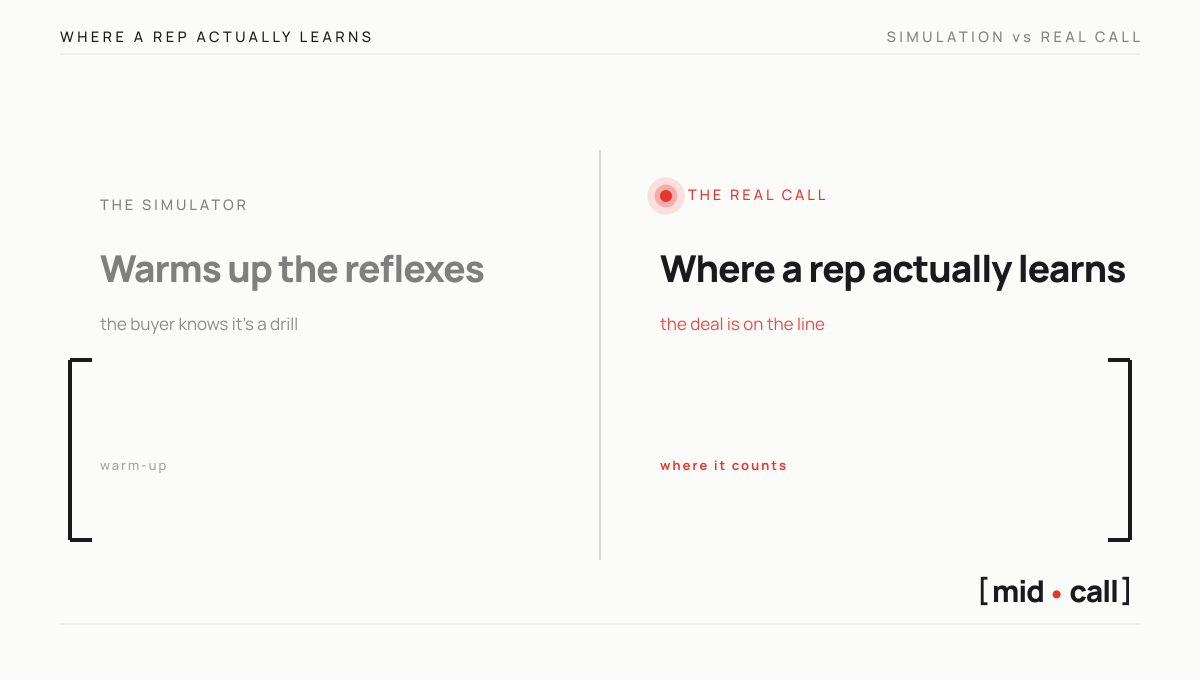
This is the real tension in onboarding. You do not learn to sell in a classroom, and you do not fully learn it in a simulator either. A rep learns to sell on real calls, real demos and real presentation meetings, where a live buyer pushes back with something no script covered and the deal is genuinely on the line. Practising against a simulated buyer helps a little, it warms up the reflexes, but the prospect always knows it is a drill, so it never carries the pressure or the stakes of the real thing. The teams that ramp fastest do not run more simulations. They get reps onto real calls sooner.
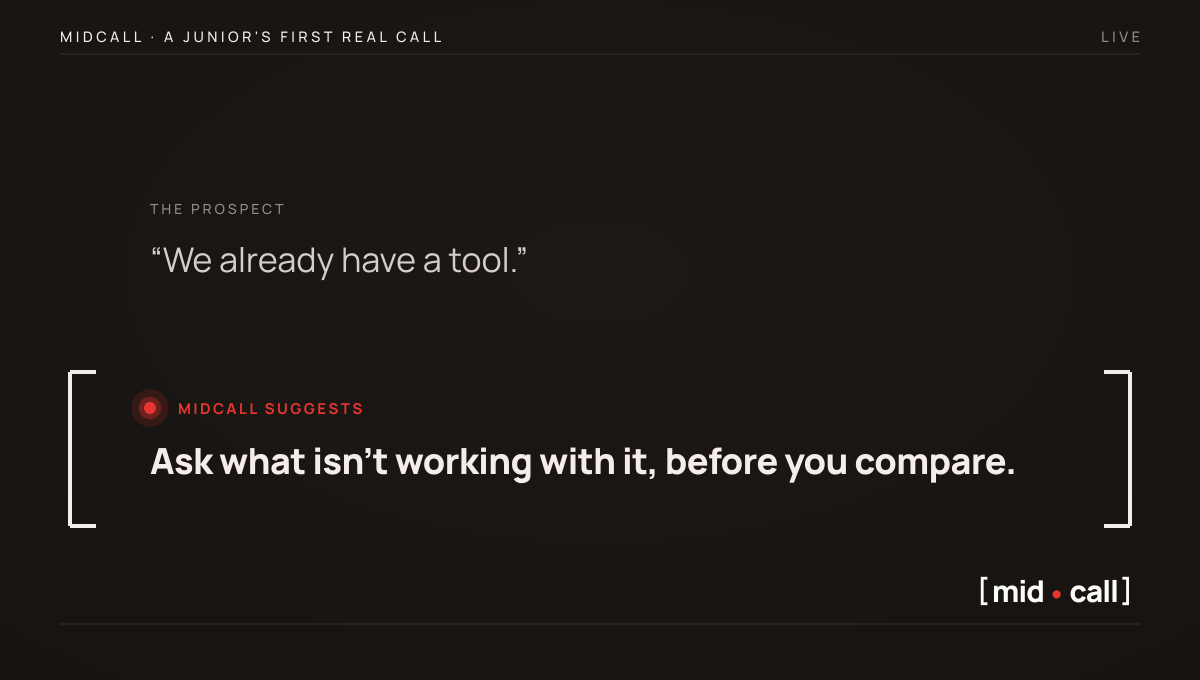
The catch is obvious, a green rep on a real call can lose a real deal, which is exactly why managers keep juniors in training longer to protect the pipeline. The way out is to let a rep take real calls sooner with a safety net on the line. That is what Midcall does during a call, it reads the conversation live and prompts the right line at the moment it is needed, so a junior handles the objection, asks the missing question and holds the next step closer to how a senior would, from their first real calls. The rep builds real skill on real deals instead of burning them to learn. And the economics are simple. A mid-market deal lost by a rep who froze is worth more than a year of the tool that would have prompted them, and a junior loses several of those while ramping. Cutting even a few of those losses pays for the copilot and shortens the ramp at the same time.
How do you personalize and measure each rep's ramp?
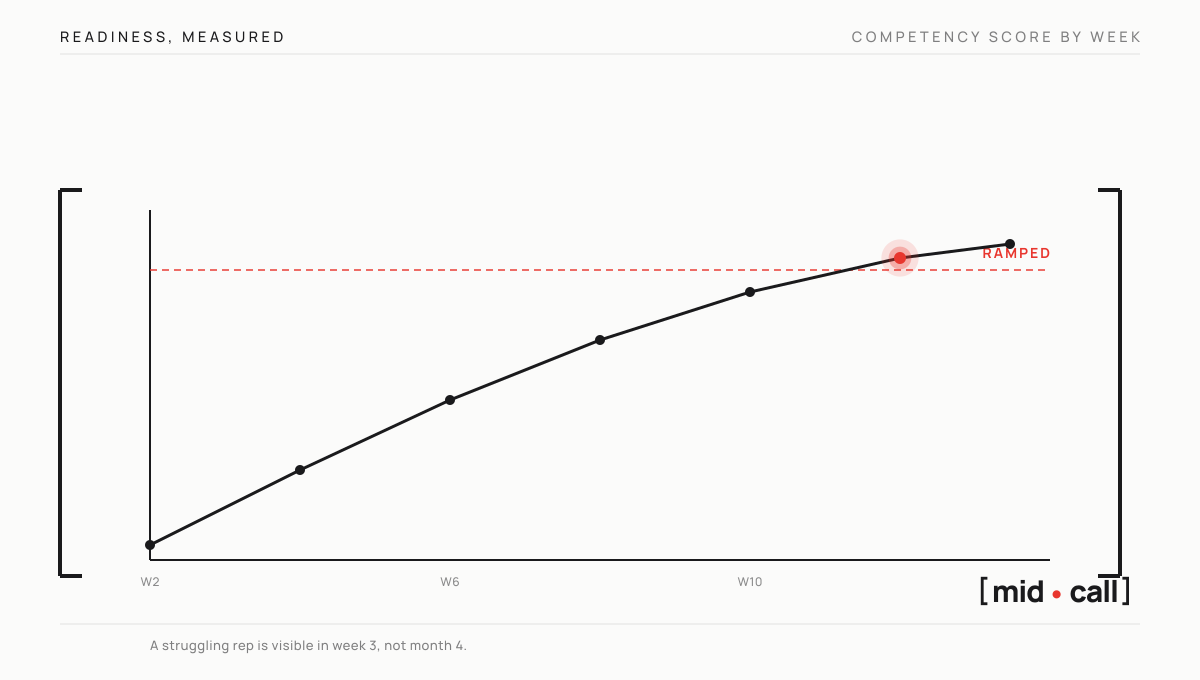
A generic curriculum ramps everyone at the same speed, which means it ramps no one at their own, and module completion tells you a rep is busy, not good. Both problems have the same fix, look at how each rep actually sells.
When every one of a new rep's real calls is scored by competency, discovery, objection handling, closing and the rest, two things happen. You see each rep's specific gap, this junior keeps skipping the quantified pain, that one loses control when price comes up, and you coach exactly that in a weekly review instead of running one generic session for the cohort. And you get readiness as data rather than gut feel, since a competency score per call gives you every new rep's trajectory on one screen, so a struggling rep is visible in week three, not month four. Midcall's per-competency scores turn each rep's real calls into a short personal coaching list and a live readiness picture, which is what personalized, measured onboarding means in practice.
Where is ramp actually won, and how do you shorten it?
Every part of onboarding that happens before the first real call is preparation. Useful preparation, but preparation. Ramp is won on the calls themselves, in the weeks when a new rep goes from watching to doing, and it is shortened by getting them there sooner and making each of those calls count.
Get a rep onto real calls earlier with a copilot that keeps them off the expensive mistakes, score every call so both of you know exactly what to fix, and the 90-day plan stops being a content marathon and becomes a measured, coached ramp that ends with a rep who can actually sell. That is what Midcall is built to do for new hires, turn the riskiest and most expensive phase of onboarding into the fastest one. It is the same reason a manager runs a real team system rather than hoping talent ramps itself.
Onboarding is one block of a wider system. Our guide to AI sales enablement covers the whole program, from content and practice to readiness measured on real calls.
Edward Labruyère, co-founder of Midcall. Former B2B SaaS AE, co-founder of Meteor, a B2B prospecting agency. I write about what actually happens inside sales calls, and what the best teams do about it.
Frequently asked questions
How long does sales onboarding take?
The structured program is usually 60 to 90 days, but full productivity takes longer and depends on the role. Commonly cited benchmarks put an SDR at two to three months to ramp, a mid-market AE at four to six, and an enterprise AE at six to nine, driven mostly by deal complexity and sales-cycle length.
What is the difference between sales onboarding and sales training?
Onboarding is the time-boxed ramp of a new hire, a program with phases and milestones that takes someone from day one to quota readiness. Training is the ongoing skill-building that continues for the life of a rep's career. Onboarding uses training, especially practice and roleplay, but it is bounded and specific to a new joiner.
Who owns sales onboarding?
In most companies with an enablement team, enablement builds and maintains the program, while the sales manager owns the coaching, the call reviews and the ramp-quota accountability. In smaller companies the manager owns all of it, which is workable with a simple plan and disciplined call reviews.
What is in a 30-60-90 day sales onboarding plan?
Three phases. Days 1 to 30 to learn the product, market, messaging and tools while shadowing calls. Days 31 to 60 to apply it on real calls under observation with a reduced quota. Days 61 to 90 to run an independent pipeline on a rising quota, with coaching focused on the rep's weakest competency.
Can a small team onboard well without an enablement team?
Yes, and many do it better than large ones. A one-page plan, a real-call review every week, and a manager who coaches the specific gap will out-ramp a polished LMS that no one opens. What matters is real practice and fast feedback, not the size of the program.
Does sales onboarding work differently for an experienced hire?
Yes. An experienced rep already knows how to sell, so their onboarding compresses the skill-building and concentrates on what is specific to you, your product, your ICP, your positioning and your competitors. The ramp is usually shorter, but skipping it is a mistake, since a senior selling your product with their old company's pitch loses deals just as fast as a junior.
See the live AI coach on one of your calls.
15 minutes. We plug Midcall into a real scenario from your team, you decide.