What is AI sales training, and does it actually make reps better?
AI sales training uses AI to let reps practice their calls against a simulated buyer and get feedback before they face a real prospect. Done well, it works, because practice is the only thing that makes training stick. But it stops the moment the live call begins, and that is where deals are won or lost.
What is AI sales training?
AI sales training is the use of artificial intelligence to build selling skills through practice and feedback, rather than through slides and one-off workshops alone. The term covers three different things, and it helps to separate them.
The first is AI role-play, where a rep holds a live conversation with a simulated buyer that objects, stalls and negotiates, then gets scored on how they handled it. The second is AI-assisted analysis, where the system reviews real calls and turns them into feedback and drills. The third is personalized learning paths, where the software decides what each rep should work on next based on their gaps. Most tools sold as AI sales training lean on the first, the simulated practice, because that is the part traditional training could never scale.
How does AI sales training work?
The mechanism behind AI role-play is simple. You set a buyer persona and a scenario, a first discovery call, a price objection, a renewal at risk. The rep leads the conversation by voice or text while the AI plays the prospect, reacting in character and pushing back when the rep gets lazy. When the exchange ends, the model scores the rep against the skills you care about, discovery depth, objection handling, clarity of the next step, and points to the exact moments that went well or badly. Because it runs on software, a rep can repeat the same scenario ten times in an afternoon, which is something a manager running manual role-plays could never offer.
The quality depends heavily on what the AI is fed. A model working from your real playbook, your objections and your deals produces sharp, specific practice. One working from generic internet data produces cookie-cutter coaching that sounds plausible and teaches very little.
What is the difference between AI sales training and AI sales coaching?
People use training and coaching interchangeably, and they are not the same job. Sales training is standardized. It teaches the skills, the product knowledge and the process every rep needs, and it usually happens up front during onboarding, then in refreshers. Sales coaching is personalized. It works on one rep's specific weaknesses over time, based on how they actually sell. AI now touches both, but at different moments in the sale. Picture a call in three parts. Before it, training and role-play build the reflexes. During it, a real-time sales coach can prompt the rep while the conversation is live. After it, analysis turns the recording into feedback for next time. AI sales training lives in the before. It is preparation, not intervention, and that distinction matters more than it looks, as the last section explains.
Why doesn't traditional sales training stick?
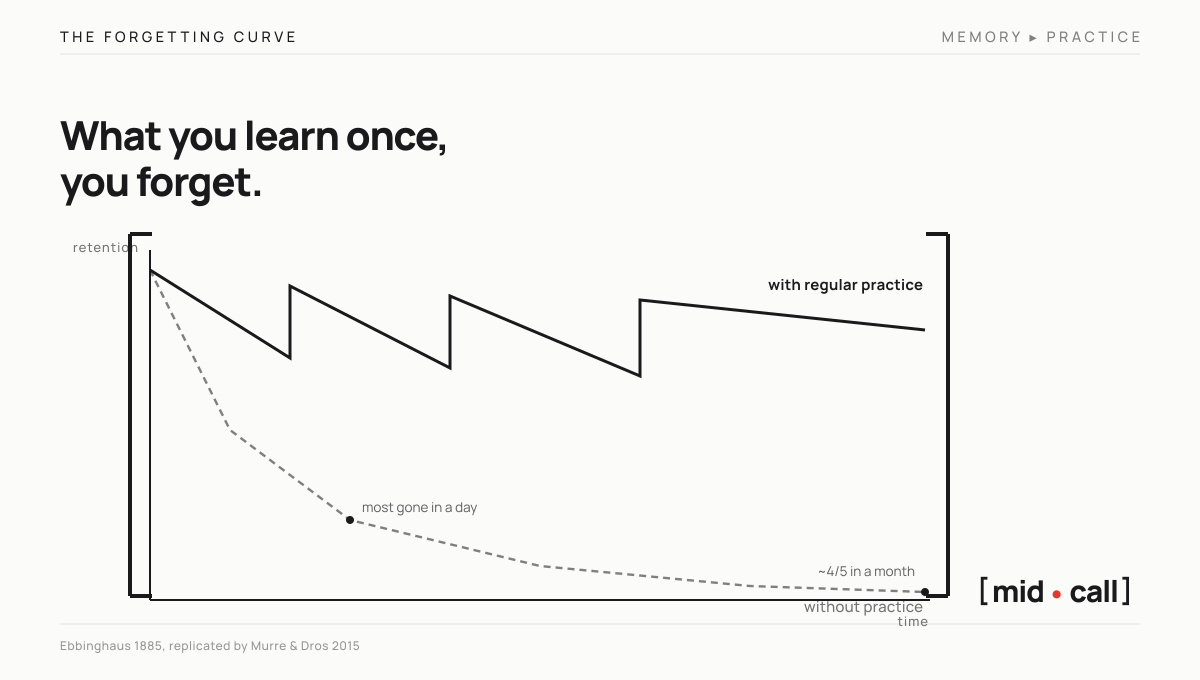
Because forgetting is the default, not the exception. In the memory research that begins with Hermann Ebbinghaus in 1885 and was carefully replicated by Murre and Dros in 2015, people lose the majority of newly learned material within a day and around four fifths within a month when they never revisit it. A sales kickoff is exactly this kind of event, a burst of information with no reinforcement, so a week later reps are back on real calls misquoting the pitch and freezing on objections the trainer covered. What flattens that curve is not more content but retrieval, the act of recalling and using knowledge instead of re-reading it. Karpicke and Roediger found that practicing retrieval produces far stronger long-term memory than passive review. That is the real case for AI role-play. Not that it is a new idea, but that it turns training from an event the brain discards into repeated practice the brain keeps.
Does AI sales training actually work?
Yes, with a clear boundary around what "work" means. For building and holding skills before the call, the evidence from learning science is strong, since spaced, repeated practice with feedback beats one-off instruction, and AI is simply the first tool that makes that practice cheap and available on demand. A junior can drill objection handling every morning without burning a manager's hour or a real deal. Where AI sales training gets oversold is in two places. It cannot reproduce the pressure of a live prospect, because the rep always knows the buyer is a machine, and a machine can be gamed or restarted. And it is only as good as its data, so a simulator built on off-the-shelf scripts teaches a rep to pass a test that a real buyer never sets. Treated as ongoing practice tied to your real playbook, it works. Treated as a one-time certification, it decays like any other event, which is why the best teams pair it with a weekly coaching rhythm rather than a single kickoff.
What is virtual sales training, and where does AI fit?
Virtual sales training is a broader idea, and it predates AI. It simply means training delivered remotely rather than in a room, through video sessions, on-demand modules and digital reinforcement, which is now how most distributed teams learn. AI has become its most active part. The old virtual model was largely one-directional, someone presenting over video, and it inherited the same forgetting problem as the in-person seminar. What AI adds is the missing half, practice and feedback, so a remote rep can not only watch the module but rehearse the conversation and get scored on it with nobody else in the room. If you are evaluating virtual sales training today, the useful question is not whether it is remote, but whether it includes real practice or just remote presentation.
How do you roll out AI sales training?
Start from a gap, not a tool. Look at where deals actually slip, thin discovery, fumbled pricing conversations, no clear next step, and train that, rather than buying a platform and hoping reps log in. Make practice a small, regular habit, a ten-minute drill a few times a week, not an annual event, because that is what the forgetting curve demands. Feed the AI your real material, your playbook, your objections, your won and lost calls, so the practice mirrors your actual sale, which also makes it the fastest way to ramp a new hire. And measure what you care about, whether reps ramp faster and hold better conversations, not how many modules they completed. You do not even need a platform to start. You can run a useful drill today with a general assistant like ChatGPT or Claude. Start with this:
Then make it harder and vary the scenario. Add a line like « interrupt me, stay skeptical, and do not accept a vague answer » to raise the pressure, and swap the setup to drill the moments that actually lose deals, such as « open on a hard price objection and do not let it go until I reframe the value » or « we are at the end of the call, push me to commit to a next step and resist every soft close ». Run each one a few times, not once.
A general model is a fine sparring partner to warm up against, but it does not know your deal, it can be too agreeable, and it will not be there when a real prospect pushes back.
Where does AI sales training stop, and what wins the call itself?
Here is the part the category pages tend to skip. Training, however good, ends the moment the real call begins. A rep can drill objection handling every morning and still blank when a live prospect says "it is too expensive" in a way that means something specific, on a deal that matters, with no restart button. Practice builds the reflex. It does not stand next to the rep when the reflex is tested.
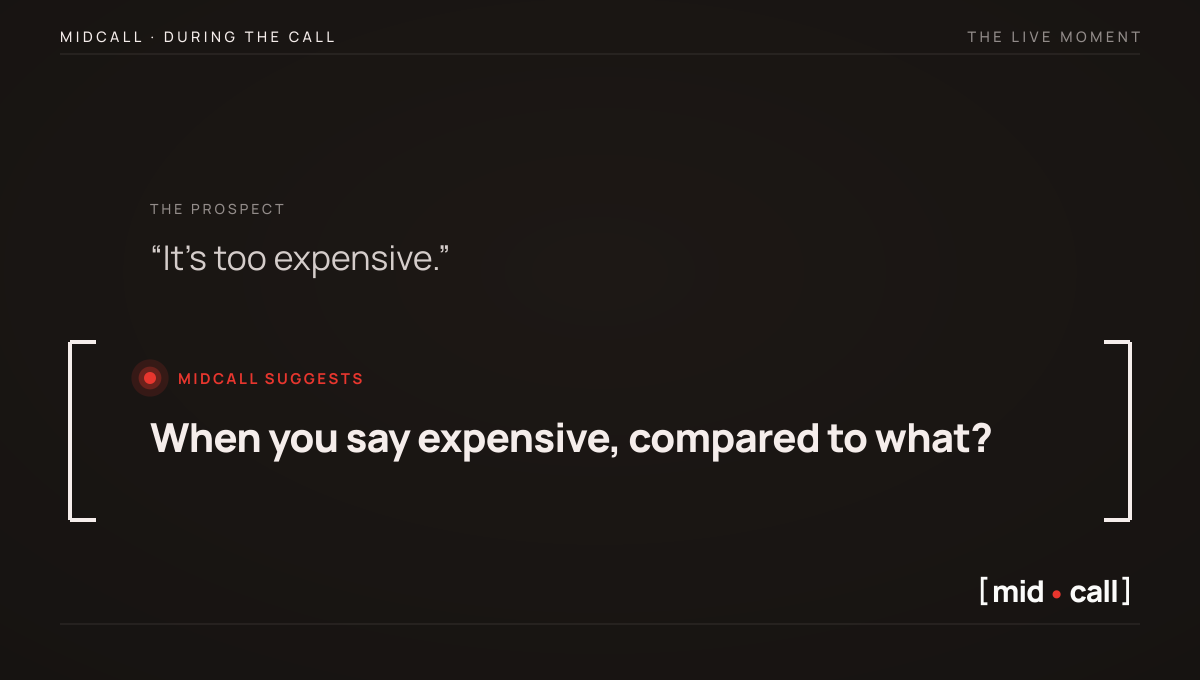
That gap, the live call, is where deals are won and lost, and it is where Midcall works. Midcall is a sales coach, not a simulator, and it does two things a training tool cannot. During the call it runs alongside the real conversation on Meet, Teams or Zoom, reads what is happening in the sale, and puts the right line in front of the rep while the prospect is still talking. After the call it scores that rep by competency, discovery, objection handling, closing and the rest, and shows exactly what to work on next, tuned to how that specific rep sells. That is what closes the loop. Practice builds the skill, live help lands it on the real deal, and the post-call score tells each rep precisely what to drill next.
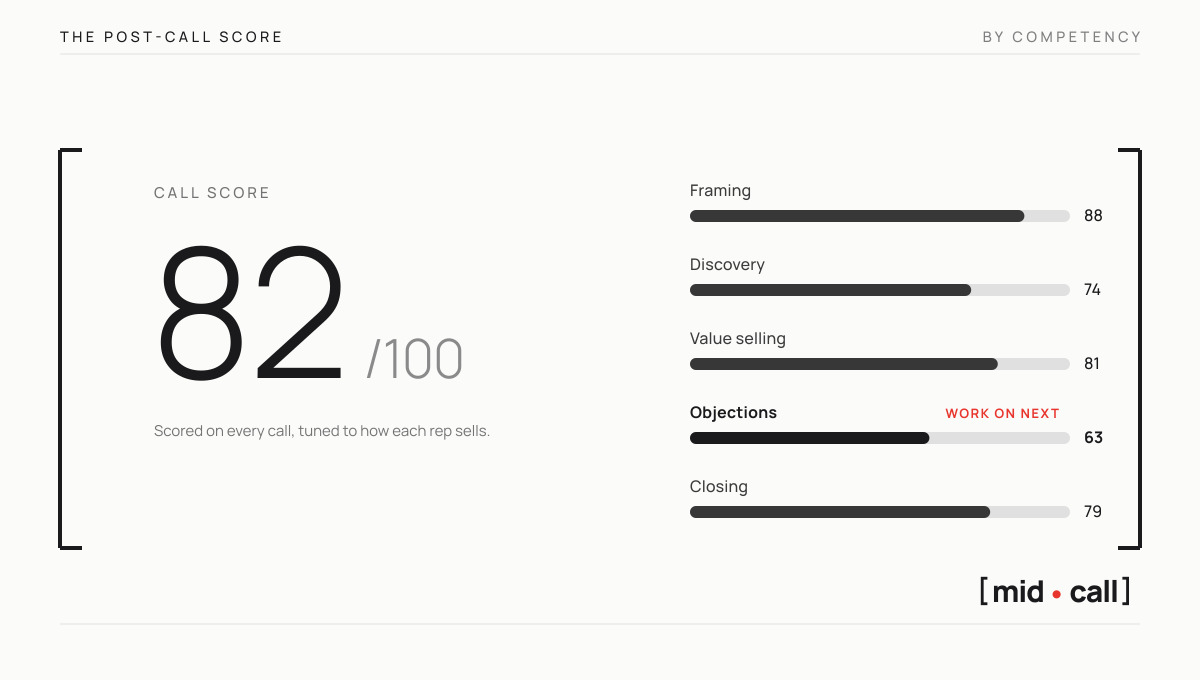
So stop treating them as a choice. Train your reps until the reflexes are there, then give them a coach on the live call so those reflexes fire when a real deal is on the line and money is moving. Juniors start closing like seniors, seniors get sharper every call, and you finally see, rep by rep, exactly what to work on next. Practice, live coaching and post-call scoring in one loop. That is what Midcall does, and it is the fastest way to turn a team that trains into a team that wins the calls it trained for. Where practice, live coaching and scoring sit inside a full program is the subject of our guide to AI sales enablement, and for a new rep's first weeks, our guide to sales onboarding shows where ramp is actually won.
Edward Labruyère, co-founder of Midcall. Former B2B SaaS AE, co-founder of Meteor, a B2B prospecting agency. I write about what actually happens inside sales calls, and what the best teams do about it.
Frequently asked questions
Can AI replace a sales trainer or a role-play partner?
No. It scales the part that never scaled, letting every rep practice on demand instead of waiting for a manager's slot. Setting the strategy, judging nuance and coaching the human still belong to a person. AI handles the reps and the volume.
Is AI role-play effective for onboarding new reps?
It is one of its strongest uses. A new hire can rehearse discovery, pricing and objection handling dozens of times against a simulated buyer without burning real pipeline, which shortens the gap between day one and their first competent call.
What sales skills can reps practice with AI?
The conversational ones, mainly. Discovery questioning, objection handling, pitching, negotiation and closing, each set in a specific scenario like a cold call, a demo or a renewal at risk. Product knowledge and process are better taught through content, then reinforced through practice.
How is AI sales training different from sales enablement software?
Enablement software manages content, playbooks and assets and gets them to reps at the right moment. AI sales training is the practice and feedback layer that turns that content into skill. Many teams run both, with enablement holding the knowledge and training drilling it.
Does AI sales training work for SDRs as well as AEs?
Yes, with different scenarios. SDRs drill cold calls, opening lines and early objections, while AEs practice discovery, demos and closing. The mechanism is the same, a simulated buyer and scored feedback, tuned to the conversations each role actually has.
See the live AI coach on one of your calls.
15 minutes. We plug Midcall into a real scenario from your team, you decide.