How do you handle the "too expensive" price objection?
Your rep runs a good demo, the prospect nods along, and then the sentence lands: "it's too expensive." What happens in the next ten seconds often decides the deal. And the worst response is the most common one: justifying the price.
Handling the "too expensive" objection starts with a diagnosis, not a pitch. "Too expensive" covers six different situations: value the prospect does not perceive, a cheaper competitor, a real budget cap, the comfort of the status quo, a negotiation tactic, or a plain smokescreen. The right move is to identify the case with one question, then treat that specific case. Answering before diagnosing is treating at random.
Here are the six cases, the word-for-word responses and the mistakes that make everything worse.
Why is "too expensive" almost never about the price?
Because no price is too expensive in the absolute: it is too expensive relative to a reference, and everything hinges on that reference. Comparing your price to an approved budget, to a competitor, to the cost of doing nothing, or to nothing at all because the prospect wants a polite exit: the words are identical, the situations have nothing in common, and neither do the responses.
That is why lists of "price objection techniques" work so poorly: one remedy for six different diseases. The reflex that changes everything fits in a single question, before any justification: "Too expensive compared to what?"
How do you diagnose a "too expensive"?
Each face of the price objection leaves clues, and one question is usually enough to confirm the diagnosis.
| The case | The tell | The question that confirms it |
|---|---|---|
| Value not perceived | The comparison points to nothing specific: "for what it is" | "Too expensive compared to what, exactly?" |
| Cheaper competitor | A precise reference exists, sometimes named | "What did you like about what you saw elsewhere?" |
| Real budget cap | The value is accepted, only the amount blocks | "If budget were not an issue, would we be moving forward?" |
| Status quo | Your price is compared to "doing nothing", which looks free | "What is the current situation costing you every month?" |
| Negotiation tactic | It shows up late in the cycle, once everything else is agreed | Silence, then: "What would make you say yes at this price?" |
| Smokescreen | It shows up early, with no real engagement in the conversation | "Let's set price aside: does the solution solve the problem?" |
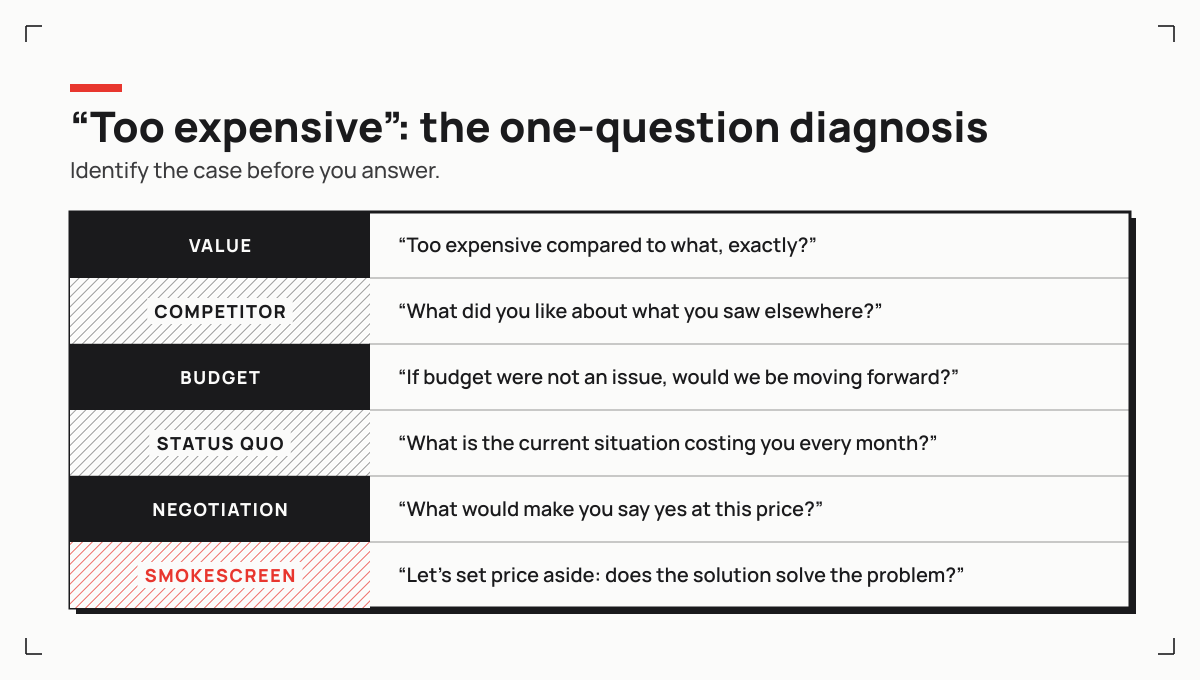
The last two cases concentrate the biggest mistakes. A negotiation tactic treated as a value objection pushes the rep to re-run their pitch and weakens their position. A smokescreen treated as a real objection wastes twenty minutes defending a price nobody is actually contesting: the real issue is elsewhere, often a pain too small to justify changing anything.
What do you say, word for word, to "it's too expensive"?
Once the case is identified, the response follows. Here are the scripts, to adapt to your offer.
| The case | The word-for-word response | Why it works |
|---|---|---|
| Value not perceived | "Fair enough. Let's step back a minute: you told me [the problem] costs you [their number] a month. What is missing for the investment to make sense?" | It brings the conversation back to their number, not your price |
| Cheaper competitor | "That's true, we are not the cheapest. Beyond price, what does the comparison come down to for you?" | Owning the gap avoids the discount spiral and moves the debate to criteria |
| Real budget cap | "Understood. If we had to start smaller to fit the envelope, what would be essential from day one?" | It saves the deal by shrinking the scope, not the price |
| Status quo | "I hear you. And on the other side of the scale, changing nothing costs [their number] a month. At what point does that cost become the problem?" | It puts a price on the apparent "free" of inaction |
| Negotiation tactic | "The price matches the scope we defined together. If we need to move on price, what do we take out?" | Every concession has a counterpart: that is what separates negotiating from caving |
| Smokescreen | "We can talk about price, but I get the sense that is not the real issue. What is actually holding you back?" | It names the game respectfully, and the mask usually drops |
The common thread across these six responses: none of them lowers the price, none justifies it with your costs, and all of them end with a question. Whoever asks the question keeps control.
How do you handle a price objection, step by step?
Five steps, in that order, and the order matters more than the wording. Two established frameworks converge here. LAER, from Carew International, runs on listening, acknowledging, exploring and responding. LAARC, taught as a standard in sales textbooks, runs on listening, acknowledging, assessing, responding and confirming. Both open on listening and both close on a check. What the price objection adds is the diagnosis, because the exploring step has one precise job here, identifying which of the six cases you are in.
| Step | What you actually do | What kills it |
|---|---|---|
| 1. Let them finish | Take the objection in full, without cutting in, even when you saw it coming | Answering over the last three words of their sentence |
| 2. Acknowledge without agreeing | "Fair enough" costs nothing and lowers the temperature. Acknowledging is not conceding | Skipping straight to the argument, which reads as defensive |
| 3. Diagnose with one question | "Too expensive compared to what, exactly?" and then silence | Stacking three questions, which turns into an interrogation |
| 4. Respond to that case only | One case, one response, nothing else. Do not cover the other five just in case | Re-running the full pitch, which brings you back to feature ground |
| 5. Confirm it is resolved | "Does that answer the point?" before moving on | Assuming it landed, then discovering it again in the follow-up email |
This sequence is specific to the price objection, where the whole job is identifying the reference behind the comparison. A stalling objection such as "I need to think about it" runs on a different sequence, covered in our dedicated article.
The fifth step is the one reps skip most. An objection that was never confirmed as resolved does not disappear, it goes quiet, and it comes back at signature time in someone else's words.
Which mistakes make the price objection worse?
| The mistake | Why it costs the deal |
|---|---|
| Dropping the price immediately | A discount given without a counterpart says one thing: the initial price was inflated. Trust drops with the number |
| Justifying the price with your costs | Your costs are not the prospect's problem: they are buying an outcome, not your margin structure |
| Re-running the feature pitch | On feature ground you become comparable, therefore compared, therefore dragged back to price |
| Taking the objection personally | "Too expensive" does not mean "you are worth nothing": a rattled rep defends, and defending weakens |
| Answering before diagnosing | The best response to the wrong case is still a wrong response, dig first |
How much discount is acceptable, and in exchange for what?
There is no universal percentage, and any article that gives you one is inventing it. The rule that holds across pricing practice is different. A concession is a trade, never a gift, and its size matters less than what comes back the other way.
The cost of getting this wrong compounds quietly. Pricing specialists converge on the same diagnosis, margin erosion rarely comes from one large giveaway but from small concessions granted without counterpart, deal after deal. Simon-Kucher makes the point from the pricing side by recommending that sales teams be trained to reduce their dependence on discounting rather than to negotiate it better.
| What you give | What you get back |
|---|---|
| A lower annual price | A longer commitment, two or three years instead of one |
| A discount on the first year | Payment up front instead of quarterly |
| A reduced scope to fit a budget | A dated expansion clause on the remaining scope |
| A price gesture | A named customer reference or a public case study |
| A free onboarding | An earlier signature, before the end of the quarter |
Three rules make this workable in a live call. Speak in amounts, not in percentages, because a percentage invites arithmetic, and a prospect who hears 10% immediately wonders why not 20%. Make each successive concession smaller than the last, so the curve itself signals that you are reaching the floor. And define the approval tiers before the call, not during, because a rep who has to invent their own limit while a buyer is waiting will always invent it too low.
When should you talk price to defuse the objection?
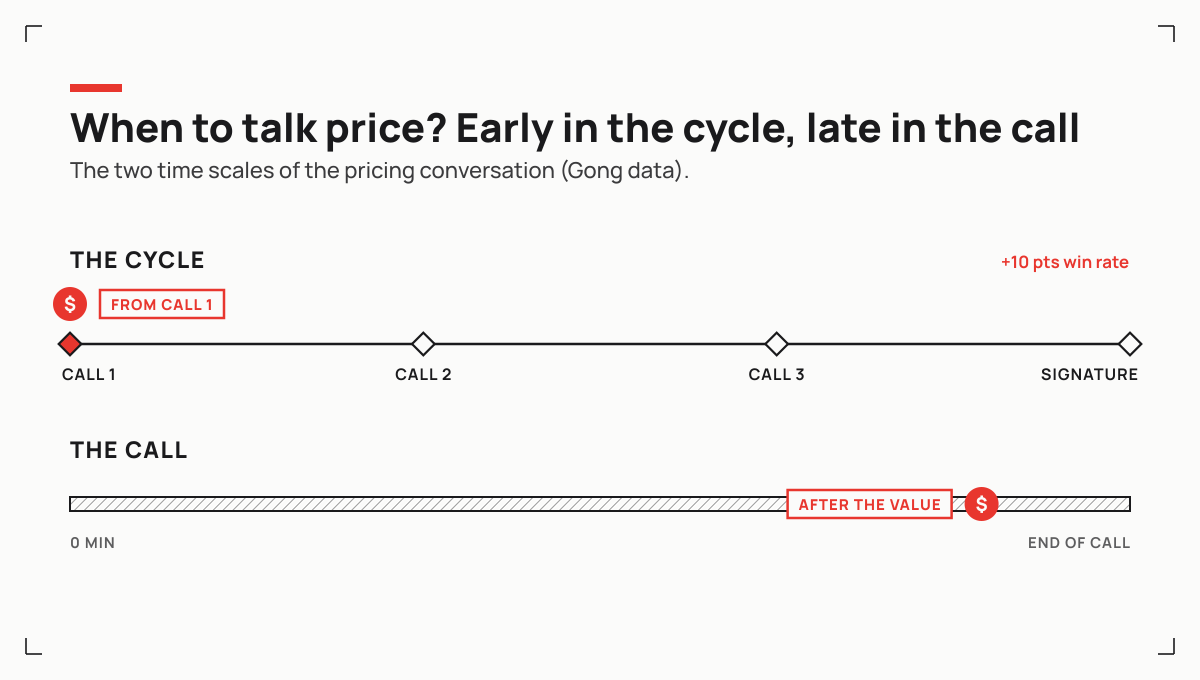
The data reconciles two pieces of advice that look contradictory. At the level of the sales cycle, win rates are 10 points higher when price is discussed on the very first call, based on Gong's analysis of 11,331 opportunities: the longer a rep waits to bring up price, the lower the odds of winning. But at the level of the call, top reps only bring up pricing at the end of the conversation, after value has been established, where average reps let it surface anywhere. The rule fits in one sentence: talk price early in the cycle, late in the call.
The simplest way to get there: the agenda announced at the top of the call, "we'll look at your situation, I'll show you how it applies to you, and we'll finish with pricing." Price has its slot, the prospect knows it, and the objection loses its element of surprise.
One last data point: three to four price mentions by the buyer in a call correlate with the highest win rates. A prospect who keeps coming back to price is not running away: they are picturing themselves as a customer. Treat those mentions as a buying signal, not a threat.
What do you do when the price objection arrives by email?
Bring it back to a conversation before you answer it. An objection written in an email has already been rationalised, often reworded for an internal audience, and answering in writing locks you into a version of the debate you did not choose.
The reply that works stays short and does three things. It acknowledges the point without conceding it. It asks the diagnostic question in writing, because even in an email it changes the answer you get. And it proposes a slot, so the conversation moves back to a channel where you can actually listen.
Something like this, adapted to your deal. "Thanks for coming back to me on this. So I bring you the right answer rather than a generic one, what are you comparing the figure to, your budget for this year or another offer? I have fifteen minutes Thursday morning if that is easier to sort out live."
Two traps to avoid. Do not attach a revised proposal to that message, because a price that moves on its own after a single email teaches the buyer that writing to you is profitable. And do not answer in the thread with a wall of value arguments, which almost always gets forwarded internally stripped of its context.
Why is the price objection won or lost during the call?
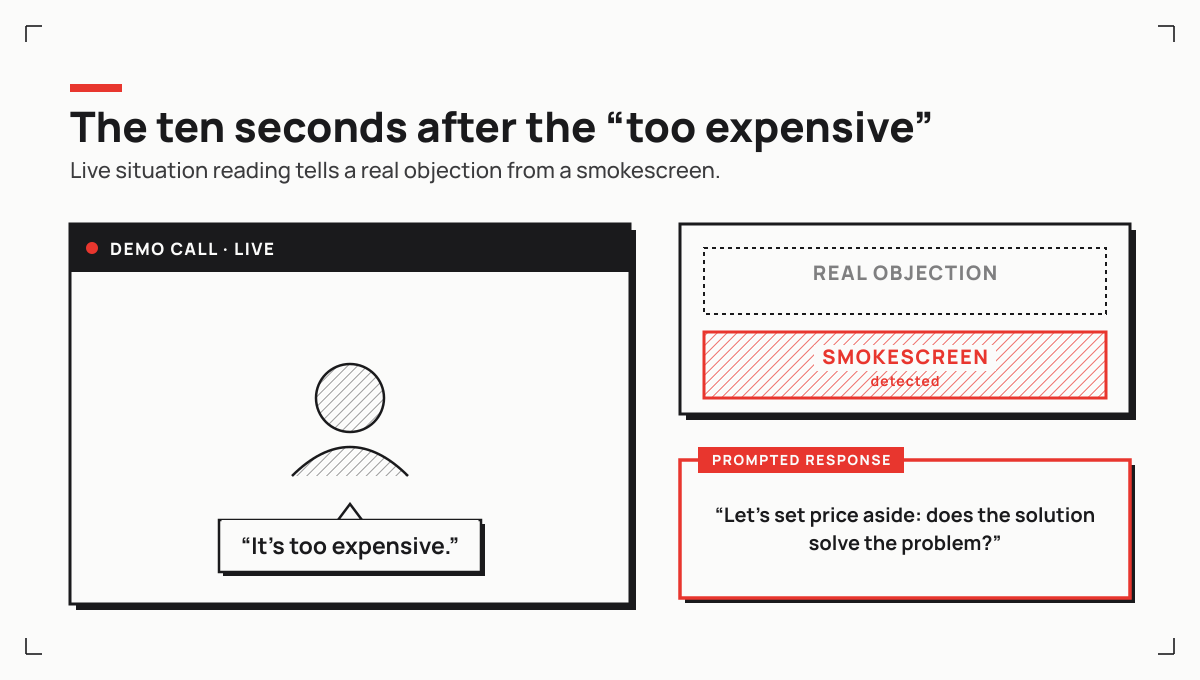
Because everything above, the diagnosis, the right question, the adapted script, has to come out in the ten seconds after the "too expensive", at the exact moment your rep is most rattled. Easy on a Tuesday morning in training. Much harder at the end of a demo, facing a prospect who is waiting, when the temptation to drop a discount to save the mood is at its peak.
That moment is exactly what Midcall is built for. During your discovery and demo calls, Midcall reads the sales situation live and tells a real objection from a smokescreen. When the "too expensive" lands, your rep has the response for that specific case in front of them, one line at a time, only when the confidence threshold is met. The help is personalized: a rep who struggles with objections gets more support than one who has them handled. On the manager side, each call's summary and the per-rep dashboard show you who faces which objections most often: your 1:1s run on facts, not on recollections. Midcall is a young product and I will not promise you a percentage of objections turned around. What changes for certain: at the most destabilizing moment of the call, your rep is no longer alone.
Prevention, meanwhile, happens one call earlier. A prospect who priced their own problem during the discovery call compares your price to that number, not to zero: that is the whole logic of the impact block, and the reason a serious MEDDIC qualification makes the price objection rare.
What should a rep have in front of them before the call?
One table, six cases, the first move and the trap for each. This is the version to put in front of a rep before a call.
| The case | Your first move | The trap |
|---|---|---|
| Value not perceived | Bring back their own number for the problem | Listing features again |
| Cheaper competitor | Own the gap, move to criteria | Matching the price |
| Real budget cap | Shrink the scope, not the price | Discounting to fit the envelope |
| Status quo | Price the cost of doing nothing | Selling the improvement rather than the risk |
| Negotiation tactic | Ask what comes out if the price moves | Conceding to keep the mood pleasant |
| Smokescreen | Set price aside and ask what really blocks | Defending a price nobody is contesting |
The six cases above are exactly the kind of battlecard an AI sales enablement program is meant to surface live, at the moment the objection lands, rather than in a library nobody opens mid-call.
Price usually surfaces in the demo itself, and our guide covers when to bring up price in a sales demo and how to move on to the terms.
Price is one objection among many, and the method for reading any of them is the same. Our guide on how to handle objections in sales covers the full CIRC method and the twelve that come up most.
Edward, co-founder of Midcall. Former AE, co-founder of Meteor, a B2B prospecting agency. I write about what actually happens on sales calls, and what the best teams do with it.
Frequently asked questions
How do you overcome a price objection in sales?
You do not overcome it, you identify it then treat it. Let the prospect finish, acknowledge without conceding, ask what the price is being compared to, respond to that specific case, then confirm the point is closed. Skipping the diagnosis is what makes objection handling feel like arm wrestling, because you end up defending a price against a reference you never identified.
What is the best response to "your price is too high"?
The best response is a question, not an argument. "Too high compared to what, exactly?" reveals the reference behind the objection, and the reference decides everything that follows. A pre-written response applied before that question is answering a case you have not identified yet.
What do you say when a prospect compares you to a cheaper competitor?
Own the gap instead of denying it, then move the conversation to criteria. "That's true, we are not the cheapest. Beyond price, what does the comparison come down to for you?" A rep who argues the price difference is negotiating on the competitor's ground, while a rep who asks about criteria brings the debate back to what the buyer actually needs.
What do you say when a customer says it's too expensive?
Diagnose before you argue, with one calm question: "too expensive compared to what?". Their answer reveals the real case, a budget cap, a competitor, the status quo, unperceived value, a negotiation or a smokescreen, and each one calls for a different response. Justifying the price before identifying the case is answering at random.
Why do prospects say it's too expensive?
Because they compare your price to a reference that looks more favorable: another offer, their budget, or most often the apparent cost of changing nothing, which they perceive as zero. When the pain has never been priced, any price looks high. That is why the price objection is mostly prevented during discovery, by getting the prospect to price the impact of their problem themselves.
Should you lower your price when a prospect objects?
Not as a first response, and never without a counterpart. An immediate discount signals the initial price was inflated and moves the relationship onto discount ground. Real budget cap: shrink the scope rather than the price. End-of-cycle negotiation: trade every concession for a counterpart, a longer commitment, a faster signature or a customer reference.
When should you bring up pricing in a sales call?
Early in the cycle, late in the call. Gong's analyses show that discussing price on the first call correlates with win rates 10 points higher, but that within a call, top reps only bring up pricing after value has been established. Announce it in the call agenda, then handle price at the end of the conversation.
What do you say when a prospect says they need to think about it after seeing the price?
First check whether the thinking is really about the amount. One question does it, "is it the price that gives you pause, or something else in the project". If the answer points at price, you are back in one of the six cases and you treat it. If it points elsewhere, the price was a polite exit, and pushing on it would make you miss the real issue.
How do you tell a real price objection from a smokescreen?
By timing and by engagement. A real price objection comes after the prospect has genuinely engaged in the conversation, often late in the cycle, and survives the test "if budget were not an issue, would we be moving forward?". A smokescreen comes early, without substantive discussion, and collapses as soon as you set price aside and ask what is actually holding them back.
See the live AI coach on one of your calls.
15 minutes. We plug Midcall into a real scenario from your team, you decide.