How do you close more deals without being pushy?
You have lived through this call. The prospect seemed interested, you rolled out your best arguments, pushed a little at the end, and they asked for time to think that they never came back from. The more you push, the less it signs, and every call gets a bit more tense than the last.
Closing more deals does not come from more pressure but from more control, and that control is built throughout the call, not in the last five minutes. Three levers make the difference: a posture that drives the exchange instead of enduring it, a frame set in the first minutes, and questions that guide the prospect toward their own decision instead of arguments that push them away from it.
To write this guide, I leaned on the work of Shannen Boutaleb, founder of the SforSales Academy, a former top performer at HubSpot and Skello with €11M closed. I watch a lot of her content on Instagram and YouTube, it is in French, and it is excellent. Her thesis fits in one sentence. You do not need to learn how to convince, you need to learn how your prospect decides.
Why aren't you closing more deals?
Because you argue at the moment you should be understanding. The natural reflex in front of a hesitant prospect is to add an argument, a feature, a discount. Every addition confirms to the prospect that they are being sold to, and a brain that feels pushed digs in. The data backs the intuition, research published by SBI and relayed by Forbes found that high-pressure tactics tend to stretch the sales cycle and shrink deal sizes, the exact opposite of what the pressure was for.
Forced closing also produces a symptom you know well, the yes of convenience. The prospect agrees to get out of the conversation, then goes dark. An agreement obtained under pressure is not a decision, it is a polite escape. The way out of that loop is not a better closing line, it is a different posture across the whole call.
What is posture in sales, and why does it decide the close?
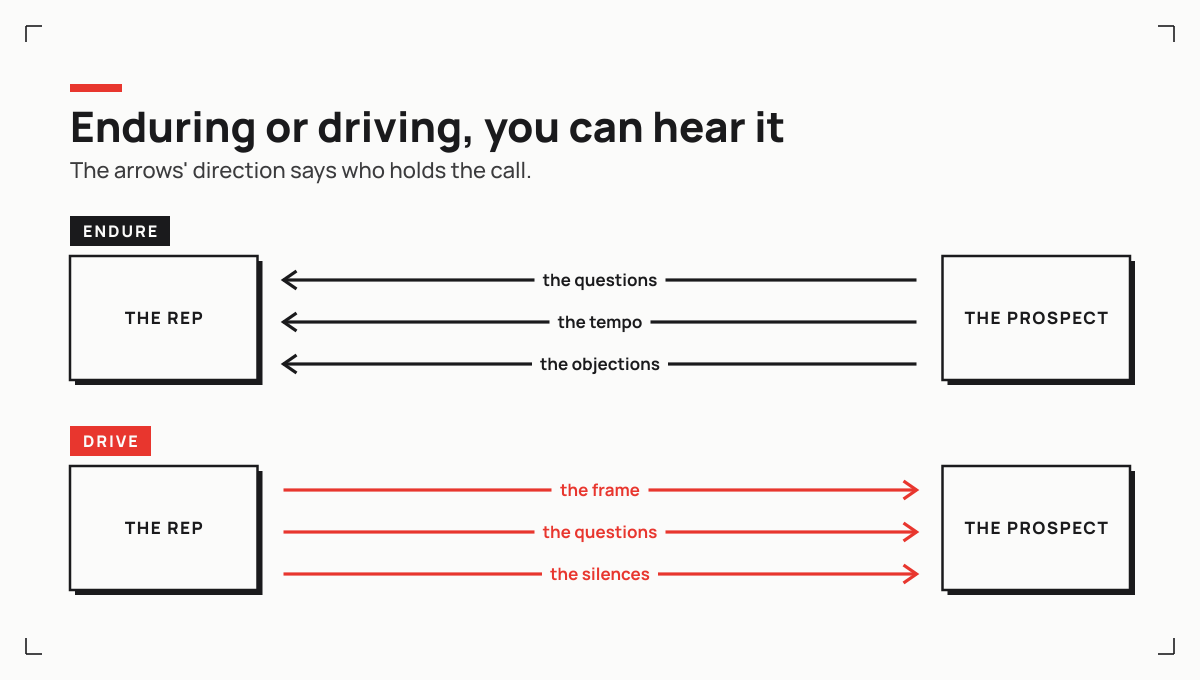
Posture is what your prospect perceives of you before your arguments, who holds the frame, who is calm, who needs this sale. Shannen Boutaleb puts it bluntly, selling always reveals your posture. A rep who endures reacts to questions, lets the discussion drift without direction and feels the tension rise as soon as the exchange gets complicated. A rep who drives knows where the call is going, asks the questions, and can afford silences.
The difference is literally audible. Tonality is one of the twelve blocks of her training program, because a calm, settled voice installs an authority that no argument can recover. And posture shows in a counterintuitive detail, the rep in control talks less. They have nothing to prove, they are trying to understand. Your prospect can perfectly feel the difference between someone who needs to sign and someone who is evaluating whether the collaboration makes sense.
How do you frame a sales call in the first minutes?
By stating the frame before you start, the goal of the call, its agenda, and the fact that a decision will be made at the end. Something like this. You suggest spending twenty minutes understanding the prospect's situation, then showing only what answers what they described, and finishing by deciding together whether a next step makes sense, whatever that decision is. Thirty seconds that change the nature of the exchange, the prospect knows where this is going, and you are the one holding the map.
Framing prevents the two slow deaths of a sales call. The meeting that drifts everywhere first, where each side reacts to the other's questions without direction. Then the free-consultant trap that Shannen Boutaleb regularly points out, the prospect who leaves with an hour of advice, a free audit and no reason to call you back. A frame set upfront also allows you to reset the call midway, you simply recall what was agreed together.
Framing includes one prohibition, do not jump to the demo. Showing the product before the problem has been verbalized turns your call into a guided tour, and a guided tour does not close, it gets thanked. That is what a discovery framework is for.
How do you guide the decision instead of convincing?
By asking the questions that make the prospect walk the path, rather than rolling out the arguments that walk it for them. This is the heart of Shannen Boutaleb's FRAME method, the art of questioning, surfacing the real stakes and letting the prospect phrase their own problem, its cost and its urgency. A prospect who says "this costs us two hires a year" is already selling themselves the solution. The same number asserted by you would have produced a polite nod.
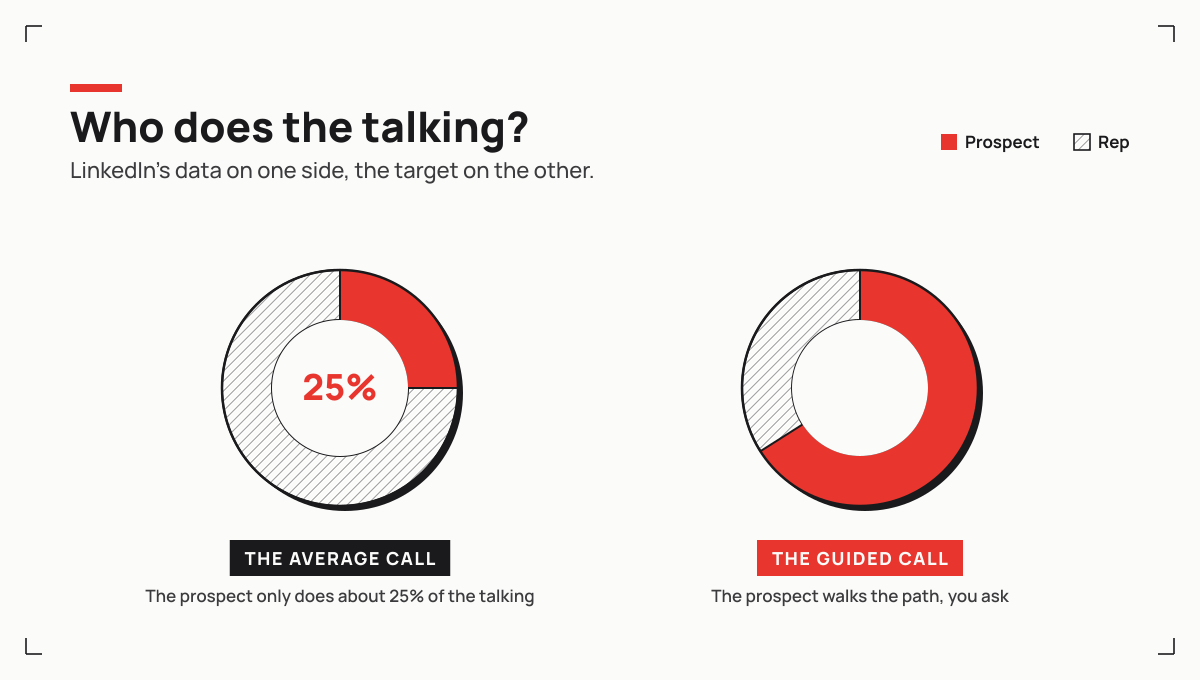
Buyers themselves are asking for it. In LinkedIn's State of Sales research, active listening ranks as the top trait buyers want from a rep, cited by 42% of them, and LinkedIn also measures the scale of the illusion, 65% of sellers believe they always put the buyer first while only 23% of buyers agree. LinkedIn also notes that on an average sales call, the prospect only does about 25% of the talking. Talking less is not shyness, it is strategy. Every minute the prospect talks is a minute they spend explaining to themselves why they need to change.
The pitch does not disappear, it changes shape. Short, late, and built as an answer to what was said rather than as a general presentation. You take their words, their numbers, their situation, and you show only what answers them.
What do you do with objections when you refuse to push?
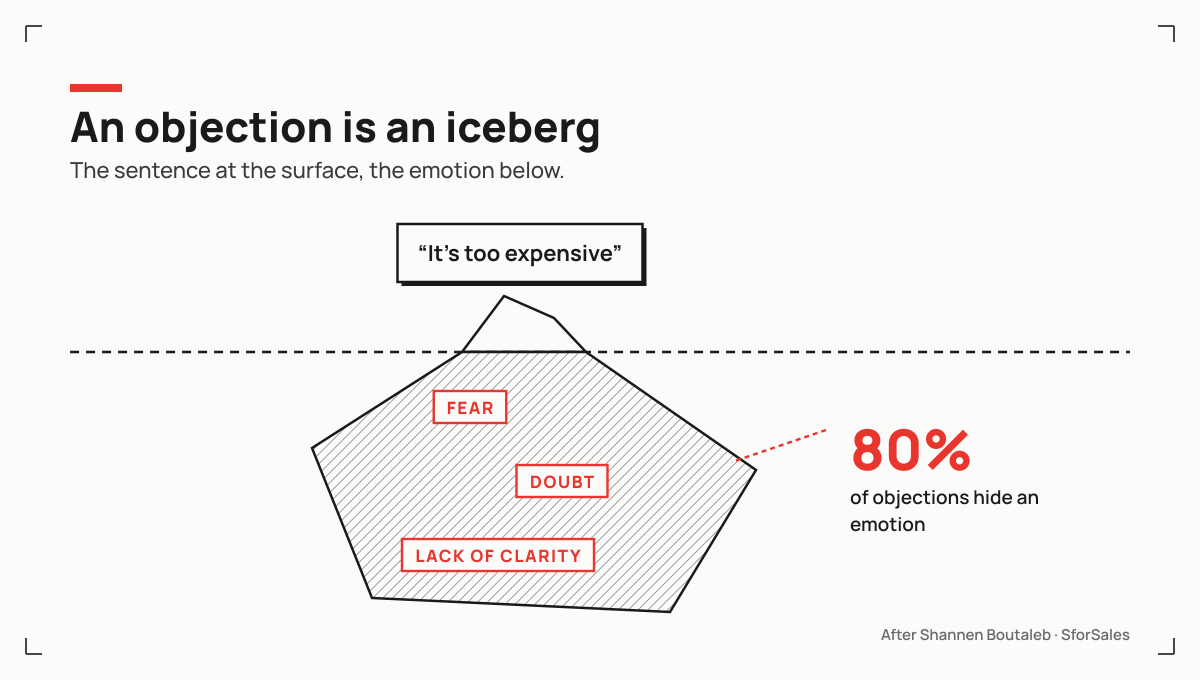
You treat them as emotions before treating them as arguments. According to Shannen Boutaleb, 80% of objections hide an emotion, the fear of making the wrong call, doubt about oneself or the solution, or a lack of clarity that pushes toward caution. Answering the sentence as spoken is therefore answering the wrong thing, and it is the mistake she puts at the top of her list, responding too fast.
Her CIRC method, documented in her newsletter (in French), chains four moves. Dig first, to understand what hides behind the words. Isolate next, to check it is the only thing blocking. Only then respond, with a proof point, a reframe or a number. Check last, to confirm the objection is actually cleared before moving on. The order is the whole method, most reps start at step three.
For the word-for-word playbook on the most frequent case, "it's too expensive" and its six faces, we wrote a full diagnostic on the price objection. The logic there is the same, understand before you answer.
Why does posture collapse mid-call, and what can you do?
Because stress brings the old reflexes back. You can know everything above and watch it evaporate at minute nine of a call that matters, the prospect pushes, you interrupt, you argue, you talk too much, you drop a concession nothing required. Posture is a muscle built over time, in training, in coaching, in call reviews. The problem is that a real call does not wait for you.
That is exactly the gap Midcall fills, during the call itself. Midcall reads the sales situation live and tells a smokescreen from a real objection, precisely the diagnosis stress makes you skip. At the moment you would launch into an argument, it prompts the question that digs, one line at a time, only when its confidence threshold is met. The help adjusts to your weak spots, a rep who folds on price is not helped in the same place as a rep who misses buying signals. And the scored summary of every call shows you where your posture held and where it gave, which is exactly the raw material of a good call review. Training builds the muscle, the copilot holds it on the days it shakes. The two complement each other, and I would be lying if I claimed a tool replaces the deep work.
Where do you start on your next call?
With three moves that require no prior training. State the frame in the first thirty seconds, goal, agenda, decision at the end. Force yourself to ask one more question before every answer to an objection, a simple "what makes you say that?" is often enough to change what follows. And after each call, write down the objections you received with the emotion you sense behind them, fear, doubt or fog, your handling will sharpen week after week.
Closing itself then becomes a formality more than a feat, a next step set at the right moment, with a prospect who has walked the path. That is the whole difference between concluding a sale and extracting a signature.
Edward, co-founder of Midcall. Former AE, co-founder of Meteor, a B2B prospecting agency. I write about what actually happens on sales calls, and what the best teams do with it.
Frequently asked questions
What does it mean to close a sale without being pushy?
It means earning the signature by guiding the prospect toward their own decision rather than pushing them toward yours. Concretely, a posture that drives the exchange, a frame stated at the start of the call, questions that get the prospect to verbalize their problem and its cost themselves, and objections treated as emotions to understand before being arguments to counter.
How do you take back control of a call when the prospect is driving?
By returning to the frame rather than raising your voice. If no frame was set, set it right then, suggest an agenda for the remaining time and a decision at the end. If it was stated upfront, simply recall what was agreed together. Control of a call is not taken by talking louder, it is taken by becoming the one asking the questions again.
Why does a prospect say yes and then disappear?
Because that yes was an exit, not a decision. A prospect pushed to conclude sometimes agrees to end the pressure, then lets the deal die in silence. It is the classic symptom of a forced close. A solid agreement is recognizable by the fact that the prospect phrased their problem, its cost and their reason to move during the call itself.
Does closing really happen at the end of the call?
No, the end of the call only reveals what happened before it. A prospect guided for forty minutes closes on one question asked at the right moment. A prospect drowned in arguments does not close, whatever technique gets used at the end. The signals that indicate the right moment to conclude are detailed in our article on closing techniques.
What is the CIRC method?
It is the objection-handling method developed by Shannen Boutaleb, founder of the SforSales Academy, in four steps. Dig into what hides behind the objection, isolate it to check it is the only one, respond with a proof point or a reframe, then check the objection is cleared before moving on. Its strength is its order, it forbids answering before understanding.
See the live AI coach on one of your calls.
15 minutes. We plug Midcall into a real scenario from your team, you decide.