How do you build an effective sales pitch?
An effective sales pitch isn't a script you recite, it's a set of arguments you deploy at the right moment. You build it ahead of time with a simple method, FAB, which turns each feature of your offer into a concrete benefit for the customer. You then tailor it to what your buyer actually cares about, whether that's cost, risk, or simplicity. But the hard part isn't the preparation, it's pulling out the right argument at the right moment on the call, the one that answers what the prospect just said. A prepared pitch recited word for word convinces less than a handful of sharp arguments placed where they count. This article gives you the method to build it, and above all to deploy it live.
What is a sales pitch?
A sales pitch is a short, focused presentation of your offer's value, usually delivered in a couple of minutes. It isn't a feature list, it's a case that your solution solves a problem the prospect has recognized. A good pitch opens a conversation rather than running a monologue. It starts from what the customer is looking for, not from what you want to say.
The most common confusion treats the pitch as a product rundown. A rundown describes what your solution does. A pitch shows why it matters to this specific person. That difference isn't cosmetic. It separates the rep who presents from the rep who convinces.
What's the difference between reciting features and selling value?
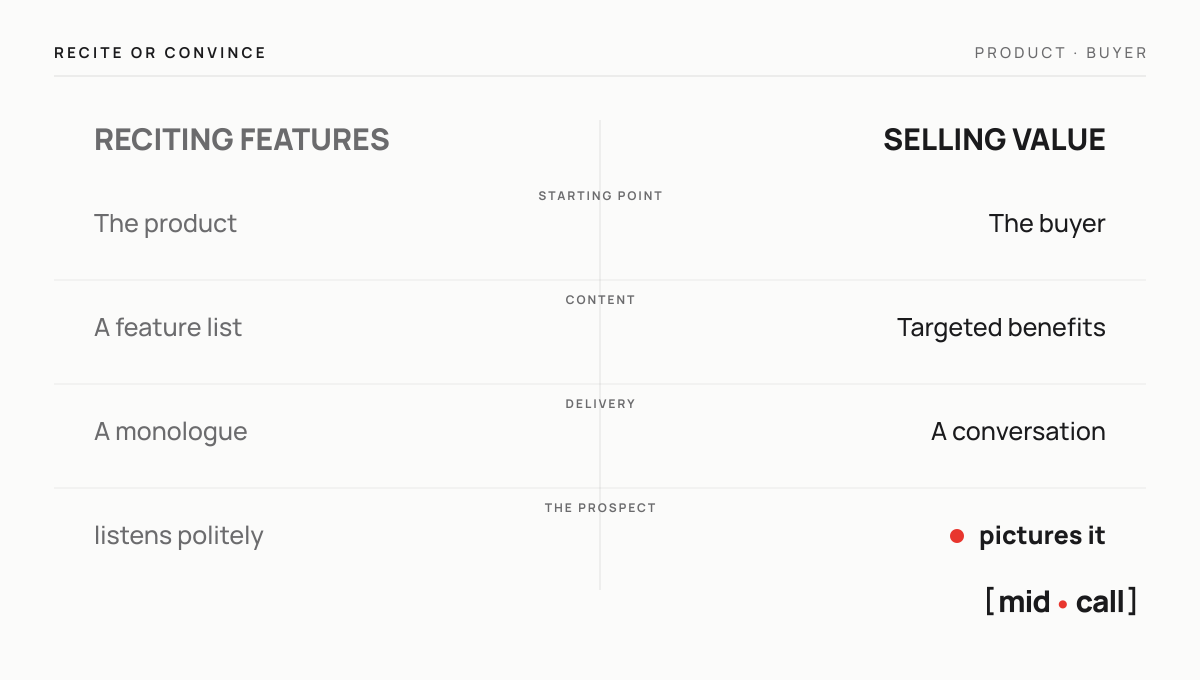
Reciting features means running through what your product does and hoping something sticks. Selling value means starting from what your buyer cares about and showing that your solution answers it. The first approach puts the product at the center, the second puts the customer at the center. A prospect doesn't buy a feature, they buy what that feature changes for them.
That shift is prepared but plays out live. You only know what truly drives your buyer once you've listened to them. That's why a good pitch always starts with discovery, not presentation. We covered that stage in our article on the discovery call framework.
| Reciting features | Selling value | |
|---|---|---|
| Starting point | Your product | The buyer's priority |
| Content | A feature list | A few targeted benefits |
| Delivery | A monologue | A conversation |
| Effect on the prospect | They listen politely | They picture it |
| What they think | "Interesting" | "How do we move forward?" |
How do you structure a sales pitch with the FAB method?
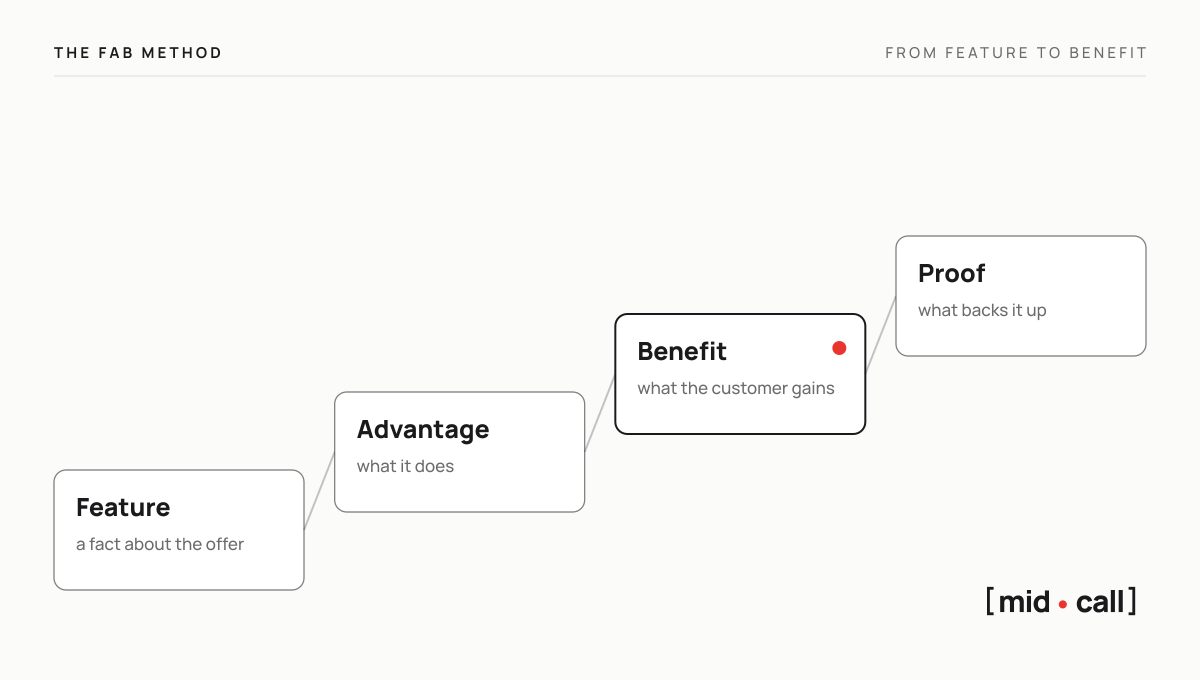
The FAB method turns each feature of your offer into an argument. It runs in three beats. The feature is a fact about your product. The advantage is what that fact does. The benefit is what the customer gains from it, in their own terms. A feature on its own has never convinced anyone. The benefit is what speaks, as long as it maps to a real need.
Many teams add proof at the end, a number, a case study or a testimonial, which gives the FABP variant. Proof locks the argument, because it turns a promise into a verifiable fact. Prepare proof for your two or three strongest arguments, not for every one.
| Step | What it is | Example |
|---|---|---|
| Feature | A fact about the offer | The tool syncs with your CRM |
| Advantage | What the feature does | Your data flows in without double entry |
| Benefit | What the customer gains | Your reps spend less time on reporting |
| Proof | What backs it up | A case study, a number, a live demo |
Take a full example. Your tool syncs the CRM automatically, that's the feature. It kills double entry, that's the advantage. Your reps get time back each day to sell instead of report, that's the benefit. And a comparable team halved its admin time in a month, that's the proof. For a buyer who cares about money, you stress the time saved per rep and its cost. For a buyer who cares about simplicity, you stress the end of the reporting chore. Same argument, two angles, depending on what they value.
How do you tailor your pitch to the buyer?
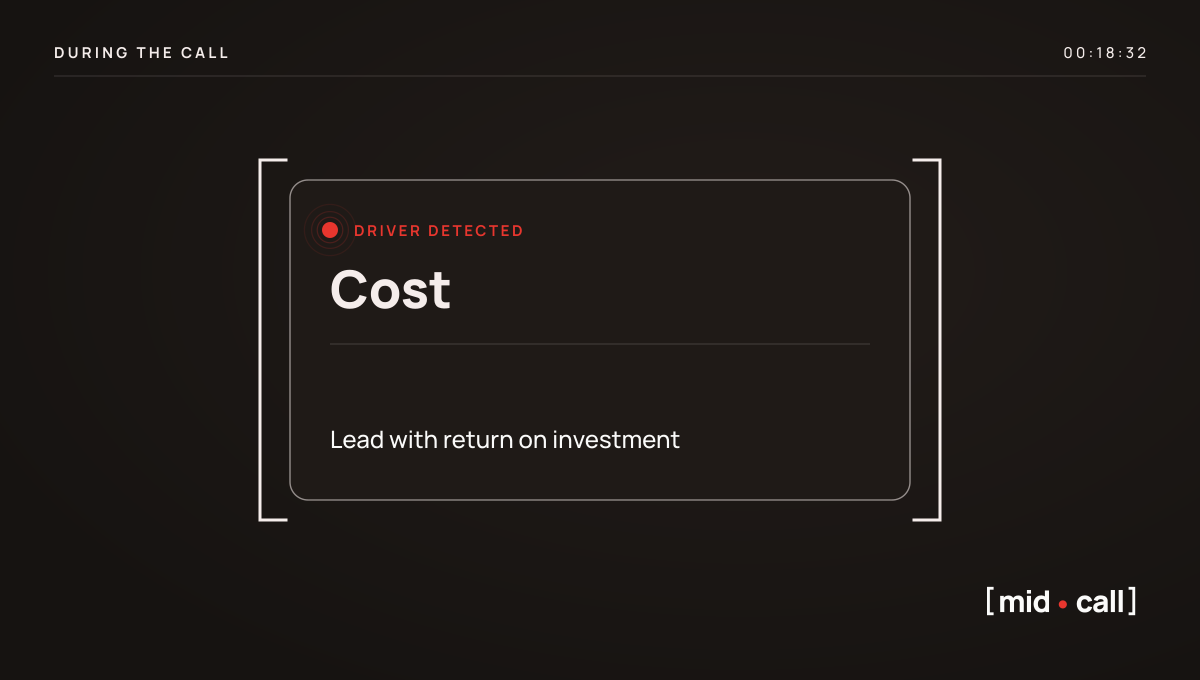
The same argument lands differently depending on what your buyer values most. Some buyers are driven by risk, others by cost, status, simplicity, or the relationship. Your job is to read the dominant driver and lead with the benefit that speaks to it. To a buyer focused on risk, you talk reliability and fewer mistakes. To a buyer focused on cost, you talk return on investment.
You only spot the right driver by listening. The words the prospect uses give it away. When they keep saying they can't afford a mistake, they're telling you it's about risk. When they ask the price three times, they're telling you it's about money. The driver isn't something to guess up front, it's something to read during the conversation.
| The buyer cares about | What drives them | The benefit that lands |
|---|---|---|
| Risk | Not making a mistake | Reliability, guarantees, lower risk |
| Cost | Protecting the budget | Return on investment, savings |
| Status | Being recognized | Exclusivity, prestige, image |
| Simplicity | Less hassle | Ease, time saved, support |
| Innovation | Staying ahead | Differentiation, cutting edge |
| Relationship | Trust | Closeness, support, being heard |
Why does a great pitch happen live, not on paper?
Because preparation isn't enough. You can have the best FAB and a perfect read on what the buyer values on paper, and it still comes down to pulling out the right argument at the right moment. On the call, the prospect hands you signals, an objection, a question, a word that reveals what they care about, and you have a handful of seconds to answer with the argument that fits. Most reps fail there, not for lack of preparation, but because they recite the planned pitch instead of picking the one that answers the moment.
A pitch recited word for word sounds false and misses. A pitch deployed, where you choose the argument that matches what the buyer just said, convinces. That difference isn't prepared, it plays out live, under pressure, while you listen and talk at once. Handled well, the exchange then slides naturally toward the decision, which we cover in our article on how to increase your close rate.
How does Midcall help you pitch at the right moment?
Midcall is a browser extension that coaches your reps during their calls, on Google Meet, Microsoft Teams and Zoom. It knows your offer, your features, your competitors and the answers to technical questions, and it surfaces the right argument the moment it counts. When the prospect raises an objection or reveals what they value, a live advice card appears with the argument or proof to use, so your rep doesn't have to dig through memory mid-conversation. The objection button hands them a framed response right when they need it.
The help is personalized per rep. A rep who's strong in discovery but fumbles the value pitch gets more support exactly there, while another is backed up elsewhere. Midcall doesn't recite one script to the whole team, it reinforces each rep on what they're missing. After the call, the summary scores value selling with the exact verbatim, so you can see which arguments landed and which fell flat.
Here's the honest version. Midcall is a young product, and I'm not going to hand you a number of extra deals we don't track yet. What holds up is that the right argument no longer comes to you ten minutes after the call ends, when it's useless. It surfaces while the window is still open.
What mistakes should you avoid in a sales pitch?
The first mistake is pitching too early. An argument thrown out before you understand the need almost always misses. Listen first, pitch second. The second mistake is piling on arguments. Three sharp ones beat ten generic ones, because each dilutes the others. Pick the two or three that hit what the buyer values and stop there.
The third mistake is selling features instead of benefits. Saying your tool does X doesn't convince, showing what the customer gains does. Reframe every feature into what it changes for them. The last mistake is reciting. A memorized pitch delivered without listening sounds false. Prepare it so you don't have to think about it, then forget it and focus on the person in front of you. And when the pitch has to land in thirty seconds on a cold call, our guide to the cold call script shows how to compress it to three sentences.
And when the pitch runs inside a live sales demo, it works best woven through tell, show, tell rather than delivered in one block.
Edward, co-founder of Midcall. Former AE, co-founder of Meteor, a B2B prospecting agency. I write about what actually happens on sales calls, and what the best teams do with it.
Frequently asked questions
What is a sales pitch?
A sales pitch is a short, focused presentation of your offer's value, usually delivered in a couple of minutes. It isn't a feature list, it's a case that your solution solves a problem the prospect has recognized. A good pitch opens a conversation instead of running a monologue.
How do you structure a sales pitch?
The most used structure is the FAB method. You start from a feature of your offer, a fact, draw out the advantage, what it does, then the benefit, what the customer gains. Many add proof, a number or a case study, to lock the argument. Prepare proof for your two or three strongest points.
What is the FAB method?
FAB stands for Features, Advantages, Benefits. A feature is a fact about your product, an advantage is what that feature does, and a benefit is what the customer personally gains from it. The benefit is what drives the decision, as long as it maps to a real need.
What's the difference between features and benefits?
A feature is a fact about your product. A benefit is what that fact changes for the customer. Reps who recite features leave the buyer to work out the value on their own, which rarely happens. Translating each feature into a concrete benefit is what makes a pitch land.
How do you improve your sales pitch?
Listen before you pitch, pick two or three sharp arguments instead of ten generic ones, and turn each feature into a concrete benefit. Re-listen to your lost calls to spot the arguments that fell flat. A live coaching tool like Midcall helps you pull the right argument at the moment it counts, during the call.
Should you memorize your sales pitch?
No. A pitch recited word for word sounds off and misses, because it doesn't adapt to what the prospect says. Prepare it so you don't have to think about it, then deploy the arguments one by one as the conversation goes. Preparation frees your attention to listen, it isn't there to be recited.
See the live AI coach on one of your calls.
15 minutes. We plug Midcall into a real scenario from your team, you decide.