How do you run a great discovery call? Framework, questions and mistakes to avoid
Most deals are not lost in negotiation. They are lost three weeks earlier, on a discovery call that felt like an interrogation or a demo in disguise.
A great discovery follows a six-block framework: framing, situation, problems and quantified impact, decision path, dated next step, recap. Plan for 20 to 30 minutes, as a dedicated call or as the first part of a demo call. The discovery call framework is that structure: a set of questions that guarantees nothing essential gets forgotten, whichever rep is running the call. Done well, discovery turns a lead into a qualified deal; botched, it produces ghost opportunities that clog the pipeline for months.
Here is the minute-by-minute structure, the questions with their follow-ups, and the rookie mistakes that cost the most deals.
What is a discovery call?
A discovery call is the early sales conversation where a rep gets a prospect talking about their situation, their problems and how they decide, before proposing anything. It happens once the prospect has shown some interest, and it runs either as a dedicated call of about thirty minutes or as the first part of a demo call. The goal is narrow and specific, to establish the facts rather than pitch the product. Everything you do later, the demo, the proposal, the negotiation, is built on what you learn here, which is why a discovery call is only as good as the framework behind it.
What is a discovery call framework?
A discovery call framework is the set of questions a rep prepares before a sales meeting to turn it into a structured conversation rather than an improvisation. Its first job: making sure the essentials, the cost of the problem, the decision path, the next step, never depend on the rep's memory in the middle of a conversation. That is the value of any sales framework, MEDDIC and SPIN included: nobody forgets the essentials on a Tuesday at 5pm, because the structure carries them instead.
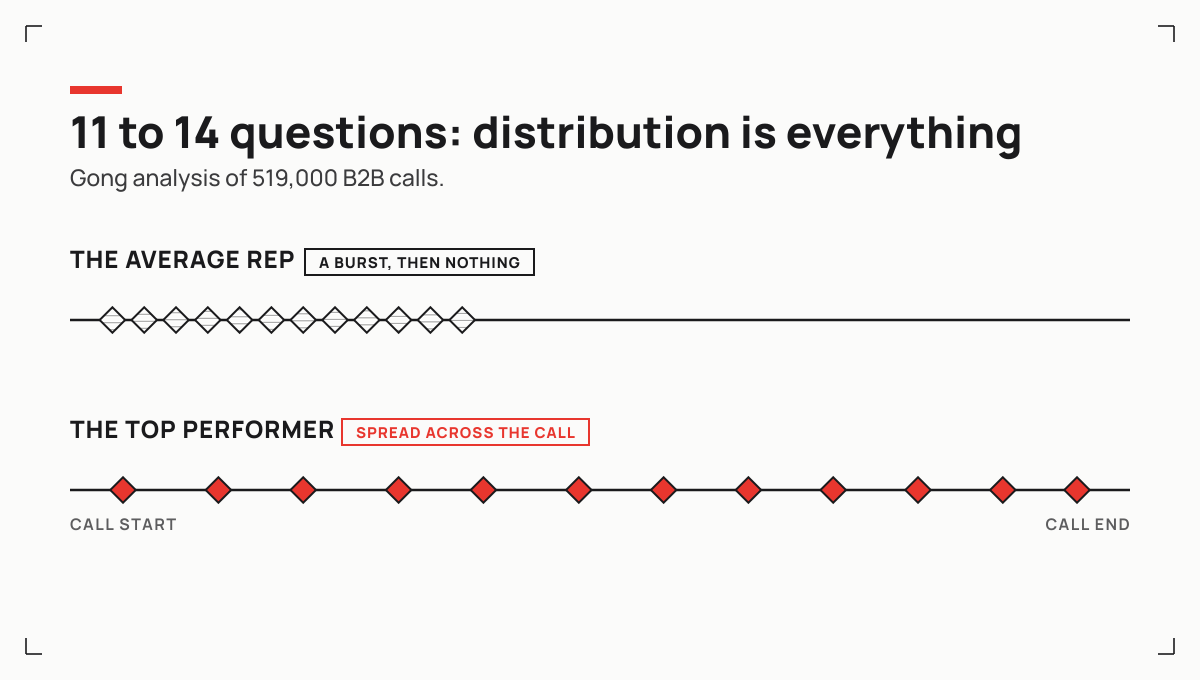
One point the data settles clearly: discovery is a conversation, not a questionnaire. Gong's analysis of more than 519,000 B2B sales calls shows that the best discovery calls ask between 11 and 14 targeted questions, and that beyond that the success rate drops back. Same study, second lesson: average reps fire their questions off in the first ten minutes, like a checklist; top reps spread them across the whole conversation.
What does the discovery call structure look like, minute by minute?
The structure below is calibrated for 30 minutes, the format of a dedicated discovery call. If your discovery opens a one-hour demo call, keep the six blocks and compress the timings: the sequence is what matters, not the stopwatch.
| Minutes | Block | What needs to happen |
|---|---|---|
| 0 to 3 | Framing | You set the agenda, the prospect validates it, everyone knows how the call ends |
| 3 to 8 | Situation | How they do it today, with which tools, which team, which volumes |
| 8 to 18 | Problems and impact | The heart of the call: the problems, their cost in dollars or hours, their deadline |
| 18 to 24 | Decision | Who decides, on what criteria, through which path: your MEDDIC grid fills in here |
| 24 to 28 | Next step | One precise step, dated, with the right people in the room |
| 28 to 30 | Recap | You restate what you heard, the prospect corrects or confirms |
Two rules cut across all six blocks. First, the best discovery calls uncover 3 to 4 business problems, not one: the first problem mentioned is rarely the one that triggers the signature. Second, the decision block is not optional: a discovery call that ends without knowing who decides, or how, has discovered nothing at all.
What questions should you ask on a discovery call?
The best discovery call questions are open-ended, and above all they are followed by a probe: the follow-up is what turns a polite answer into usable information.
| Block | The opening question | The follow-up that digs |
|---|---|---|
| Situation | "How do you handle this today?" | "What made you keep that setup until now?" |
| Problem | "What stopped working in that process?" | "Walk me through the last time it happened." |
| Impact | "What happens if nothing changes this year?" | "What does that add up to, in dollars or hours per month?" |
| Decision | "Once you've made your choice, what steps remain before signature?" | "Who else needs convincing, and what matters to them?" |
| Next step | "What would the right next step look like on your side?" | "What could stop that meeting from happening?" |
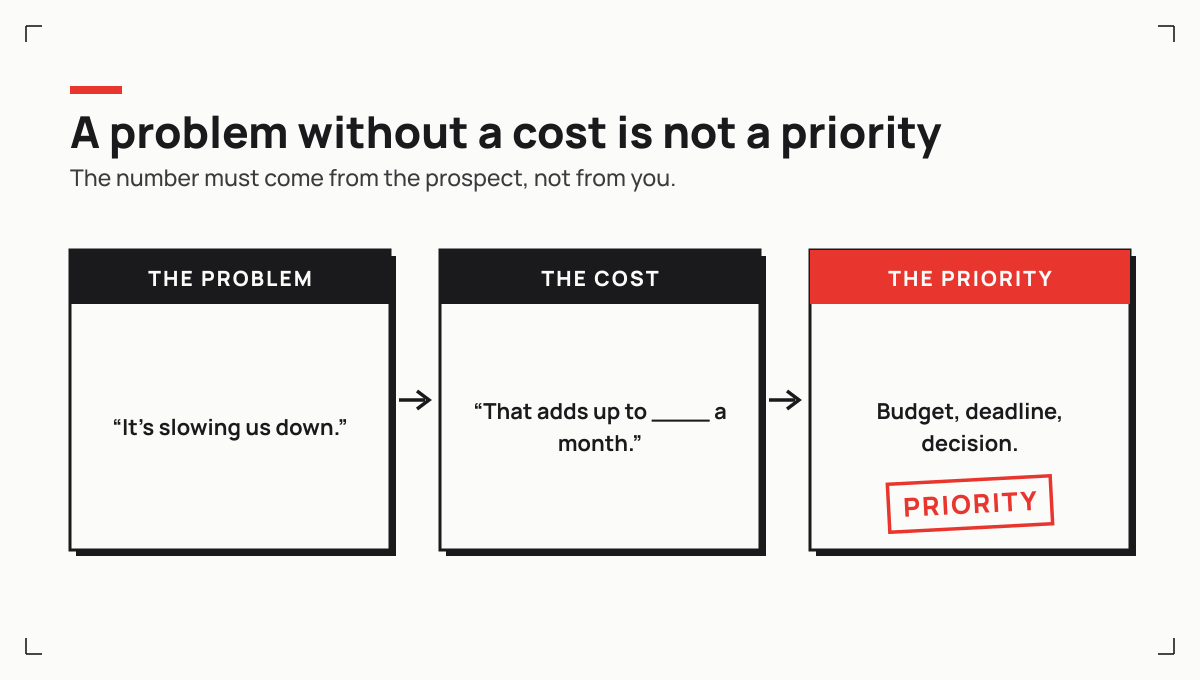
A problem without a cost is not a priority, it is a conversation topic. Until the pain has been priced by the prospect themselves, in dollars, hours or lost deals, the impact block is not finished.
What are the most common discovery call mistakes?
Discovery mistakes look the same from one team to the next, and most of them get fixed the moment they are named.
| The mistake | Why it costs the deal | What to do instead |
|---|---|---|
| The interrogation | Twenty questions in a burst: the prospect shuts down and answers get shorter | 11 to 14 questions spread out, each one building on the last answer |
| Pitching at minute five | You are proposing a solution to a problem you have not understood yet | No product talk before the pain is priced |
| Closed questions | "Do you have challenges with X?" invites a polite yes and a dead end | "Walk me through what happens when X fails" invites a story |
| Challenging from the start | Pushing back on a prospect whose stakes you do not know yet is arrogance, not challenge | You earn the right to challenge by first proving you understood |
| Never quantifying | A pain without a cost becomes bearable again the moment the call ends | Get the prospect to say the number, never say it for them |
| Running standard discovery on a C-level | An executive will not sit through a discovery questionnaire: they expect you to have done your homework | Run discovery with their teams first, show up prepared |
| Ending without a dated next step | "I'll follow up" is the sentence that buries the most deals | A date, a goal, the right people invited before you hang up |
Why does discovery happen during the call?
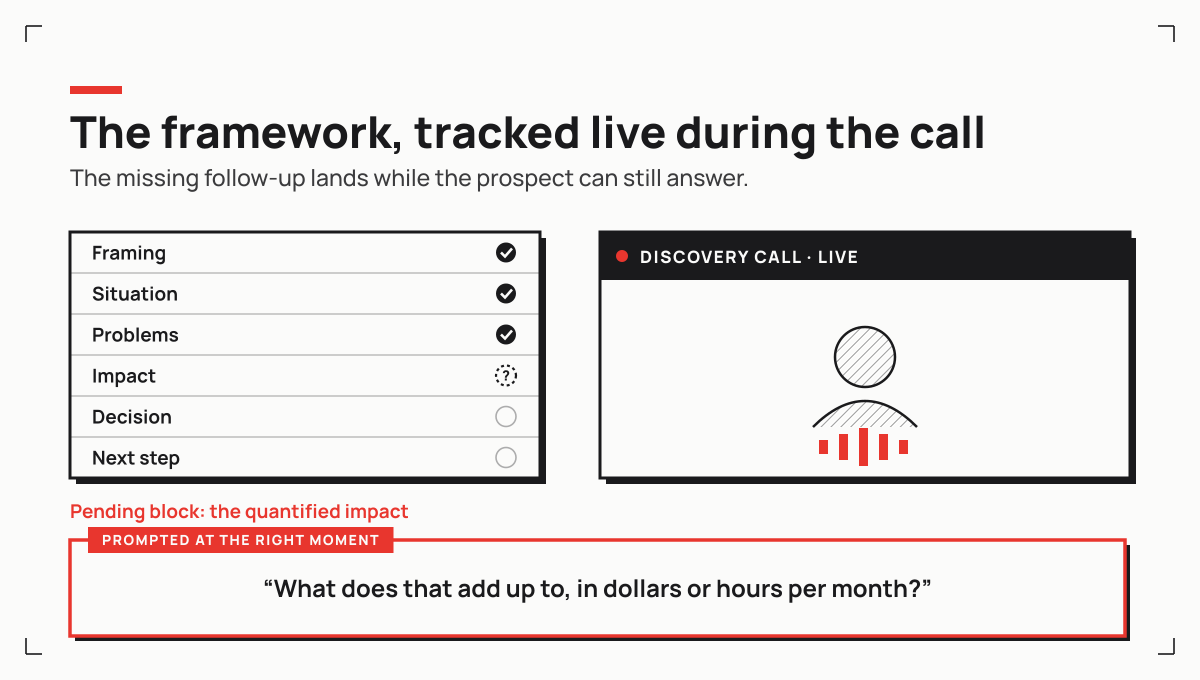
Because a discovery call asks your rep to do everything at once: truly listen, run the framework, take notes, spot what is missing and phrase the right follow-up. That load is exactly where blocks get dropped: the follow-up that prices the pain never gets asked, the decision path stays fuzzy, and nobody notices until the notes get reread, long after the prospect hung up.
That is the problem Midcall works on during your discovery and demo calls. Midcall reads the sales situation live, tracks qualification as the conversation unfolds and prompts the missing question at the moment it can still be asked, one line at a time, only when its confidence threshold is met. Your rep stays focused on listening: the framework holds itself. And the help is personalized per rep: a junior who systematically forgets to price the pain gets more support on that block than a senior who has it down. A dropped block becomes visible during the call, at the only moment it can still be fixed. And Midcall does not stop at the call. It scores each discovery afterwards, so you can see exactly which block a rep keeps dropping and coach it, rep by rep.
How do you roll out a discovery framework across your team?
Three decisions are enough. Write one shared framework, short, that each rep adapts to their conversation: the framework is a safety net, not a script. Make discovery the number one topic of your monthly call review: one discovery call replayed as a team is worth ten theories. And anchor the framework to your MEDDIC grid: discovery is the moment the grid fills in, the two are one system. That system, far more than individual talent, is what moves a team's close rate. And when the price objection still lands despite a good discovery, our guide to handling "too expensive" takes over.
Discovery is also the first competency an AI sales enablement program should score on real calls. And for the call that earns the meeting in the first place, our guide to writing a cold call script starts one step earlier.
When discovery flows straight into a demo in the same call, our guide on how to conduct a sales demo picks up where the discovery leaves off.
A good discovery also surfaces the common sales objections early, while they are still easy to address.
Edward, co-founder of Midcall. Former AE, co-founder of Meteor, a B2B prospecting agency. I write about what actually happens on sales calls, and what the best teams do with it.
Frequently asked questions
What is a discovery call?
A discovery call is the sales meeting where a rep asks structured questions to understand a prospect's situation, problems, quantified impact and decision path before proposing a solution. It can run as a dedicated 30-minute call or as the first 20 to 30 minutes of a demo call, and it serves one goal: establishing facts about the prospect.
How many questions should you ask on a discovery call?
The documented benchmark sits between 11 and 14 targeted questions, based on Gong's analysis of more than 519,000 B2B calls. It is a benchmark, not a rule: below that, discovery tends to stay shallow; far beyond it, the call turns into an interrogation and the success rate drops back. Distribution matters as much as count: the best discoveries spread their questions across the whole conversation.
How long should a discovery call last?
A dedicated discovery call typically lasts 30 minutes: three of framing, five on the situation, ten on the problems and their quantified impact, six on the decision path, four for the next step and two of recap. When discovery opens a one-hour demo call, it takes the first 20 to 30 minutes with the same sequence. Either way, a longer discovery does not discover more, it discovers worse.
What is the difference between discovery and qualification?
Discovery is the conversation; qualification is what it produces. The discovery call gets the prospect talking about their situation, their problems and their decision, and qualification, for instance with the MEDDIC framework, judges on those facts whether the deal deserves to continue. A good discovery fills the qualification grid without the prospect ever feeling like they sat an exam.
Should you send the agenda before a discovery call?
Yes, a short agenda sent the day before almost always improves the call: the prospect knows what to expect, prepares their numbers and treats the meeting as a working session rather than one more sales call. Never send your list of questions, though: the value of discovery comes from the conversation, not the form.
See the live AI coach on one of your calls.
15 minutes. We plug Midcall into a real scenario from your team, you decide.