What is AI sales enablement, and why must it reach the call?
AI sales enablement is the use of AI to equip reps with the right content, coaching and guidance at the moment they need it, and to measure whether it works on real calls. Most enablement acts before the call and after it. The part that decides revenue happens during the call, and that is where enablement has to reach.
What is sales enablement?
Sales enablement is the discipline of giving a sales team everything it needs to sell effectively, and of measuring whether it does. In practice it covers four things. Content, meaning the decks, case studies, battlecards and playbooks reps use with buyers. Training and onboarding, so a new rep reaches quota readiness and an experienced one keeps sharpening. Coaching, the ongoing work of improving how each rep actually sells. And the tools and data that hold it together, from the content library to the CRM.
It is usually owned by a dedicated enablement function in larger teams, and by the sales manager in smaller ones. Its job is not to produce material. Its job is to make reps better in front of buyers, and to prove it.
What is AI sales enablement?
AI sales enablement applies artificial intelligence to that discipline, so that content, coaching and guidance stop being static resources a rep has to go and find, and become context-aware help delivered at the right moment. Concretely, it shows up in five places. Content recommendation, where the right case study or battlecard is surfaced for a specific deal and buyer instead of a library the rep has to search. Practice, where a rep rehearses the hard moments against an AI simulation whenever they need to, instead of waiting for a yearly workshop. Conversation intelligence, where real calls are transcribed and analyzed so managers see what actually happened rather than what the CRM note says. Real-time guidance, where the rep is prompted during the live conversation, at the moment a question or objection lands. And readiness measurement, where a rep's skills are scored from actual selling rather than inferred from a completed course. The first three are now common. The last two are where the gap sits, and where the rest of this guide focuses.
The shift is from a repository to an assistant. Highspot's State of Sales Enablement Report 2025, drawn from 350 go-to-market professionals across 21 countries, found that 45% of high-performing organizations are investing in AI-driven next steps for sellers, meaning guidance delivered in the flow of work rather than in a document.
What is revenue enablement, and how is it different from sales enablement?
Revenue enablement is sales enablement extended to every team that touches the customer, not only sales. Marketing, customer success, solutions engineers and support are equipped with the same messaging, the same content and shared goals, so the buyer gets one coherent experience from first touch to renewal. It is the term Gartner and Forrester now standardize on, and it reflects a real shift, from enabling a team to enabling an outcome.
Two things distinguish it from classic sales enablement. The scope, since it covers the whole customer journey rather than the deal cycle alone. And the yardstick, since programs are tied to revenue outcomes and run continuously instead of as one-off initiatives. It is also distinct from revenue operations, which is the systems and process backbone that keeps those teams running. RevOps builds the machine. Revenue enablement makes the people in it better.
Why does most sales enablement stop before the call?
Because it was built to prepare reps, not to be there when they sell. Look at where enablement spends its effort. Before the call, it produces content, runs training and certifies reps on the pitch. After the call, it analyzes recordings and reports on adoption. The moment in between, the live conversation where the buyer pushes back and the deal is actually decided, is the one place enablement has never had a presence.
That is why the adoption problem never goes away. A rep who scored 100% on the certification still freezes on the first real objection, because knowing the answer in a quiz and finding it under pressure are two different skills. Content is used on a fraction of calls because nobody has time to search a library mid-conversation. And readiness is reported as course completion, which says nothing about what a rep does in front of a prospect. Enablement leaders who feel they cannot prove their impact are usually right about the symptom. The work is real. It stops at the door of the call.
What does AI change at the moment of execution?
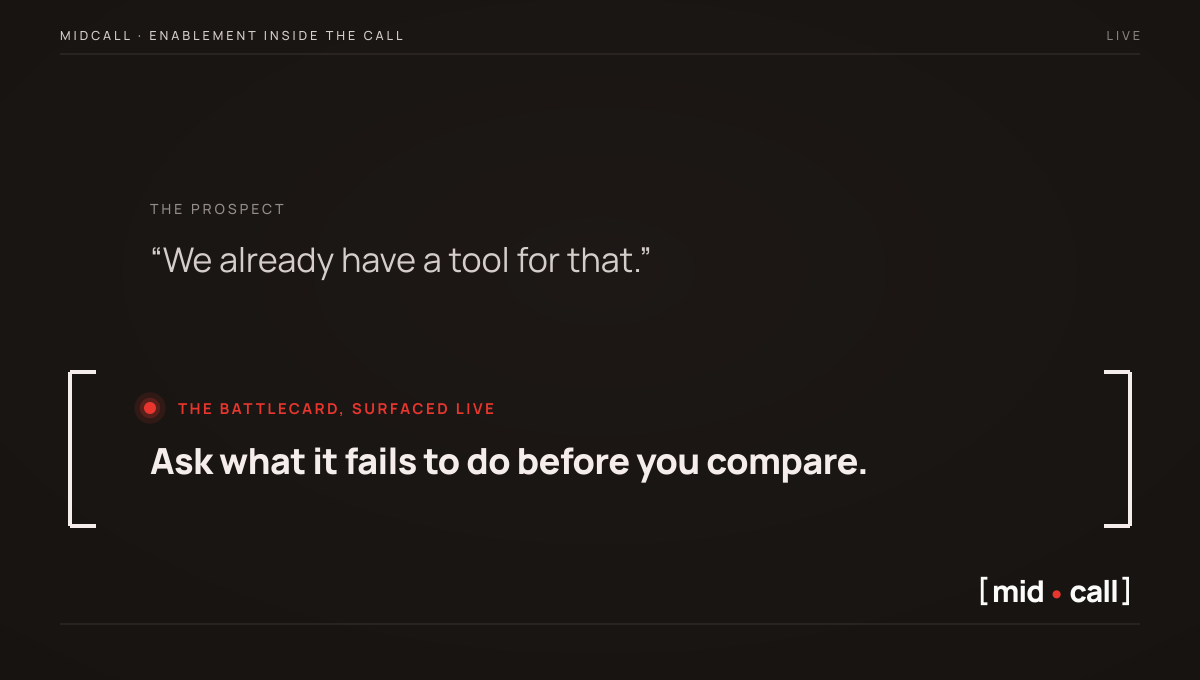
It puts enablement inside the call for the first time. Instead of hoping a rep remembers the playbook, an AI sales coach follows the conversation as it happens and prompts the right line at the moment it is needed. The prospect raises the objection the battlecard covered, and the answer appears, one suggestion at a time so the rep stays focused on the buyer rather than on a screen. A buying signal passes, and the rep is nudged to act on it instead of talking past it. A qualification block is about to be skipped, and the framework the team runs on, MEDDIC, SPICED, BANT or any other, is tracked live so nothing is left out.
This is what Midcall does during a call on Google Meet, Microsoft Teams and Zoom. The content your enablement team built finally reaches the rep at the only moment it can change the outcome, and it reaches them personalized, since a rep who struggles with objections gets more support there than one who already handles them well. Enablement stops being something reps consume before the call and becomes something that works alongside them in it.
How do you measure sales readiness on real calls, not on course completion?
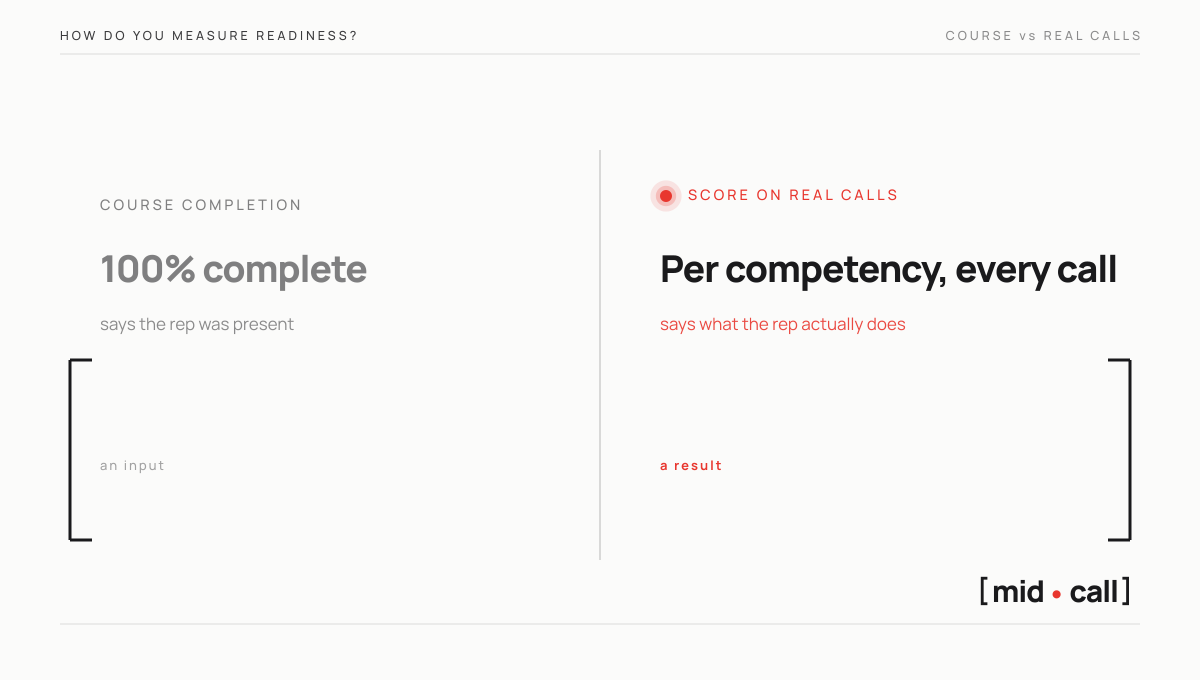
Sales readiness is a rep's proven ability to execute on real calls, and the only honest way to measure it is on real calls. Course completion tells you a rep was present. A certification tells you they knew the answer once. Neither tells you whether they run a solid discovery, handle a real objection or hold a next step when a buyer goes vague. The signal you need is a score per competency on every call a rep runs, so that readiness becomes a trajectory you can see rather than a box you tick.
That is the second half of what an AI sales coach provides. After each call, Midcall scores the conversation out of 100 with a written verdict, then scores each competency, framing, discovery, value selling, objection handling and closing, backed by the exact verbatims behind each score and concrete advice to reach 100 next time. It surfaces the objections that came up and how the rep answered, the talk time against a target, and the monologues that ran too long. For the enablement leader, the manager view rolls this up across the team, with the objection families that come up most and each rep's progression call after call.
This matters because measurement changes outcomes. Highspot's State of Sales Enablement research found that organizations using analytics to measure training effectiveness are 36% more likely to decrease ramp time and drive consistent execution. Readiness measured on real calls is that analytics layer, built from what reps actually do rather than from what they completed.
How do you build an AI sales enablement program that reaches the call?
Start from the call and work backward, instead of starting from a content library and hoping it gets used. Here is the sequence that holds.
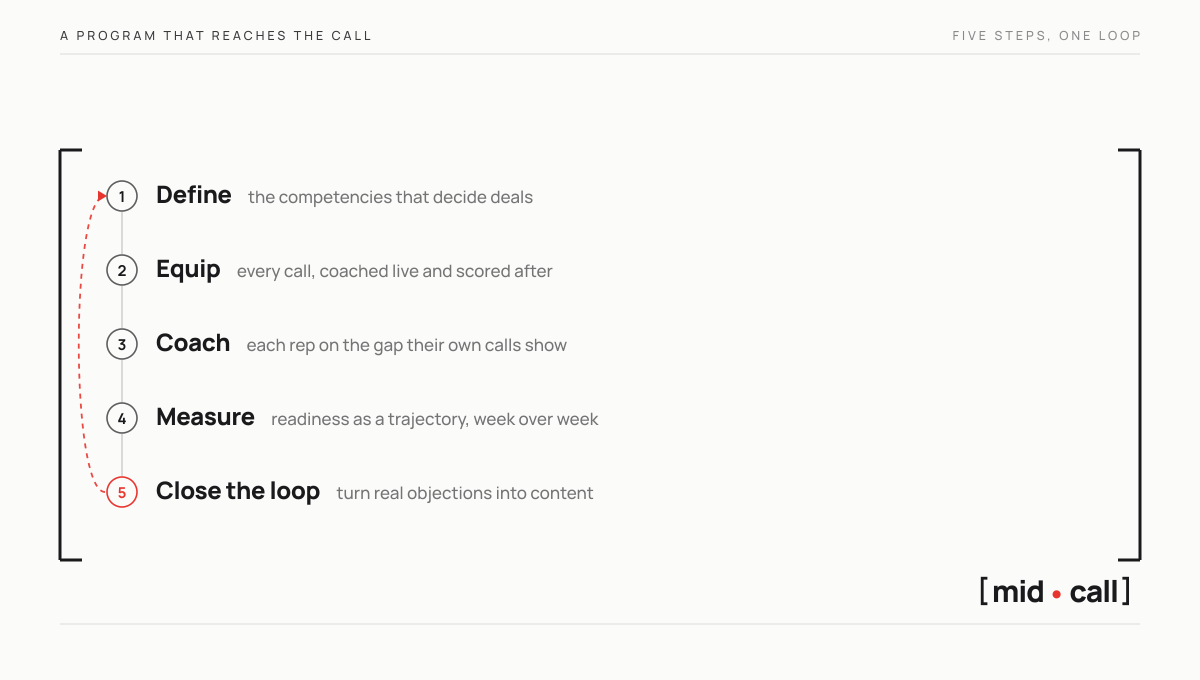
A readiness bar can be as simple as a target score per competency, say 75 out of 100 on objection handling, that a rep has to hold across their last ten calls before carrying a full quota. It turns readiness from a judgment call into a threshold everyone can see, and it gives the enablement team a number to report that means something.
Run on this loop, enablement stops being a program you launch and becomes a system that improves the team every week, with proof.
Where does real-time coaching fit in your enablement stack?
Think of your enablement stack as three layers, each doing a different job at a different moment. Before the call, content and learning platforms such as Highspot, Seismic or Showpad hold the material, the courses and the certifications. After the call, conversation intelligence tools such as Gong, Modjo or Claap record and analyze what happened, feed the CRM and support deal reviews. During the call, real-time coaching is the layer that has been missing, and it is where Midcall sits.
It does not replace the content platform, since the content still has to exist. It does not replace conversation intelligence, since Midcall connects to Gong, Modjo and Claap and passes the recording along rather than adding a second bot to the meeting. It fills the gap between the two, at the moment the other layers cannot reach, and it feeds the CRM you already run, HubSpot, Salesforce or Attio. If your enablement stack has a before and an after but nothing during, that is the layer to add.
Edward Labruyère, co-founder of Midcall. Former B2B SaaS AE, co-founder of Meteor, a B2B prospecting agency. I write about what actually happens inside sales calls, and what the best teams do about it.
The complete AI sales enablement playbook
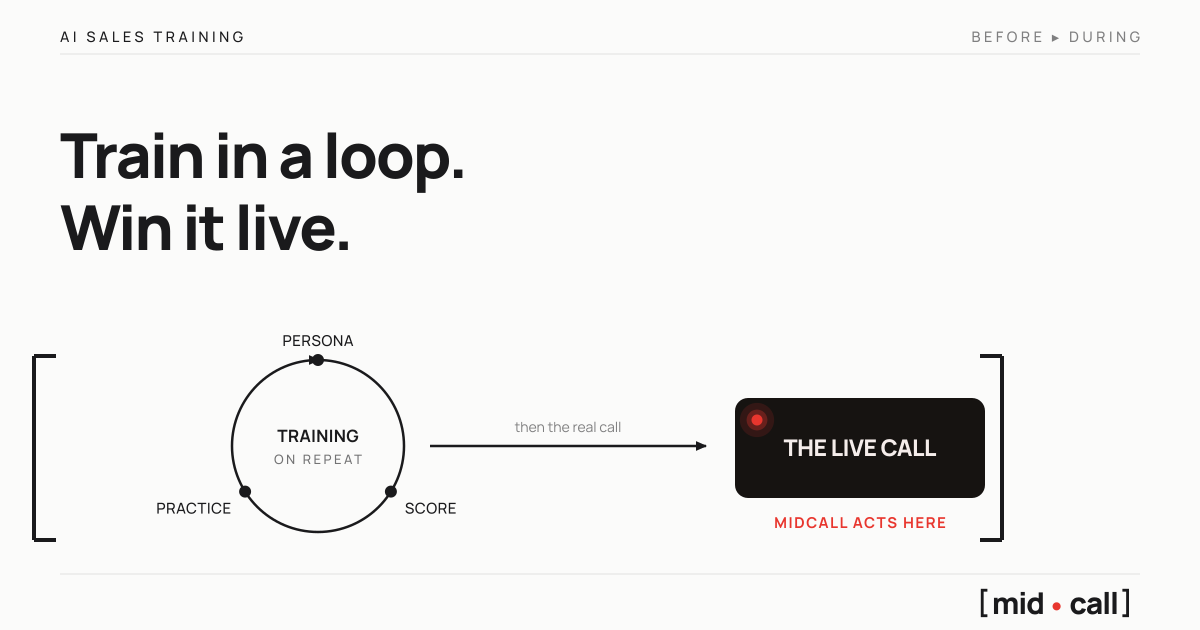
Every layer of the program has its own guide. Here is the full cluster, from practice and onboarding to the live call and its scoring.
 AI & Sales7 min
What is AI sales training, and does it actually make reps better?
AI sales training lets reps practice calls against a simulated buyer, get feedback and ramp faster. What it does, what it doesn't, and how to roll it out.
Read →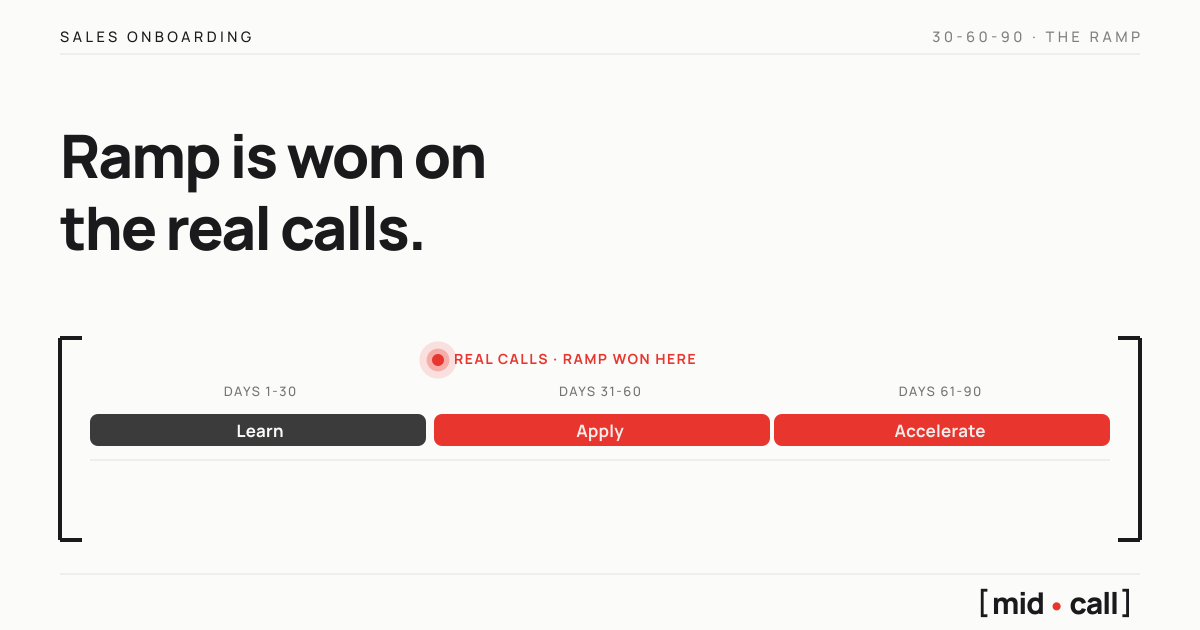 Guides6 min
What is sales onboarding, and how do you ramp reps faster?
Sales onboarding is the 30-60-90 day ramp for new reps. The plan, the mistakes that keep ramp slow, and why ramp is really won on the first real calls.
Read →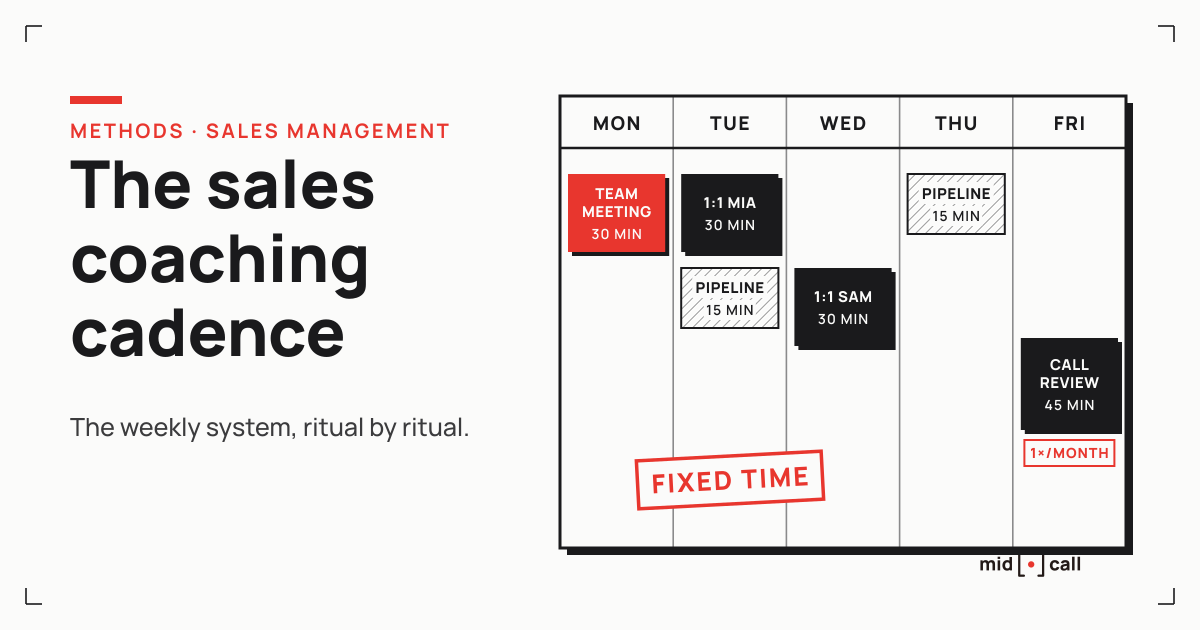 Methods8 min
The sales coaching cadence top sales leaders run every week
The complete sales coaching cadence: weekly 1:1s, a 30-minute team meeting, separate pipeline reviews and monthly call reviews, with minute-by-minute agendas.
Read →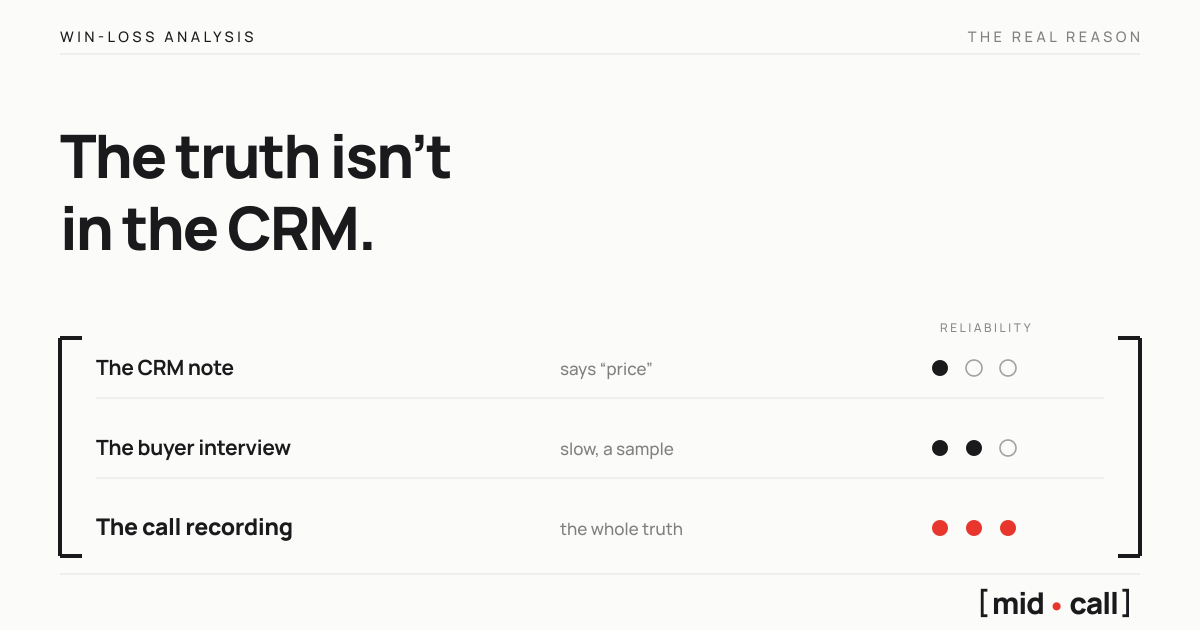 Guides6 min
What is win-loss analysis, and how do you find the real reason?
Win-loss analysis tells you why you really win and lose deals. Why the reasons most teams record are wrong, how to run it, and where the truth actually lives.
Read →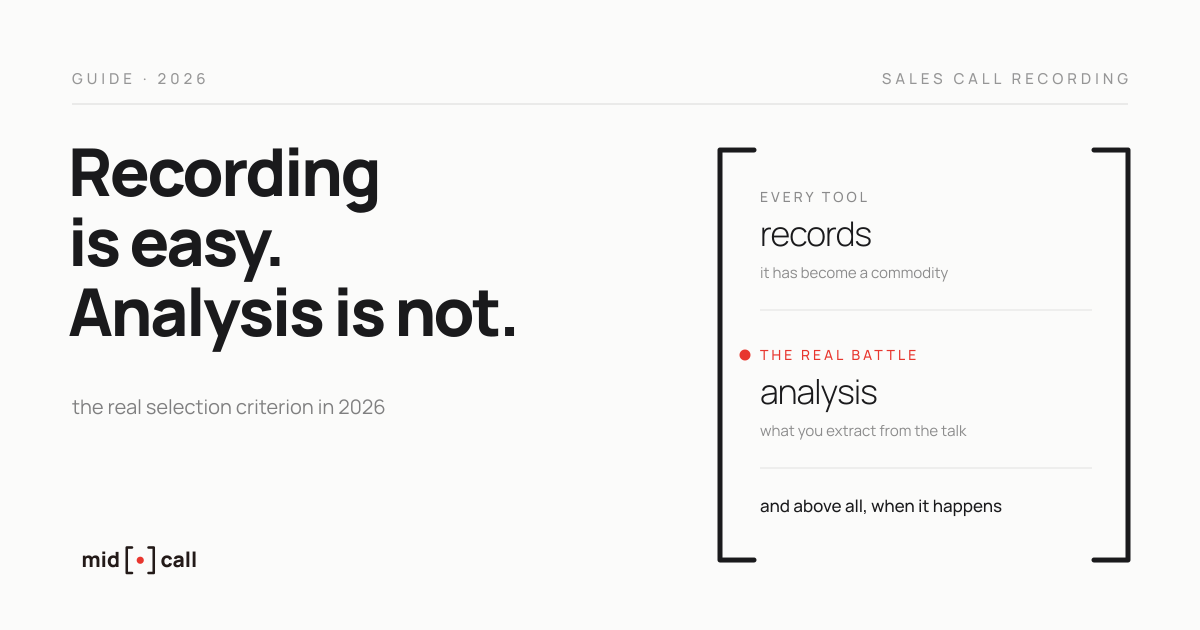 Guides6 min
How do you choose sales call recording software?
How to choose sales call recording software in 2026, the criteria that matter, why recording is no longer the differentiator, and where live analysis fits.
Read →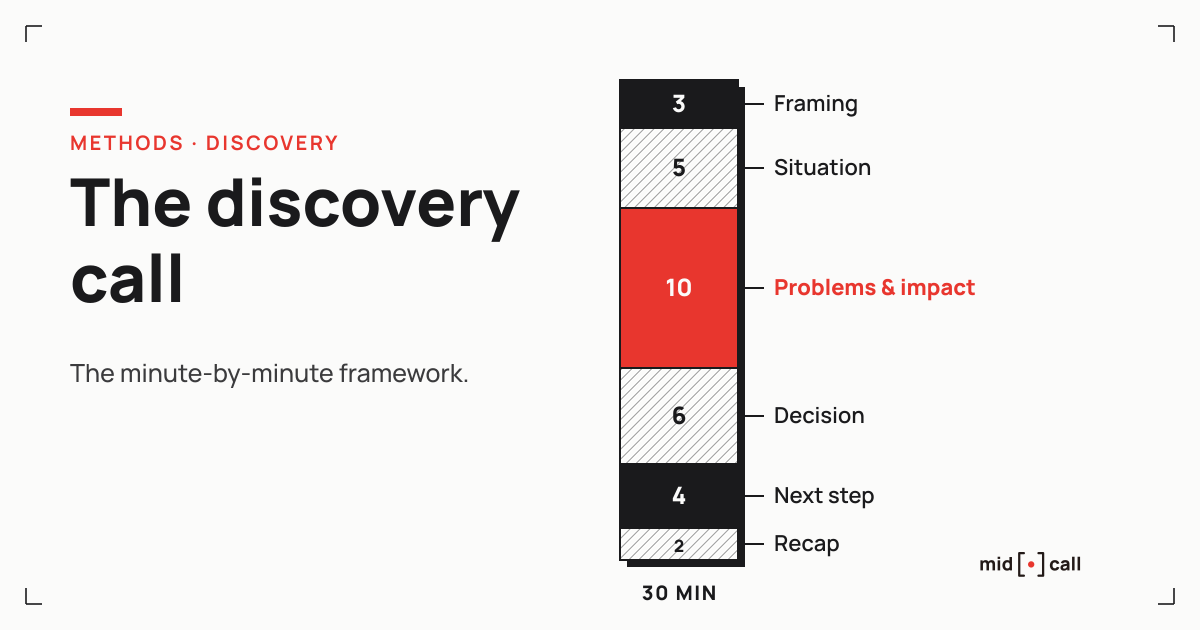 Methods7 min
How do you run a great discovery call? Framework, questions and mistakes to avoid
A great discovery call follows a six-block framework over 20 to 30 minutes: the minute-by-minute structure, the questions, the follow-ups and the rookie mistakes.
Read →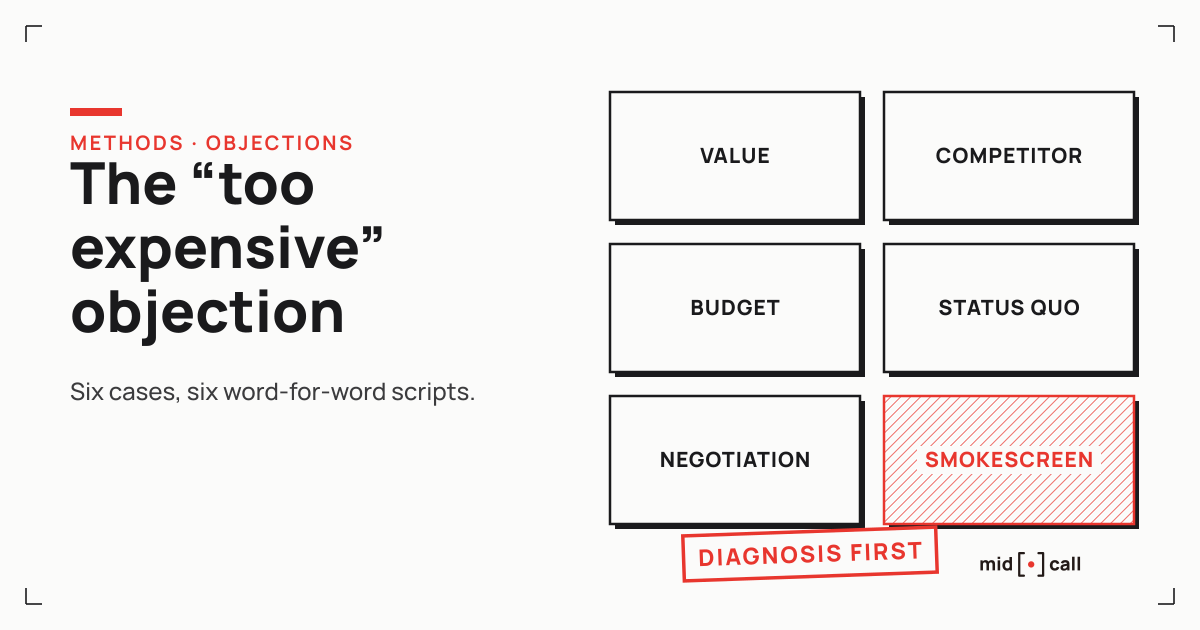 Methods10 min
How do you handle the "too expensive" price objection?
How to handle price objections, with the six cases behind "it's too expensive", the word-for-word scripts, the discount guardrails and the mistakes to avoid.
Read →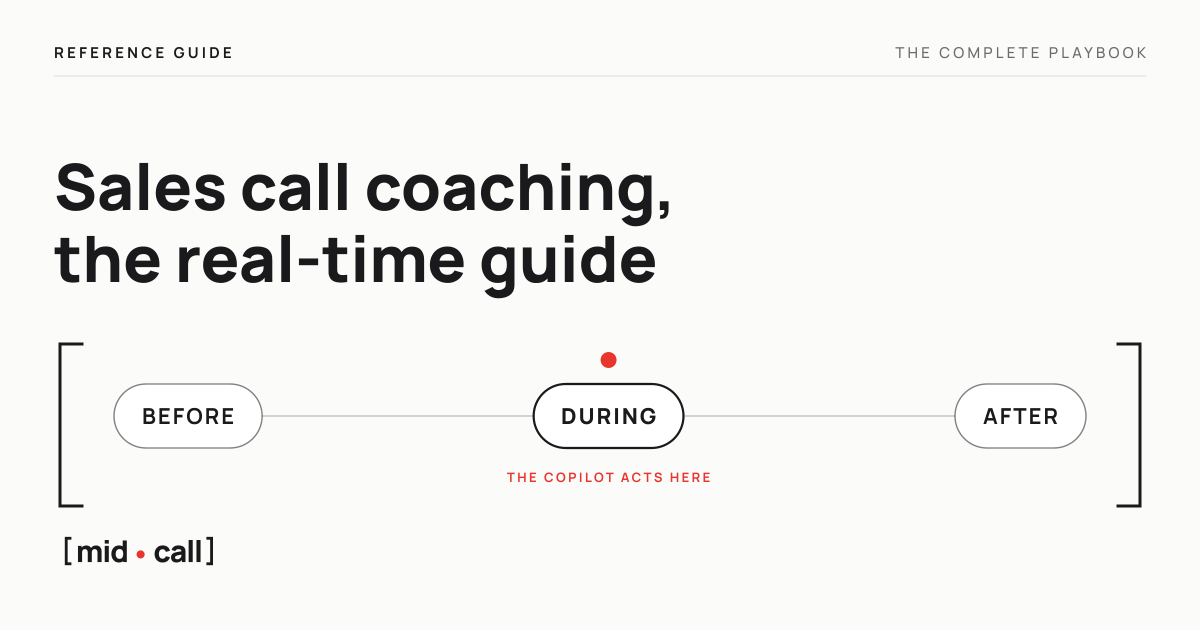 Guides14 min
Sales Call Coaching in Real Time: The AI Coach That Helps Your Reps Mid-Call
Sales call coaching that works in real time: an AI sales coach helps your reps during the call, not after. Objections, buying signals, ramp time, GDPR.
Read →
Frequently asked questions
What is the difference between sales enablement and sales training?
Training is one component of enablement. Enablement is the whole system, content, training, coaching and tools, plus the measurement of whether reps actually sell better as a result. Training builds a skill. Enablement makes sure it shows up on calls.
Who owns sales enablement?
In larger sales organizations, a dedicated enablement function, often reporting to the CRO or to RevOps. In smaller teams, the head of sales or a senior manager. Whoever owns it, the mandate is the same, to make reps better in front of buyers and to prove it.
What is the difference between revenue enablement and RevOps?
Revenue enablement improves the people across every customer-facing team, through content, training and coaching. Revenue operations builds and runs the systems, processes and data those teams depend on. One develops capability, the other runs the machine.
How do you measure the ROI of sales enablement?
Tie it to outcomes reps control and enablement influences, ramp time for new hires, win rate on qualified deals, competency scores on real calls, and adoption of the content and coaching provided. Course completion is an input, not a result.
What is sales readiness?
A rep's proven ability to execute the skills that decide deals, measured on real calls rather than on certifications. A readiness score per competency, tracked over time, shows who is ready, who is progressing and who needs help.
Does AI sales enablement replace the enablement team?
No. It gives the team leverage. AI handles the parts that do not scale by hand, guidance on every call, scoring every conversation, surfacing patterns across reps, so the enablement team can spend its time on strategy, content and the coaching conversations that need a human.
Can a small sales team do enablement without a dedicated function?
Yes. A manager with a clear set of target competencies, coached calls and a weekly look at the scores runs a better enablement program than many large teams with a content library nobody opens. The function is optional. The discipline is not.
See the live AI coach on one of your calls.
15 minutes. We plug Midcall into a real scenario from your team, you decide.