What is sales coaching, and how do you coach every call?
Sales coaching is the ongoing, personalized work of helping a rep sell better, based on how they actually sell. It is the most effective lever a sales leader has, and the least scalable one, because a manager can watch a handful of calls a week. This guide covers what sales coaching is, the methods that work, how to coach a real call, and how to coach every call rather than a few.
What is sales coaching?
Sales coaching is the continuous, one-to-one work a manager does to improve how a specific rep sells. It starts from real situations, a discovery call that went sideways, an objection that was dodged, a next step that was never locked, and it works on that rep's specific gaps until the behavior changes on the next call. It is personalized by definition, because two reps with the same number rarely have the same problem.
It is not a pipeline review, which is about the deals. It is not a performance review, which is about the past. And it is not training, which is about knowledge. Sales coaching is about what the rep does in front of a buyer, and about changing it. In most teams the manager is the natural coach, because they know the context, the deals and the people. Enablement teams and external coaches can add method, but the day-to-day coaching that moves a rep lives with the manager.
What is the difference between sales coaching and sales training?
Training transfers knowledge to a group. The product, the methodology, the pitch, the objection library, delivered in a room or a course, the same for everyone. It builds the base, and every rep needs it. Coaching starts where training stops. It is individual, it works from what the rep actually did on a real call, and it turns knowledge into behavior. A rep can pass every certification and still freeze on the first real objection, because knowing the answer and finding it under pressure are two different skills. Training gives the first. Coaching builds the second.
The closest thing we have to a scientific case for one-to-one coaching comes from education. In his landmark 1984 study, Benjamin Bloom found that the average student tutored one-to-one performed better than 98% of students taught in a conventional classroom, an effect of two standard deviations that has been debated ever since but never dismissed. The lesson transfers to sales. Group instruction levels a team up. Individual coaching, on real work, is what separates reps who plateau from reps who keep improving.
Which sales coaching methods actually work?
The methods that hold all share one principle, coach from a real call, on one thing at a time, by asking before telling.
Coaching from real calls is the reference. The manager listens to a call, or a moment in it, and debriefs on what actually happened rather than on what the rep says happened. Every other method is a substitute for this one when you cannot get to the call.
The coaching 1:1, kept apart from the pipeline review. If every 1:1 becomes a deal inspection, skill development never happens. A useful rule is 70/30, the rep speaks seventy percent of the time. If the manager talks more than that, it is training, not coaching.
Questions before answers. The GROW sequence, goal, reality, options, will, exists for a reason. A rep who diagnoses their own call owns the fix. A rep who is told what to do complies until the manager looks away.
Role-play in low-stakes settings, ideally in triads where reps rotate between seller, buyer and coach, and increasingly against an AI simulation the rep can run alone. Useful to rehearse the hard moments, provided everyone remembers that the real call is where the skill is tested.
One skill at a time. Discovery this month, objection handling next. A rep given five things to fix fixes none.
A steady rhythm. A weekly coaching cadence, short and regular, beats a long session once a quarter.
How do you coach a rep on a real call, step by step?
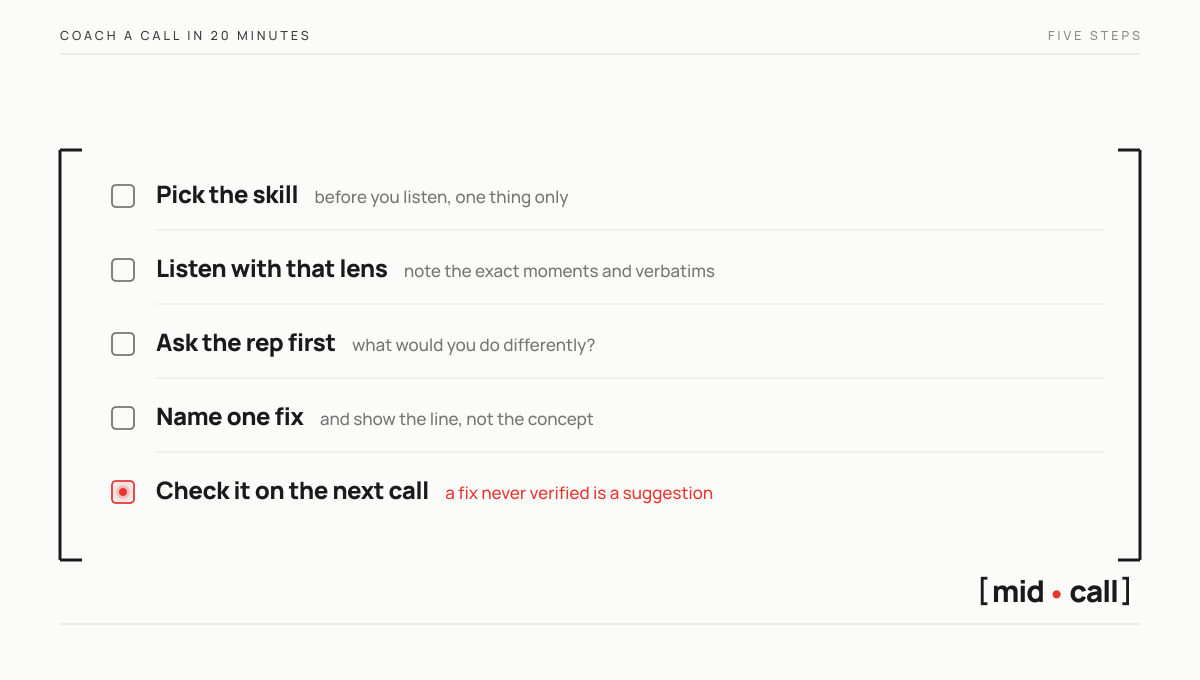
Here is the sequence that works on a single call, and takes twenty minutes.
In practice it looks like this. A rep runs a solid discovery but never quantifies the pain, so every proposal later stalls on price. The manager picks that one skill, finds the two moments in the call where the prospect described a problem and the rep moved on, and asks the rep what they heard. Together they write the one question that was missing, something like "what does that cost you over a quarter?" The rep uses it on the next call, the manager listens for it, and the fix becomes a habit. That is coaching. Everything else is commentary.
What mistakes kill sales coaching?
Six mistakes come back in almost every team, and each one quietly turns coaching into something else.
Coaching that is a pipeline review in disguise. The meeting is called coaching, and thirty minutes later it has covered forecast, deal status and next steps, and not one skill.
Coaching only the bottom of the team. The reps who move the number most are usually in the middle, and they are the ones nobody coaches.
Generic feedback. "Be more confident" or "listen more" gives the rep nothing to do. Feedback works when it points at a moment, with the words that were said.
Telling instead of asking. The manager delivers the answer, the rep nods, and nothing changes, because the rep never owned the diagnosis.
Coaching from memory, or from the CRM note. Without the call itself, the manager coaches the rep's story, not the rep's behavior.
No follow-up. The fix is agreed and never checked on the next call, so it evaporates.
How do you measure the impact of sales coaching?
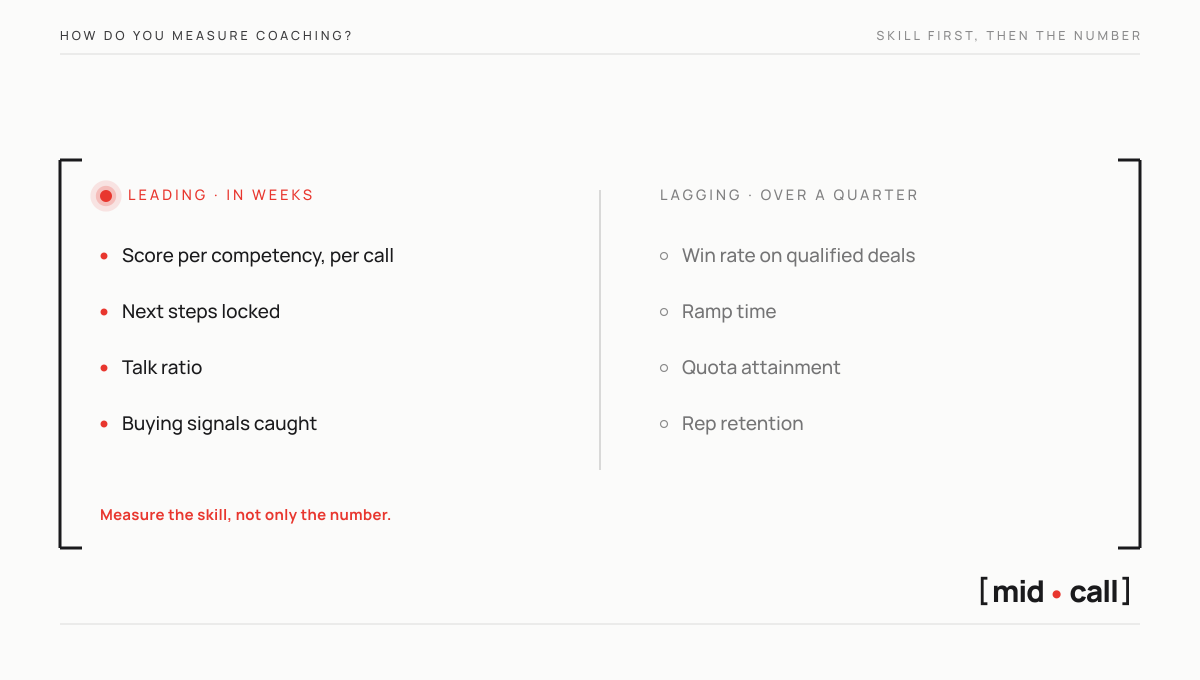
Measure the skill, not only the number, or you will never know whether coaching worked or the market did. Two families of indicators, read together, tell you.
Leading indicators, the ones coaching changes first. A score per competency on each call, discovery, objection handling, closing, tracked over time for each rep. The share of calls that end with a locked next step. The talk ratio, and how often a rep lets a buying signal pass. These move within weeks when coaching is working.
Lagging indicators, the ones the business cares about. Win rate on qualified deals, ramp time for new reps, quota attainment, and rep retention, which improves when people feel they are getting better. These move over a quarter, and they only mean something once the leading indicators have moved first. When the win-loss analysis shows the same objection fumbled across the team, that is your coaching backlog, and your proof when the pattern disappears.
Why does sales coaching not scale?
Because the best method is the one that scales worst. Coaching from real calls needs the manager to be on the call, or to listen to it afterwards, and there are only so many hours. Most managers can closely coach five to seven people, and even then, on a fraction of what those people do.
The arithmetic is unforgiving. Eight reps who each run ten calls a week produce eighty calls. A manager who listens to three of them, which is already a serious commitment, has coached less than four percent of what happened. The other seventy-seven calls were coached from memory, from the CRM note, or not at all. And the reps who most need help, the new ones and the ones in the middle, are precisely the ones whose calls nobody hears.
This is not a motivation problem. Every sales leader knows it. It is a ceiling built into the method, and it is why so many coaching programs start strong and fade. The answer is not less coaching. It is coaching that does not depend on the hours a manager does not have.
How do you coach every call, not just a few?
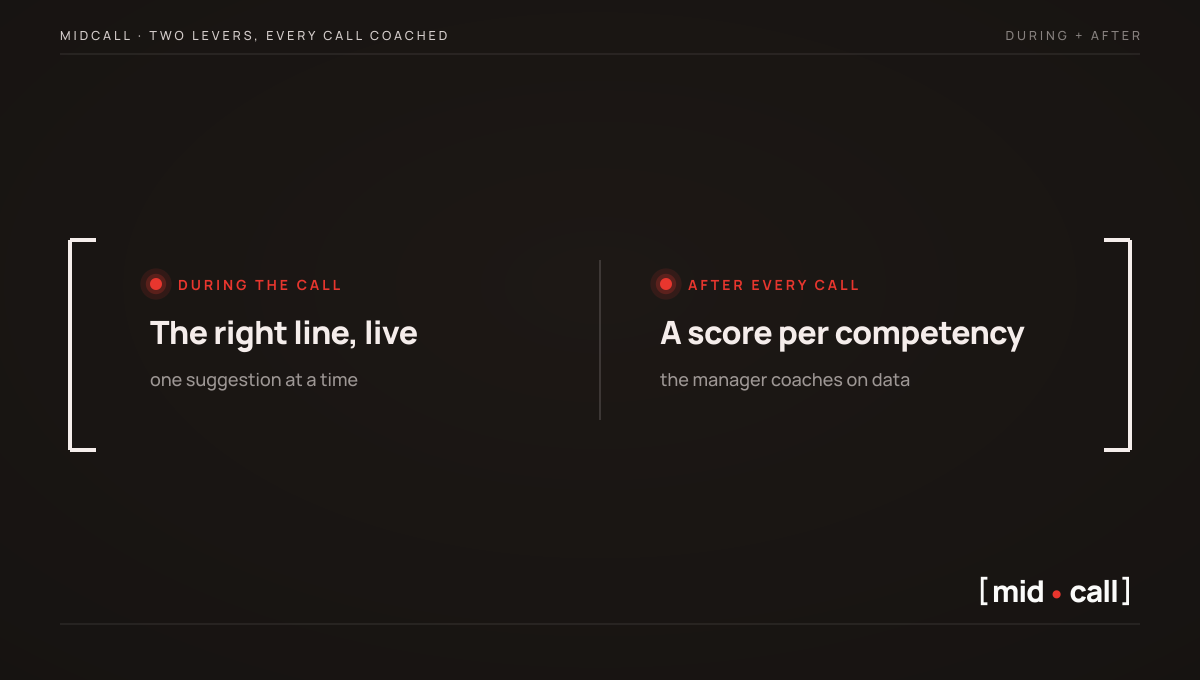
Two levers remove the ceiling, and they work together.
The first is to score every call, automatically, on the competencies that make or break deals. When each call comes back with a score out of 100 and a score per skill, framing, discovery, value selling, objection handling and closing, backed by the exact verbatims and by concrete advice to reach 100 next time, the manager no longer picks the three calls to listen to at random. The scores point to the rep who keeps skipping the quantified pain and the rep who loses control the moment price comes up, and the 1:1 starts from evidence instead of from memory. Coaching becomes personalized by construction, since each rep is coached on the gap their own calls show.
The second is to coach during the call. A rep who gets the right question, the right answer to an objection or the reminder of a skipped qualification block at the moment it matters does not need to wait for Friday's debrief to do better. A junior operates closer to a senior from their first real calls, and the manager's coaching lands on top of a rep who is already being helped in the room.
This is what Midcall does. During a call on Google Meet, Microsoft Teams or Zoom it follows the conversation and prompts the right line, one suggestion at a time, keeps the qualification framework on track, whatever method the team uses, and flags the buying signal the rep is about to talk past. After the call it scores the conversation and every competency, surfaces the objections and how the rep answered them, and gives the manager a team view with each rep's progression and the objection families that come up most. Your coaching keeps its method. It stops depending on the hours you do not have, and it finally covers every call, from the rep's first week of onboarding to the deal that closes the quarter.
Edward Labruyère, co-founder of Midcall. Former B2B SaaS AE, co-founder of Meteor, a B2B prospecting agency. I write about what actually happens inside sales calls, and what the best teams do about it.
Frequently asked questions
How often should you coach a sales rep?
Weekly, in a short 1:1 kept separate from the pipeline review, plus one real call reviewed per week. Frequency matters more than length. Twenty focused minutes every week outperform a two-hour session every quarter, because a skill only sticks when the fix is checked on the next call.
Should the manager coach, or an external coach?
The manager, first. They know the context, the deals and the rep, and they are there for the follow-up, which is where coaching actually lands. An external coach or an enablement team adds method and a fresh eye, and is worth it for specific skills, but if the manager does not own the weekly loop, nothing changes.
Does sales coaching work for a small team?
Better than anywhere else, because the manager can still hear most of the calls. The ceiling bites as the team grows, which is exactly when a small team should put the coaching rhythm and the call scoring in place, before the manager runs out of hours.
What is the GROW model in sales coaching?
A four-step questioning sequence, goal, reality, options, will. What are we trying to improve, what actually happened on the call, what could you do differently, what will you do next time. It keeps the manager asking rather than telling, so the rep owns the fix.
How long before sales coaching shows results?
Behavior changes within weeks when the coaching is specific and checked on the next call. The numbers, win rate, ramp time and quota, follow over a quarter. Measure the skills, not only the results, or you will give up before the results arrive.
Can AI replace a sales coach?
No, and it does not need to. It removes the ceiling. AI scores every call and prompts the rep live, which the manager cannot do at scale, so the manager's own coaching becomes rarer in volume and far better in aim, focused on the conversations that need a human. The method stays. The blind spots go.
See the live AI coach on one of your calls.
15 minutes. We plug Midcall into a real scenario from your team, you decide.