What is a sales demo, and how do you conduct one?
A sales demo is the live presentation where you show a qualified prospect how your product solves the problems they told you about. Its job is to help the buyer decide, not to prove that every feature works. You can plan the demo in advance, but it succeeds or fails live, the moment a question or an objection takes you off your script.
What is a sales demo?
A sales demo is a live presentation in which a rep shows a qualified prospect how the product solves the problems they described, to help them decide whether to buy. It is also called a sales demonstration or sales presentation, and it usually runs on screen share. It usually follows discovery in the same call, once the prospect has laid out their problems, and it exists to connect what the product does to what the buyer needs.
It is not the same thing as a product demo.
| Sales demo | Product demo | |
|---|---|---|
| Audience | A prospect evaluating a purchase | An existing customer or user |
| Goal | Help the buyer decide | Teach how a feature works |
| Content | Two or three problems the buyer described | The features the user needs |
| Ends with | Price, terms and a dated next step | The user able to do the task |
A sales demo is part of a buying decision, so it speaks to the buyer's problems, their numbers and their next step, and it leaves out everything they did not ask about. The test of a sales demo is simple. At the end, can the prospect explain to a colleague why this solves their problem? If they can, the demo did its job. If they can only list features, it did not.
When should you run the demo, and who should be in the room?
Run it right after discovery, in the same call. In most B2B SaaS deals the first meeting lasts about an hour, the first half is discovery and the second half is a demo built on what the prospect just told you. That is the default, and it only works if you genuinely listen in the first half instead of rushing to share your screen. Here is a typical breakdown, to adjust to your deal.
| Phase | Time | What it is for |
|---|---|---|
| Discovery | 20 to 25 min | Understand the situation, the problems and who decides |
| Bridge | 2 to 3 min | Recap what you heard, confirm the demo agenda |
| Demo | 20 to 25 min | Show two or three problems solved, with questions along the way |
| Close, price and terms | 10 min | Check the fit, discuss price and terms, book the next step |
Leave real room for the conversation. In Gong's analysis of 67,149 recorded SaaS demos, successful demo calls lasted 30.5% longer than unsuccessful ones, 47 minutes against 36, and Gong's advice is to spend that extra time on dialogue with the buyer, not on showing more features. A separate demo call a few days later makes sense in longer cycles, when the discovery reveals several stakeholders who need to see the product, or when the demo needs a tailored environment you cannot build on the fly.
Who should attend depends on who decides. At minimum, the person who owns the problem. Ideally, someone who will use the product every day and, if you can get them, the person who approves the budget. Ask the question directly while booking, "Who else would need to see this before a decision?" If the decision-maker cannot join, plan the demo so your champion can retell it, with the problem, the outcome and the numbers stated plainly enough to survive being repeated in an internal meeting.
How do you prepare a sales demo?
Preparation is where most demos are made, and it takes less time than people think.
Start from what you already know about the prospect, the notes from the first contact, their company, their role, the problems that usually come up in their situation, and prepare two or three demo paths you can pick from. Then let the discovery half of the call decide. Keep the two or three problems the prospect cares about most, in their words, and drop everything else. For each problem, decide the one screen or workflow that shows it solved, and the result it produces, a report built in two clicks instead of three hours, a missed step caught automatically. That is value mapping, each thing you show tied to a pain the buyer expressed.
Then write the agenda and send it with the invite, discovery first, demo second, so the prospect knows what to expect and can correct it before the call. Decide the next step you will ask for, a technical review, a meeting with the budget owner, a trial with two users, and put it in your plan now, not in the last two minutes. Finally, prepare your data so the product looks like the prospect's world. A demo filled with the prospect's own industry, company size and vocabulary lands far better than one filled with placeholder data.
How do you conduct a sales demo, step by step?
Here is how to conduct a sales demo in seven steps, whatever you sell.
- Bridge from discovery with what you heard. Recap the prospect's situation and the problems they just described, then ask them to confirm or correct it. It proves you listened and gives them a chance to add what they left out.
- Confirm the agenda and the goal. Say what you will show and what you would like to decide at the end of the call.
- Show the outcome first. Start with the result the buyer wants, the finished report, the dashboard, the problem solved, then show how you get there. Peter Cohan's Great Demo! method calls this doing the last thing first.
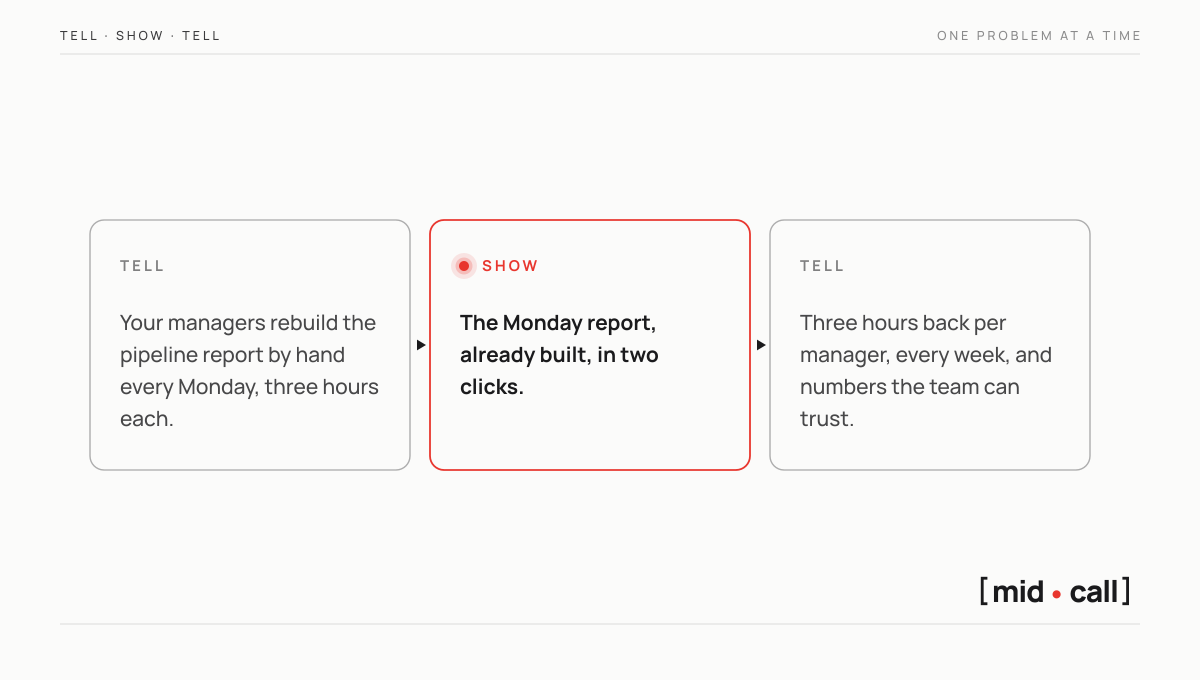
- Walk through each problem with tell, show, tell. Say what you are about to show and why it matters to them, show it, then say what it changes for them. One problem at a time, a few minutes each.
- Check in every few minutes. "Is that how your team would use it?" A demo where the prospect speaks often is a conversation. A demo where they stay silent for twenty minutes is a lecture.
- Handle questions and objections when they come, not at the end.
- Close the loop, then talk about price and terms, and book a dated next step.
Here is what that looks like in practice. In the first half of the call, a sales ops lead at a forty-rep company tells you that managers rebuild the pipeline report by hand every Monday, about three hours each, and that nobody trusts the numbers. You switch to the demo by repeating exactly that, and ask if you got it right. You show the Monday report already built, then the two clicks behind it. You ask whether that report would replace theirs. They say yes, but reps never update the CRM, so the data would still be wrong. You do not skip it. You ask how often it happens, then show the reminder the tool sends when a deal goes stale. You close with, "Does this solve the Monday problem?" They say yes, ask about pricing for forty seats, and you walk through it before booking Thursday at ten with their head of sales to agree on the terms.
How do you end a sales pitch or demo and move to pricing?
End a sales pitch or a demo on purpose, keeping the last ten minutes for it, never on "any questions?" Recap the problems you covered and what each one looks like once solved, in one or two sentences. Ask a direct question that tests the fit, "Based on what you saw, does this solve the problem we talked about?" Listen to the answer, because a hesitant yes tells you more than a polite one.
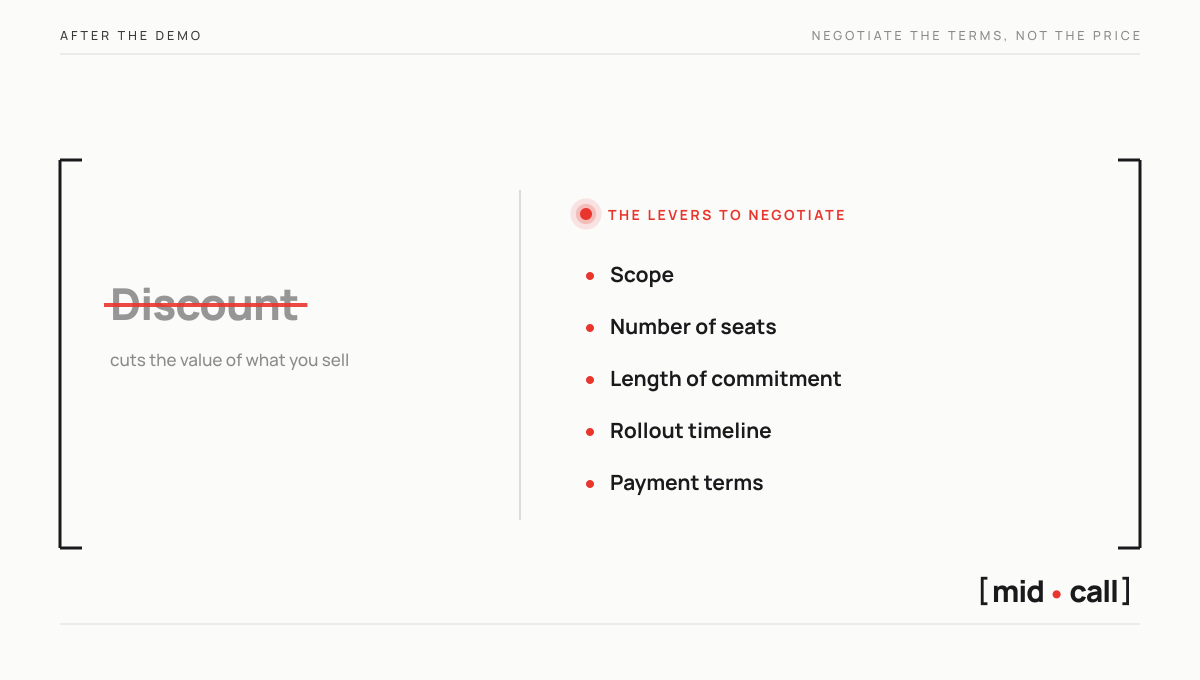
Once the fit is confirmed, the conversation can move to price. It often happens in the same call, especially when the prospect asks, and there is no reason to dodge it. State the price plainly, tied to the problems you just showed solved, without apologizing for it. Then open the discussion on the terms of the deal, the scope, the number of seats, the length of the commitment, the rollout timeline, the payment conditions. Negotiating on terms is healthier than negotiating on price. A longer commitment, a phased rollout or a pilot on one team gives the buyer what they need without cutting the value of what you sell. If the discount question comes up, our guide to price objections covers how to hold your ground.
Then book the next step before you hang up, with a date and the right people in it. "The next step is a thirty-minute session with your head of sales to agree on the terms. Would Thursday at ten work?" A proposal, a pilot or a technical review all work, as long as it is booked. A demo that ends with "I'll send you some information" has not ended, it has stalled. The same logic runs through the closing techniques that turn interest into a dated commitment.
How do you handle questions and objections during a demo?
Treat them as the best part of the demo, because they show what the buyer is actually weighing. When a question comes, answer it now if it takes a minute, and park it visibly if it needs a deep dive, writing it down in front of the prospect so they know it will come back.
When an objection lands, do not push through your slides. Acknowledge it, ask a question to understand what sits behind it, then answer with proof, a screen, a customer example, a number. Many objections in a demo are really questions about risk, will my team use it, will it work with our tools, what happens if it fails. Price comes up too, and it deserves the same calm treatment rather than a discount reflex. Watch for buying signals as well, a prospect asking about rollout, onboarding or contract length is telling you the demo is working, and that is the moment to move toward the next step.
What mistakes kill a sales demo?
Six mistakes come back again and again.
Demoing without discovery. If you do not know the problem, you are guessing which features to show, and the demo turns into a tour.
Opening with your company story. The buyer came for their problem, not your founding date or your client logos.
The feature dump. Showing everything the product can do makes it harder to see what matters, and every extra feature is a new question you did not need.
The monologue. Twenty minutes of talking while the prospect watches means you have no idea what they think. The same Gong research found that reps in successful demos speak in short bursts of no more than 76 seconds, while unsuccessful demos contain uninterrupted pitches of up to 106 seconds.
Skipping an objection. Moving on to keep the script on track tells the buyer their concern does not matter, and it will come back at decision time.
No next step. The demo ends on "let me know", and the deal stalls for two weeks.
How do you get better at demos, call after call?
Most reps never find out what happened in their own demos. They remember how the call felt, not what they said, how long they talked, or the objection they let slip at minute twenty-two. And the manager hears one demo in ten at best. So the same mistakes repeat, demo after demo, and the plan built before the call keeps breaking at the same moments.
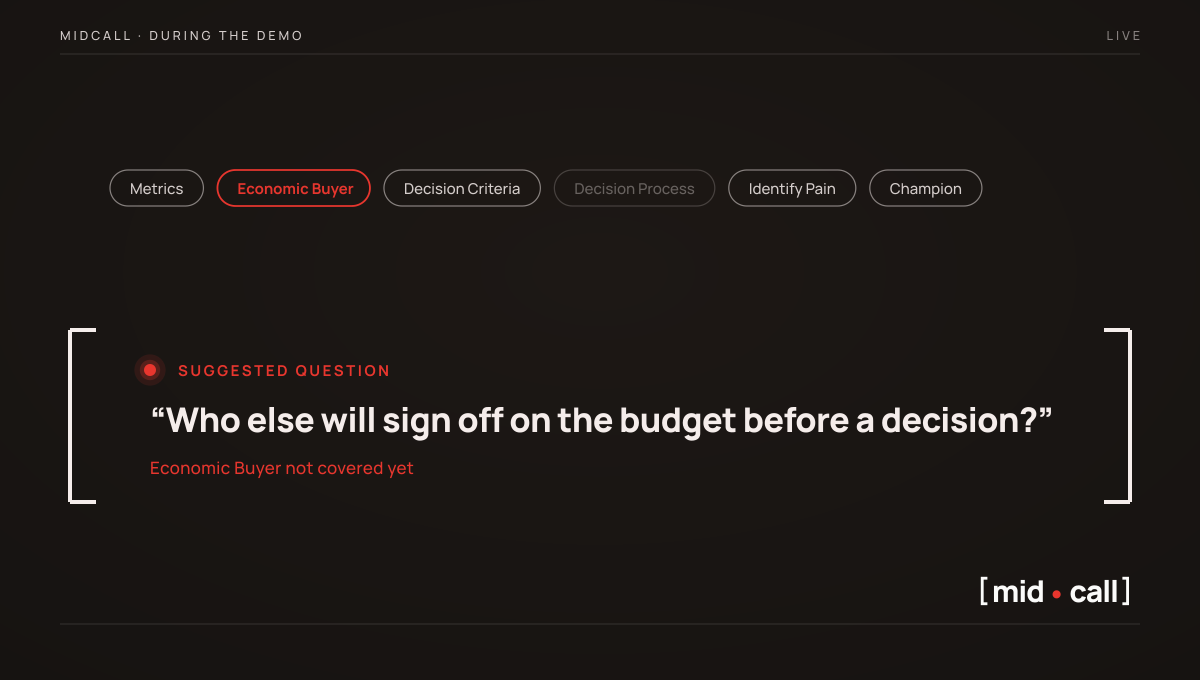
The fix is to get help while the demo is running and a clear read of it afterwards. That is what Midcall does. You can give it the context of the meeting beforehand, so it knows the prospect before the call even starts. During the demo on Google Meet, Microsoft Teams or Zoom, it follows the conversation and prompts the right move at the right moment, one suggestion at a time. It can suggest an open question such as "What brings you to look at this topic today?" to open up the real need before you present the offer. It reads whether an objection is a real one or a smokescreen and suggests how to answer. It keeps your qualification framework visible, Metrics, Economic Buyer, Decision Criteria and the rest, so you notice the block you have not covered yet. And it flags the buying signal you are about to talk past.
After the demo, Midcall scores the call out of 100 and each competency, framing, discovery, value selling, objection handling and closing, with the exact verbatims behind each score. It measures how much the prospect spoke against a target range, counts the long monologues, the very pattern Gong's data links to unsuccessful demos, and lists the objections that were left unhandled. The rep knows exactly what to fix before the next demo, and the manager coaches on evidence rather than on memory, as described in our sales coaching guide. The plan stays yours. Midcall makes sure it holds when the demo goes off script.
Objections are where most demos are won or lost, and our guide on handling objections during a demo gives you a method for the ones you hear most.
Edward Labruyère, co-founder of Midcall. Former B2B SaaS AE, co-founder of Meteor, a B2B prospecting agency. I write about what actually happens inside sales calls, and what the best teams do about it.
Frequently asked questions
How long should a sales demo be?
In a one-hour first meeting, plan about thirty minutes of demo after the discovery, plus time for questions and for price. If the demo alone takes longer, you are probably showing too much. A short demo that covers the two or three problems that matter works better than a long one that covers everything.
What is the difference between a sales demo and a product demo?
A sales demo is part of a buying decision and speaks to a prospect's problems, numbers and next step. A product demo teaches someone, usually a customer, how to use the product. The first is built around the buyer, the second around the product.
Should the demo happen in the same call as discovery?
In most B2B SaaS deals, yes. A one-hour first meeting that starts with discovery and moves into a demo is the norm. It works if you really listen in the first half and shape the second half on what you heard. A separate demo call is useful in longer cycles with several stakeholders, or when the demo needs a tailored setup.
How many features should you show in a demo?
As few as it takes to solve the problems the prospect described, usually two or three workflows. Each feature you show should connect to a pain they expressed. The rest can wait for a follow-up if they ask.
How do you run a good virtual demo?
Share only the window you need, close notifications, keep your camera on and pause often, because it is harder to read a room on video. Ask direct questions to keep the prospect engaged, and check that they can see what you are pointing at.
How do you end a sales pitch or a demo?
Recap the problems you covered and what each looks like once solved, ask a direct question to check the fit, then move to price and terms if the prospect is ready, and book a dated next step before hanging up. Never end on "any questions?" or "I'll send you some information".
When should you bring up price in a sales demo?
Once the prospect has confirmed that what they saw solves their problem, usually in the last ten minutes of the meeting, or earlier if they ask. State the price plainly and tie it to the value you just showed, then negotiate the terms rather than the price.
What should you send after a sales demo?
A short recap the same day, with the problems you discussed, what you showed for each one, the answers you promised and the next step with its date. Write it so your champion can forward it to people who were not on the call.
See the live AI coach on one of your calls.
15 minutes. We plug Midcall into a real scenario from your team, you decide.