Sales Call Coaching in Real Time: The AI Coach That Helps Your Reps Mid-Call
Your rep is on a second call. Twelve minutes in, the prospect says "it's a bit expensive for us." Two seconds of silence. The rep pivots to ROI, senses it isn't landing, promises to send a recap. The prospect never calls back.
You will find out on Monday, in a very well-formatted report. The deal died Thursday at 2:12 pm.
Real-time AI sales coaching means giving your reps an AI sales coach that assists them during the live sales call: it listens to the conversation as it happens and shows them on screen what to say at the exact moment they need it, the answer to an objection, the discovery question they skipped, the differentiator against a competitor they just named, the buying signal worth locking in.
The prospect sees nothing. It is the only moment when help still changes the outcome of the deal.
This guide covers why this category became viable in 2026, what it costs you not to have it, and how to judge a tool properly.
Real-time coaching builds on sales fundamentals we cover in five practical guides: a MEDDIC qualification tracked during the call, a structured discovery framework, price objection handling that diagnoses before answering, closing techniques built on buying signals, and management rituals that anchor progress in the team's week.
What does AI sales coaching actually mean?
AI sales coaching is the use of artificial intelligence to help a rep sell better on their calls, and what it actually does depends entirely on when the help lands. You will also see it called a live AI coach or an AI sales copilot.
The term covers three different families of tools, and that is the first place buyers get confused.
Before the call: AI roleplay. Practice with a simulated buyer, pitch rehearsal, objection drills in a safe environment. Useful during onboarding.
After the call: AI analysis. The tool records, transcribes, scores the call and feeds the manager's debrief. Useful for improving over time.
During the call: the real-time AI sales coach. The AI assists the rep live, in the actual conversation, with a real prospect on the other end. That is the subject of this guide, and the only one of the three that affects the deal currently on the table.
| Moment | What happens | What it changes |
|---|---|---|
| Before the call | Roleplay, drills, account brief | The rep arrives prepared |
| During the call | The AI sales coach shows what to say, live | The deal in progress can still be won |
| After the call | Transcription, scoring, recap, manager coaching | The rep improves for next time |
Watch the vocabulary carefully. Some post-call vendors use "real time" to describe feedback delivered a few minutes after the call ends. One question settles it in a demo: show me what my rep sees on screen while the prospect is still talking. If the answer is a dashboard reviewed later, that is post-call analysis, whatever the label says.
How does AI sales coaching work?
An AI sales coach does three things in sequence. It follows the conversation as it happens, it reads the sales situation rather than isolated keywords, and it surfaces the right line or action for the rep at the moment it lands. What separates the tools on the market is not that mechanism, it is the timing.
Before the call, an AI sales coach plays a simulated buyer so a rep can rehearse before it counts. After the call, it scores a recording and feeds the manager's review. During the call, it prompts the rep while the prospect is still talking, and the prospect sees nothing. That last window is the only one that can still change the deal on the table, and it is where this guide lives.
Why real-time coaching became possible only recently
Because the technology just crossed the threshold that makes it work at all.
Assisting a rep mid-call requires three things at once: continuous transcription that does not drift, understanding of a sales situation rather than isolated keywords, and a response in under a second. Two years ago, the models capable of the second condition were too slow for the third. A perfectly correct suggestion that lands eight seconds after the objection is worthless, because the conversation has already moved on.
That constraint is what broke. The sales tools that dominated the past decade were built under the old limitation: since AI could not help during the call, they optimized everything after it. They did that job extremely well, which is exactly why they won their market. But their entire architecture rests on a technical ceiling that no longer exists.
Put differently, your current sales stack was almost certainly designed for a world where nobody could help your rep live. That world is gone.
What it costs you not to have in-call coaching
Run the numbers on your own team. It is rarely a pleasant exercise.
The deals you lose on a single sentence. Not on product, not on real budget, but on an objection handled badly at minute twelve. Those losses never show up as avoidable: they get logged as "price" or "not a priority" in your CRM. Pull your last five losses and ask each rep for the precise moment it turned. You will know.
The months your juniors spend losing deals while they learn. This is the heaviest and most invisible cost. The Bridge Group's SaaS benchmark puts average AE ramp at 5.3 months, with a median of 6, stretching past nine months when ACV exceeds $50K. During all that time, your new hire is practicing on real prospects, which means real lost deals. Worse, a Gartner survey cited in the same analysis found that 27% of new B2B reps never hit quota at all.
The customers you sign badly. A rep in a hurry who skips qualification closes accounts that should not have closed. They leave six months later, and the cost resurfaces in your churn without anyone connecting it to a rushed discovery call a year earlier.
The coaching your managers never get around to. Post-call tools generate data and wait for someone to work it. In most teams, nobody does that consistently. The data exists, the improvement does not. The fix is a structured coaching cadence, which we lay out ritual by ritual.
The concrete benefits of a real-time AI sales coach
Four effects, in the order you will notice them.
More deals closed. The mechanism is direct: an objection answered properly the moment it lands does not turn into "let me get back to you." Your rep stays in control of the conversation instead of absorbing it, and attempts the close when the prospect has just signalled interest, not three days later over email. It is one of the five levers we break down to increase your close rate.
Fewer deals lost for the wrong reasons. A deal lost because the prospect has no budget is a healthy loss. A deal lost because your rep answered vaguely about security, or fumbled a competitor comparison, is avoidable. Real-time guidance removes precisely that category.
Dramatically faster junior ramp-up. This is the most visible effect. A junior with in-call support holds a senior-level conversation before accumulating the experience, because the right answer arrives at the moment of the question. You are not replacing training, you are removing the stretch where your new hire learns by burning deals. Against an average ramp approaching six months, every month recovered is a month of quota recovered.
Lower churn. An indirect but real effect: a coach that enforces qualification during the call reduces the number of customers signed on a misunderstanding. You sell to people whose need was verified live, and those are the ones who stay.
A note on honesty about numbers: Midcall is a young product, and I would rather not hand you percentages pulled out of a marketing hat. The mechanisms above are verifiable on your own calls within a few weeks, which is worth more than a promise.
An AI that knows your company, not generic sales advice
This is what separates a useful coach from a fortune-cookie generator, and it should be the first thing you test.
A generic AI coach will tell your rep to "acknowledge the objection and ask an open question." Thanks, they knew. What they need is the precise answer to that precise question, about your product, in this context.
Midcall works from your material: your offers, your feature catalogue, your positioning, your competitors, your recurring objections and your sales framework. What that changes mid-call:
Technical questions. The prospect asks how the integration with their ERP works, or what happens to data encryption. Your rep does not have to improvise or promise to follow up: the answer is there. You avoid the "let me come back to you on that" which kills momentum and adds a week to the cycle.
Competitor comparisons. The prospect names the tool they are evaluating in parallel. The coach surfaces the real difference on the specific point raised, without trash talk and without guesswork. This is the moment of truth in a lot of deals, and the moment reps improvise most.
Objections specific to your market. "We already have a tool," "I need to check with engineering," "let's revisit next year." Every market has its three signature objections. A coach that knows them replies with one usable line, not sales theory.
Adaptation to each rep's profile. Midcall does not coach your ten reps the same way. It works from each one's strengths and weak spots, and concentrates the help where it actually changes something. A rep who struggles with objection handling gets substantially more support on that front than a rep who already handles objections well: the latter gets help on what they are missing instead, discovery or closing for example. It is individualized coaching, not one script rolled out across the whole team.
What an AI sales coach actually does during a call
Five use cases carry most of the value.
Handling an objection on the spot. The primary use case. The objection lands, the response appears. Your rep can also trigger help themselves when they feel stuck, with one click on an Objection, Challenger or Closing button.
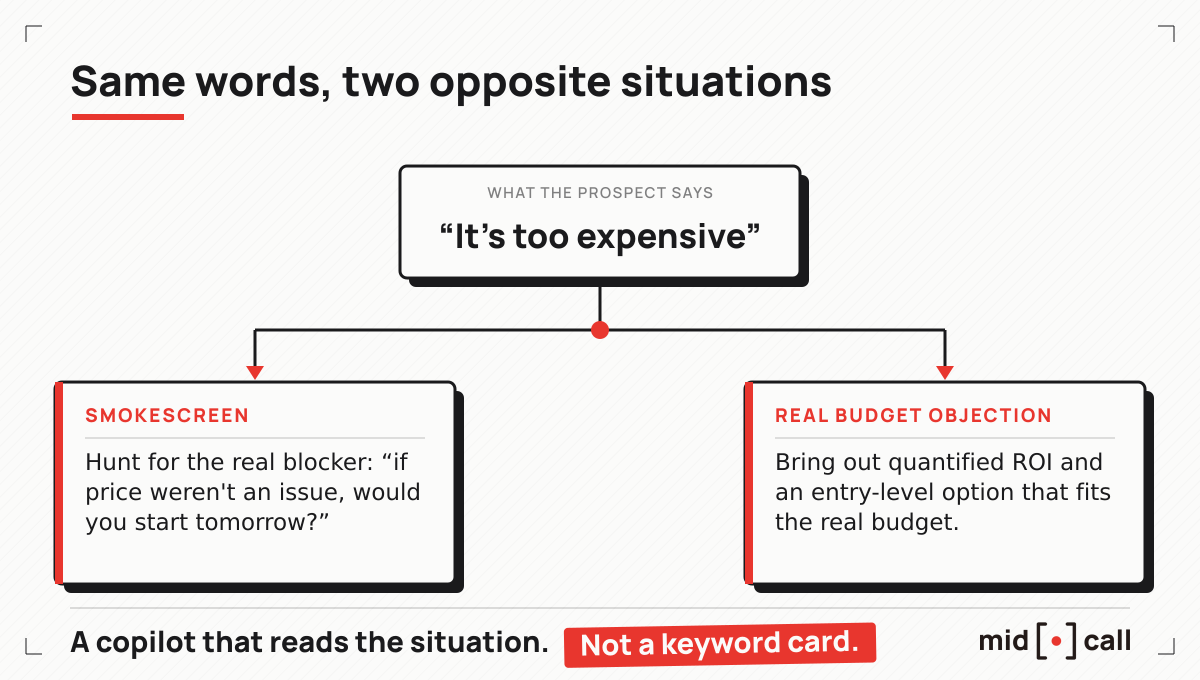
Reading the situation, not just the words. The same phrase hides opposite situations. "It's too expensive" can be a smokescreen, when budget is not the real blocker, or a genuine budget objection. The responses have nothing in common. In the first case you hunt for the real obstacle: "if price were not an issue, would you start tomorrow?" In the second you bring out quantified ROI and an entry-level option. Plenty of tools simply spot a keyword and display a pre-written card: those will make your rep say the wrong thing with total confidence.
Tracking qualification live. Your framework, MEDDIC or otherwise, displays during the call. Your rep sees what still needs securing before hanging up, instead of discovering it that evening in front of the CRM.
Catching buying signals in what is said. Interest, doubt, projection into usage, expressed by the prospect's own words. When they ask "and when could you start?", they are projecting: that is the moment to lock the next step, not to run three more slides.
Debriefing after the call. Call score, recap, and progression call over call, so you see where your rep is actually improving.
What does an AI sales coach change for each role: SDR, AE, AM?
A real-time coach does not coach an SDR the way it coaches an AE: each role has its own critical moments, and the help concentrates there.
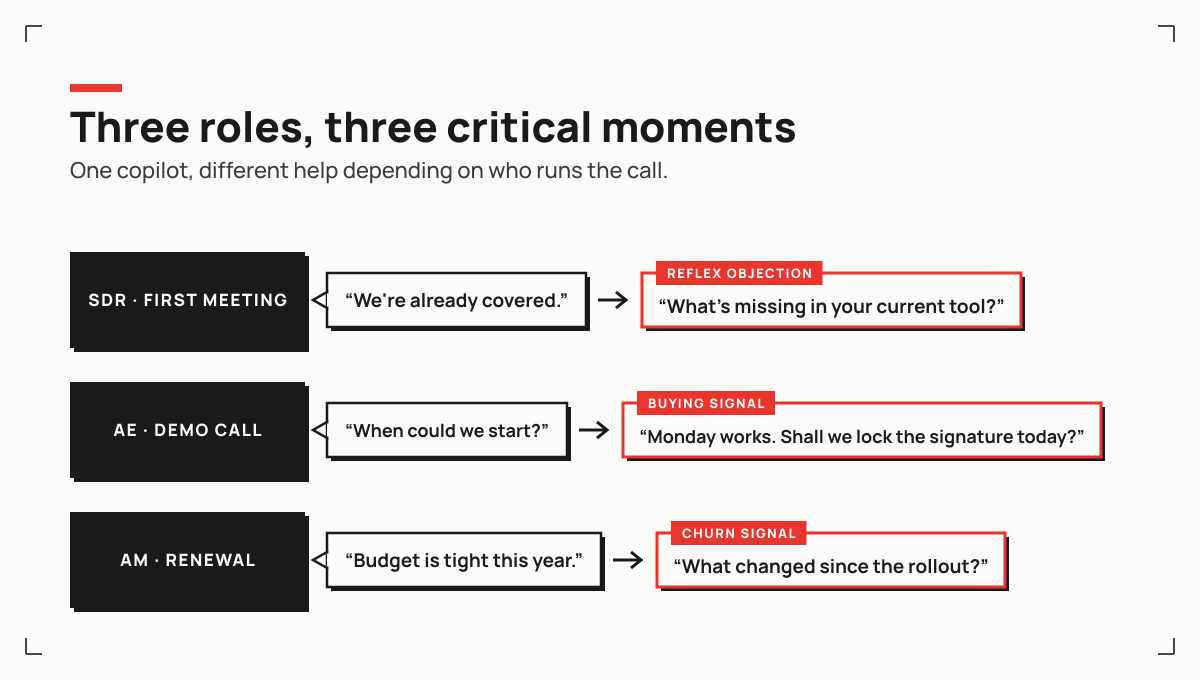
For the SDR. Their first video meetings hinge on reflex objections: "we're already covered," "just send me an email," "I don't have time." The coach prompts the response that keeps the conversation open, then the discovery question that turns the exchange into a qualified meeting for the AE.
For the AE. On discovery, demo and negotiation calls: the qualification grid fills in live, verbal buying signals get caught the moment they pass, and the closing question lands when it has the best odds. In negotiation, the coach helps hold the price line rather than dropping a discount under the pressure of the moment.
For the AM and CSM. On renewals and upsells: a "budget is tight this year" slipped into a sentence is a churn signal, and the coach treats it as one, prompting the questions that surface the real issue while the customer is still there to talk about it.
When should you adopt a real-time coach, and when should you skip it?
Three symptoms make adoption a priority, and one inverse symptom should talk you out of it.
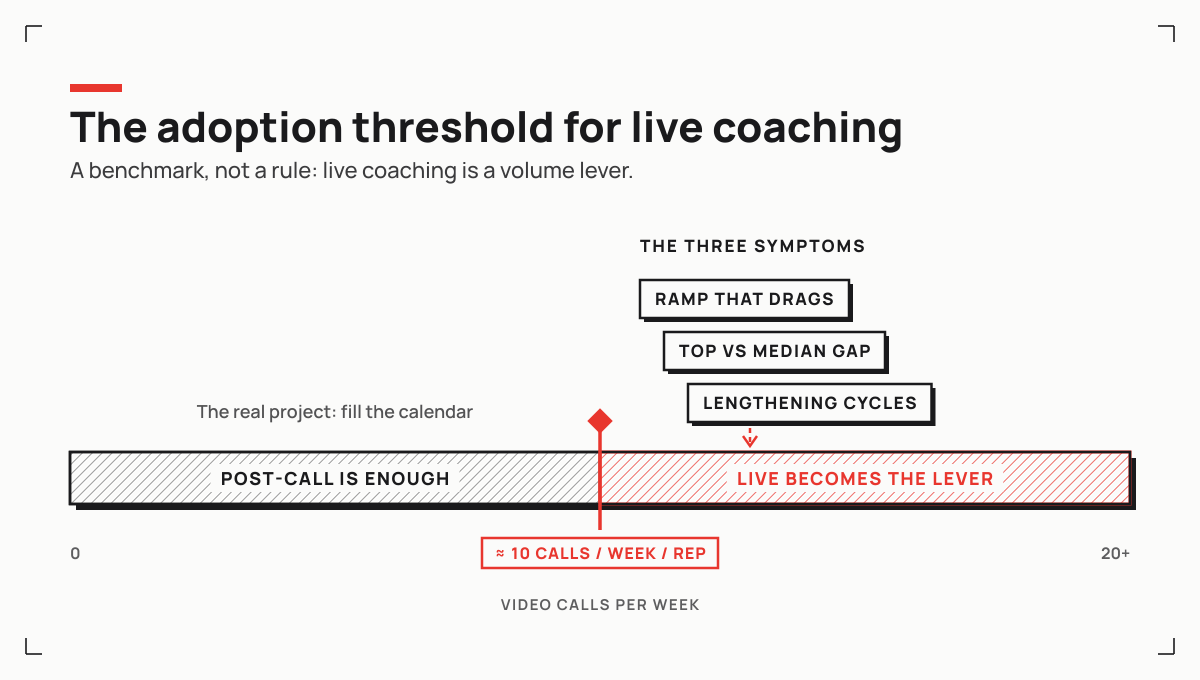
The first symptom is a ramp that drags: your new hires take months to hold a senior-level conversation, and every month of waiting is a month of quota lost. The second is a gap between your top reps and the median that you cannot transfer: call reviews and training have not been enough to replicate the reflexes at the top of the board. The third is a lengthening cycle: you find out too late that a deal had no identified decision-maker and no priced pain, because qualification never held during the calls.
The inverse symptom deserves saying out loud, because it will save you a budget: below roughly ten video calls per week per rep, a post-call coaching tool covers most of the need. Live coaching is a volume lever, and its value multiplies with the number of conversations it steps into. It is a benchmark, not a rule, but if your reps spend their week anywhere other than in meetings, start by filling their calendar.
How to evaluate a real-time AI sales coach in a demo
Four tests that prevent expensive mistakes.
Latency. Time it. Between the objection spoken and the suggestion displayed, anything beyond two seconds is unusable in live conditions.
Discretion. The display must be local to the rep: no extra participant in the meeting, no shared panel. For the prospect, the call is a normal call.
Silence. A tool that displays constantly becomes background noise, or worse, pulls your rep out of the conversation. Midcall shows one line at a time and stays quiet below its confidence threshold: better to say nothing than to say something stupid mid-call. Ask to see what happens when the AI does not know.
Specificity. Ask a technical question unique to your product. If the answer is a piece of generic sales advice, you have your verdict.
Language depth. If your team sells in more than one language, run the demo in each. Plenty of platforms are built in English and localized afterwards, and the gap shows in how precise the suggestions are. Midcall handles English and French with the same depth.
Does the prospect see it? And what about GDPR?
No to the first question: the display is local to the rep, with no additional visible participant and no shared panel.
On data, ask any vendor three questions: what is retained, where is it hosted, and are my conversations used to train a model shared with other customers. Your legal team will ask anyway. At Midcall, use through the extension creates no recording at all, the audio being transcribed on the fly then discarded. In meeting-assistant mode, the recording is captured by our provider and deleted automatically no later than five days after the meeting, with no copy kept by Midcall. Everything is encrypted and hosted in Europe, GDPR compliant. For teams selling into European markets, that last point tends to shorten the security review considerably.
A word on consent: notification and recording obligations vary by country, and by whether you keep a recording at all. Have your counsel validate your configuration rather than trusting a marketing page, including ours.
The objections you will hear inside your own team
They come up every time, and they are legitimate.
"My reps will read instead of listening." This is the genuine risk, and it depends entirely on design. A tool that displays a wall of text turns your rep into a teleprompter reader. A tool that shows one line, rarely, does not break listening. Test this specific point: it decides adoption.
"My senior reps will call it surveillance." Look at who owns the information. A coach whose panel belongs to the rep and which produces no monitoring report does not create that problem. A tool that feeds the manager's reporting first does.
"We already have a call analysis tool." Keep it. These are two different moments, which brings us to the next point.
How much does real-time AI sales coaching cost?
Midcall is quote-based, with two plans, Pro and Max, billed per seat. A pilot cohort is currently open to ten teams, with founding pricing locked for 24 months.
The right way to think about it is not cost per seat, it is break-even. Take your average annual contract value. At $15,000, a single saved deal in the quarter more than covers a team of five equipped reps. Then add ramp: against an average approaching six months, one month gained per new hire is a month of quota recovered, which compares favourably to an annual licence.
So the real question is not price, it is whether you are losing deals mid-call. Your last five losses will answer that for free.
How do you measure the ROI of an AI sales coach?
Measure it A/B, over one quarter: equip part of the team, not the rest, with comparable profiles, and track four metrics.
| The metric | What it should show |
|---|---|
| Time-to-quota for new hires | Ramp shortens: the equipped hire reaches quota faster |
| Win rate on qualified deals | Fewer deals lost for the wrong reasons |
| Average ACV | The price line holds: fewer discounts dropped under call pressure |
| Rep retention | A rep who improves stays; a rep who suffers through their calls leaves |
I will not hand you a universal target to put next to those metrics: it depends on your cycle, your ticket size and your team, and Midcall is too young a product for me to promise you a percentage. That is exactly the point of the protocol: measured A/B on your own calls, the improvement is yours, not a marketing page's.
Should this replace your post-call tool?
No, and this matters for your budget decisions.
The two do not overlap. A post-call platform gives you analysis, forecasting, history and a populated CRM, that is the territory of conversation intelligence platforms, which I break down in the Gong vs Chorus comparison. A real-time coach gives you a better-run conversation while it is happening. Cutting one to fund the other just trades one problem for another.
Priority depends on your situation. If you have nothing and your CRM is empty, start with post-call: automatic logging gives your reps time back immediately. If you already have a post-call tool well embedded and your win rates are flat despite the coaching, the missing piece is real time. For the full picture of every brick and its budget, see our guide to the AI sales stack.
How do you coach sales calls week to week?
Sales call coaching works when each of the three moments of a call has an owner and a routine. Before the call, training and role-play build the reflexes, which is where practice drills and onboarding belong. During the call, the real-time coach reads the conversation and prompts the rep as things happen, the only window where help still changes the outcome of the deal in progress. After the call, review does the long-term work, feeding scoring, peer feedback and the manager's debrief.
The manager holds the loop together. A weekly coaching cadence turns what the tools surface into actual progress, one skill per rep at a time, anchored to real calls rather than theory. Without that cadence, post-call data piles up unused. The coach does not replace this loop, it feeds it, because the moments it flags live are exactly the ones worth reviewing afterwards.
Your next call happens in a few hours
It can be won, or it can become a post-mortem next week. That is the one thing a real-time AI sales coach changes: it moves the help from the moment when it is too late to the moment when it is still winnable. Seen from the enablement side, that is the execution layer most programs have been missing, which our guide to AI sales enablement lays out. And when a deal is lost anyway, win-loss analysis is how you find the real reason.
If you would rather judge from evidence than from a web page, with your reps: I will show you in 20 minutes and you test it on your own calls afterwards.
Edward, co-founder of Midcall and former AE. I built the tool I wish I'd had on my calls: a coach that talks during the call, not after.
The complete sales call coaching playbook
Every piece of sales call coaching has its own guide. Here is the full cluster, in the order a deal moves through them.
 Methods7 min
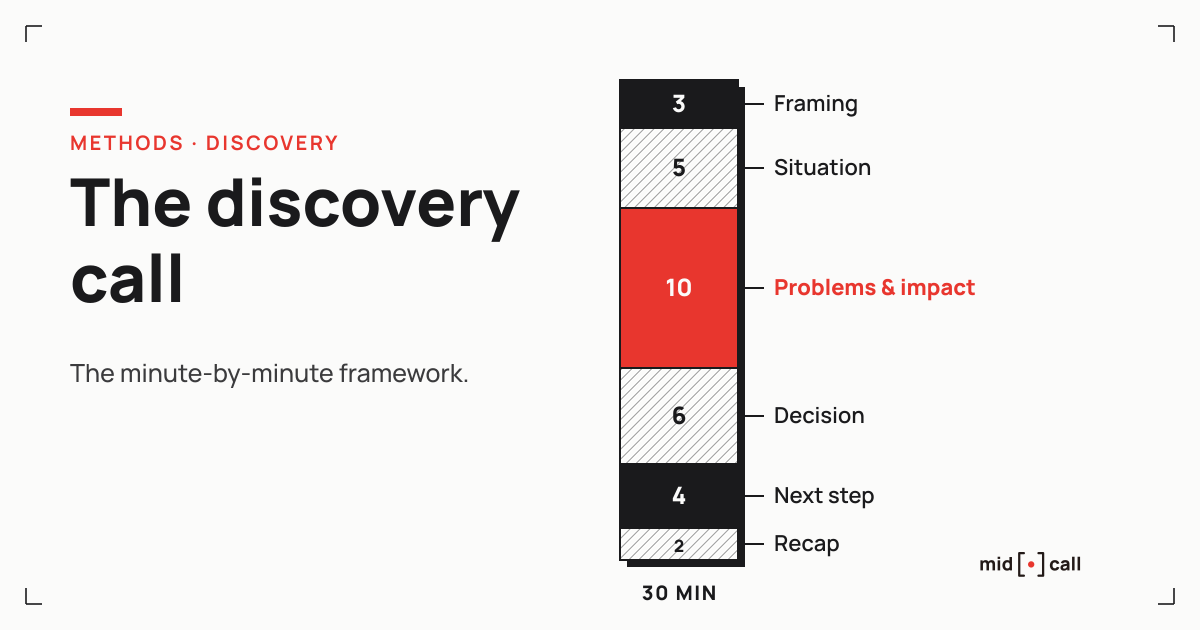
How do you run a great discovery call? Framework, questions and mistakes to avoid
A great discovery call follows a six-block framework over 20 to 30 minutes: the minute-by-minute structure, the questions, the follow-ups and the rookie mistakes.
Read →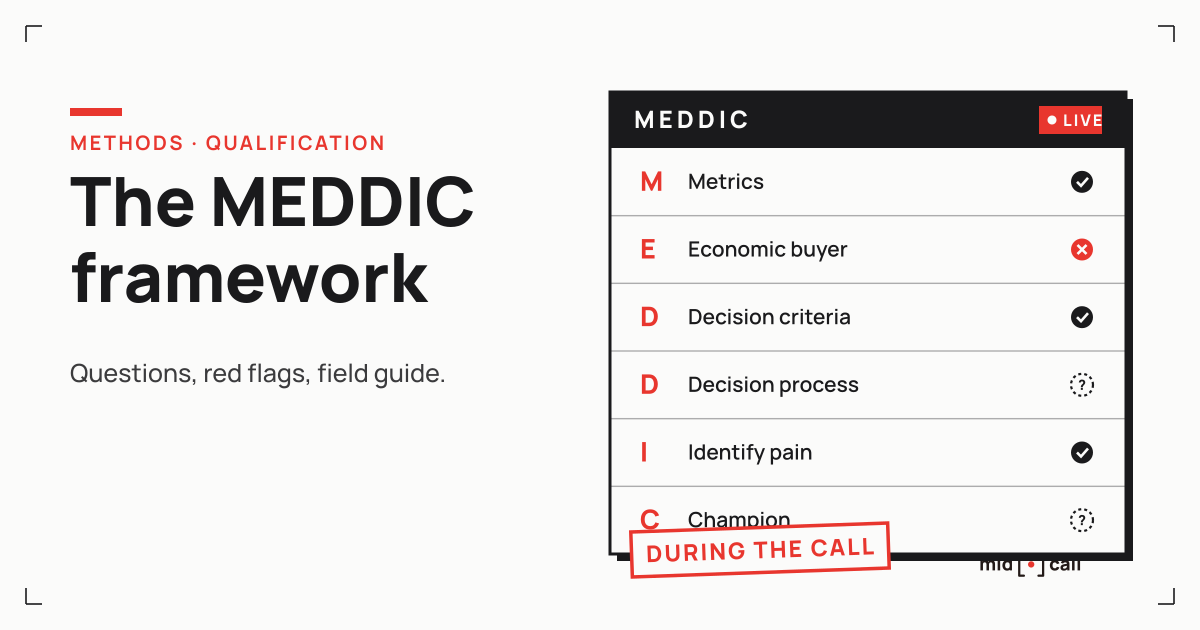 Methods7 min
The MEDDIC framework, and why qualification happens during the call
MEDDIC explained letter by letter: the exact questions to ask on a call, the red flags that expose a fragile deal, and how to roll it out across your team.
Read →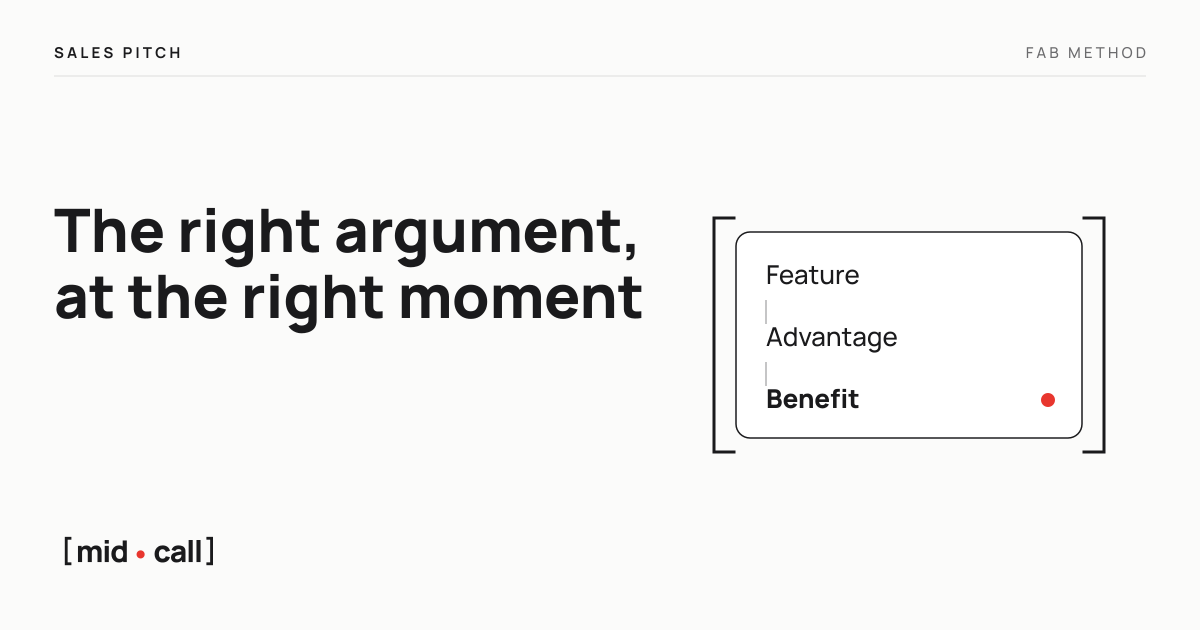 Methods6 min
How do you build an effective sales pitch?
A sales pitch isn't a script you recite, it's a set of arguments you deploy at the right moment. The FAB method, buyer tailoring, and examples.
Read →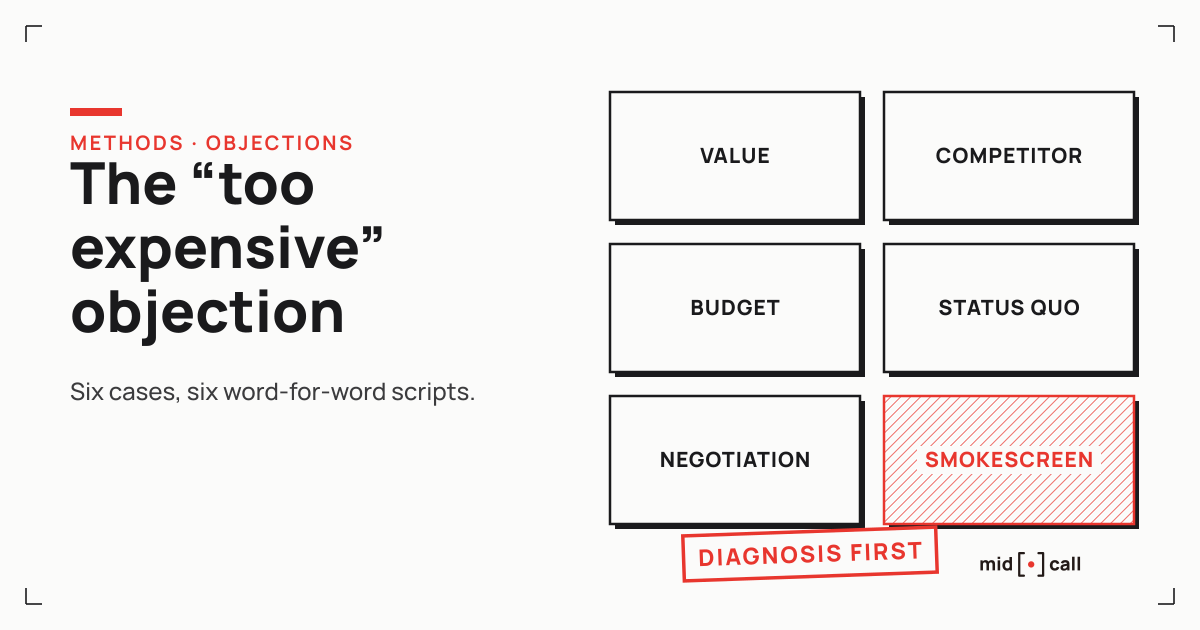 Methods10 min
How do you handle the "too expensive" price objection?
How to handle price objections, with the six cases behind "it's too expensive", the word-for-word scripts, the discount guardrails and the mistakes to avoid.
Read → Methods5 min
How do you respond to "I need to think about it"?
How to respond to the "I need to think about it" objection, with the exact wording to use, the replies to avoid and the read by stage of the buying cycle.
Read →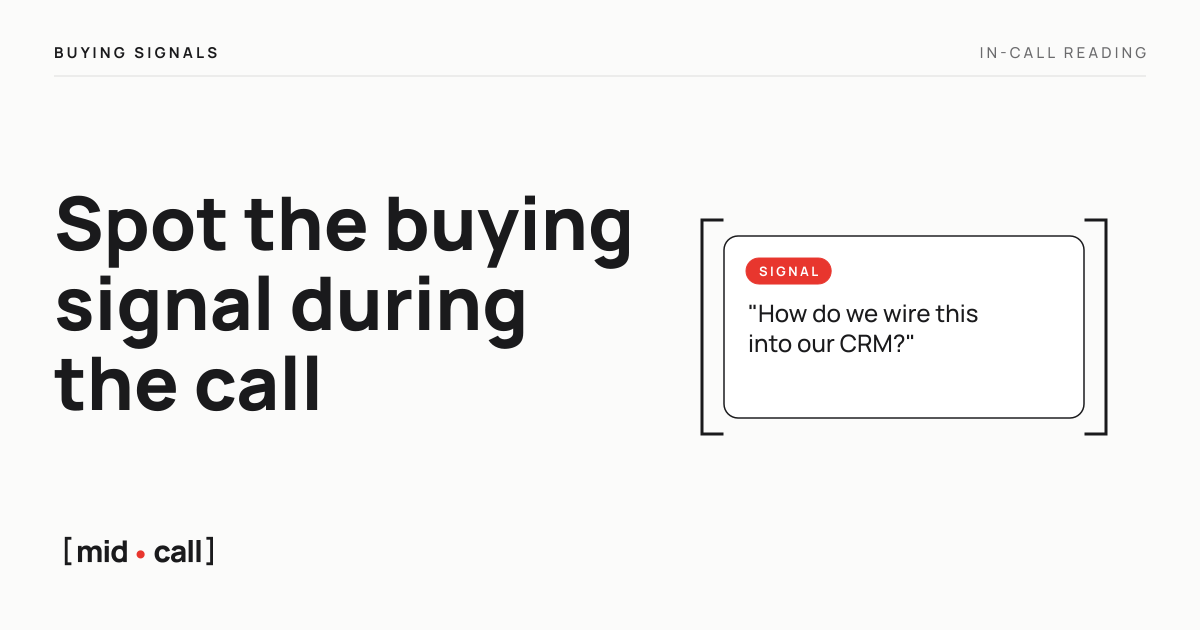 Methods7 min
What are buying signals during a sales call?
A buying signal is a phrase or question that shows your prospect is picturing life with your product. Here's how to spot and act on them live.
Read →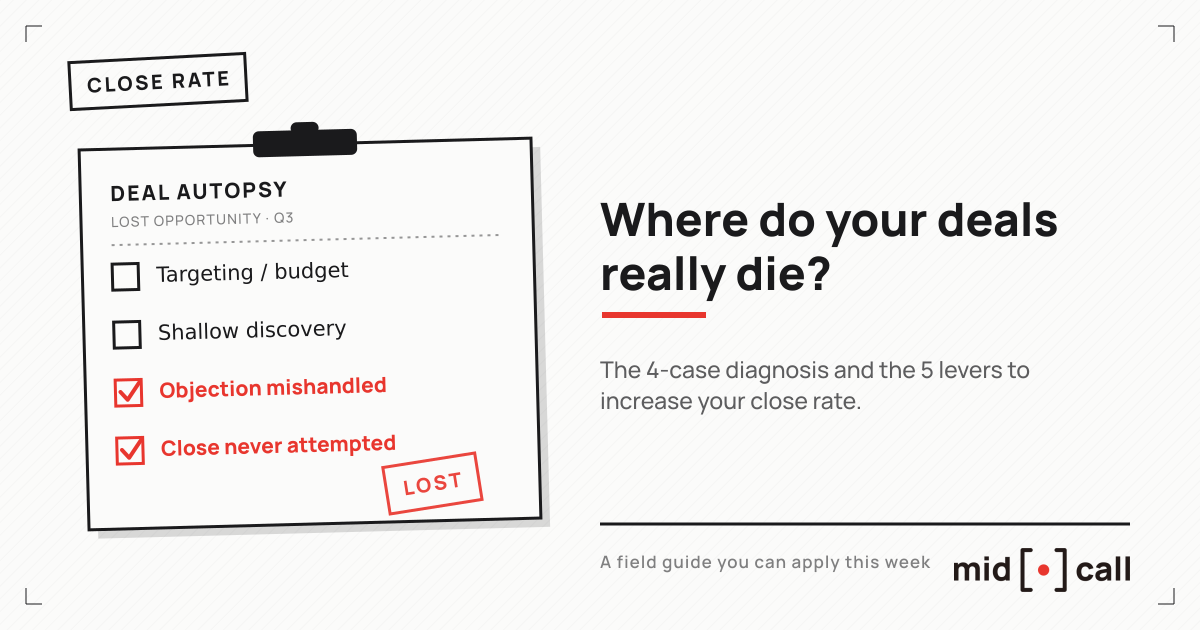 Methods9 min
How to increase your close rate: the levers that actually work in B2B
How to close a deal in B2B, the six-step sequence, the five levers that lift your close rate, and what changes on a deal with several decision-makers.
Read →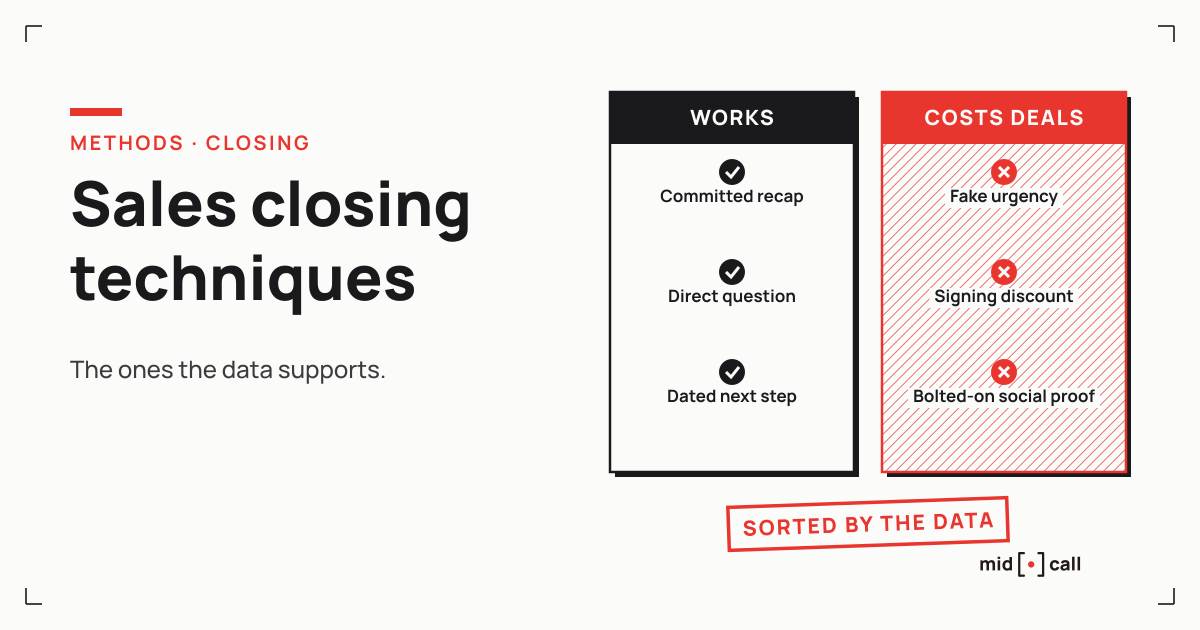 Methods7 min
Which sales closing techniques actually work? Buying signals, scripts and data
Won and lost closing calls look almost identical: the real sales closing techniques live elsewhere. Buying signals, scripts and data to close more deals.
Read →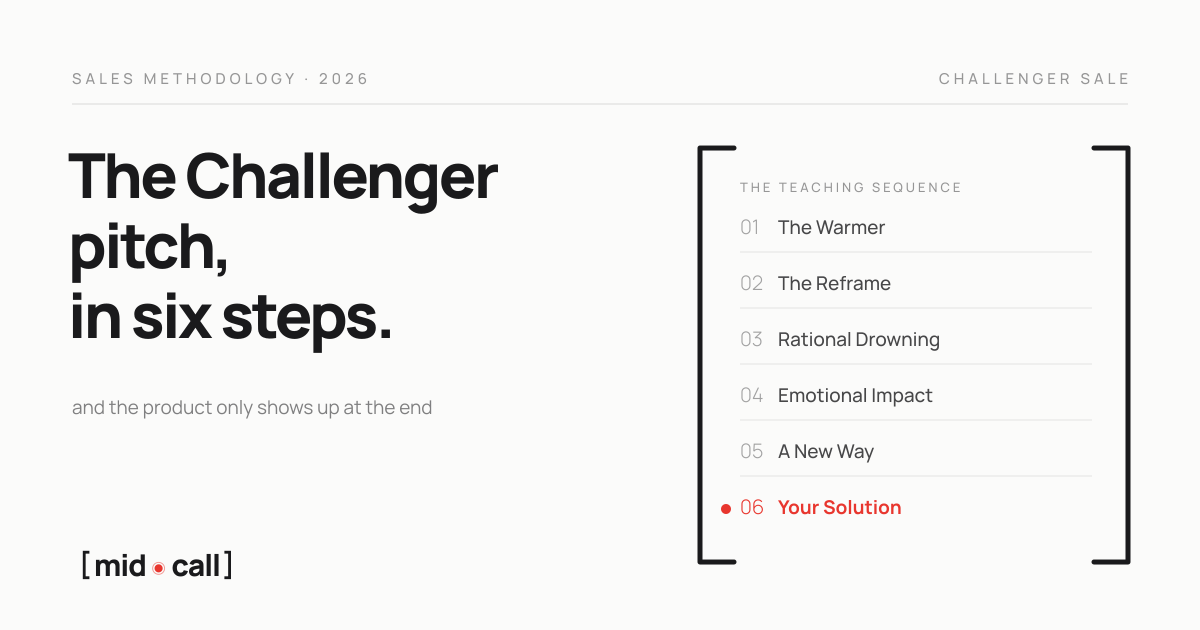 Methods8 min
How do you apply the Challenger sales methodology on real calls?
The Challenger sales methodology made applicable, the four skills, the six-step teaching pitch with a full worked example, and when it works against you.
Read →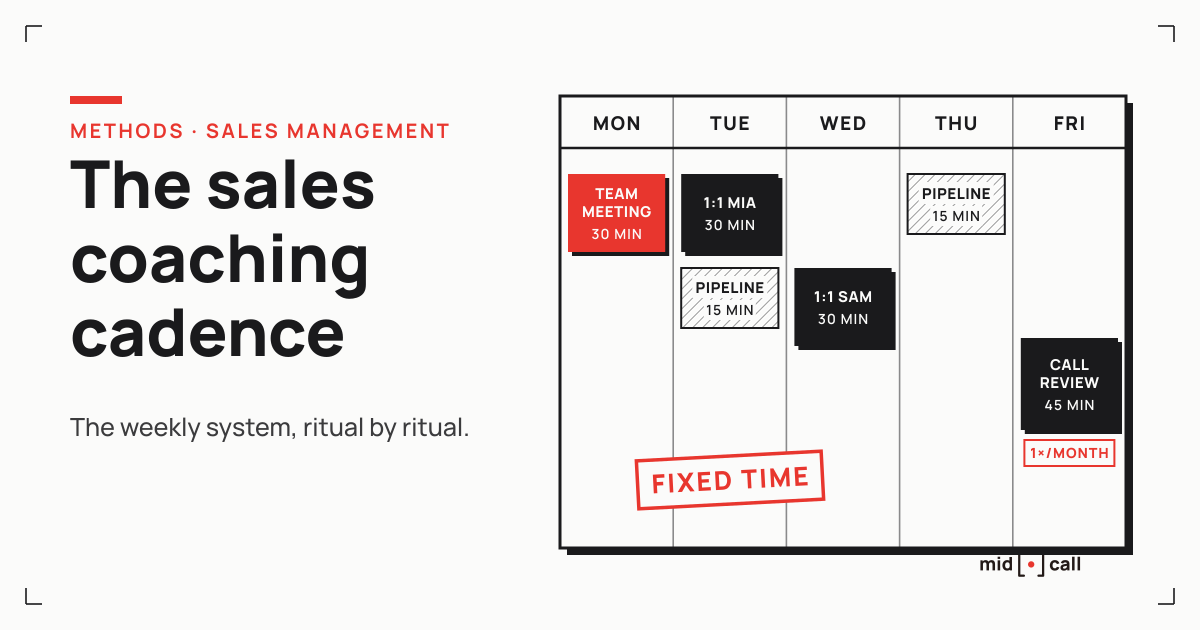 Methods8 min
The sales coaching cadence top sales leaders run every week
The complete sales coaching cadence: weekly 1:1s, a 30-minute team meeting, separate pipeline reviews and monthly call reviews, with minute-by-minute agendas.
Read →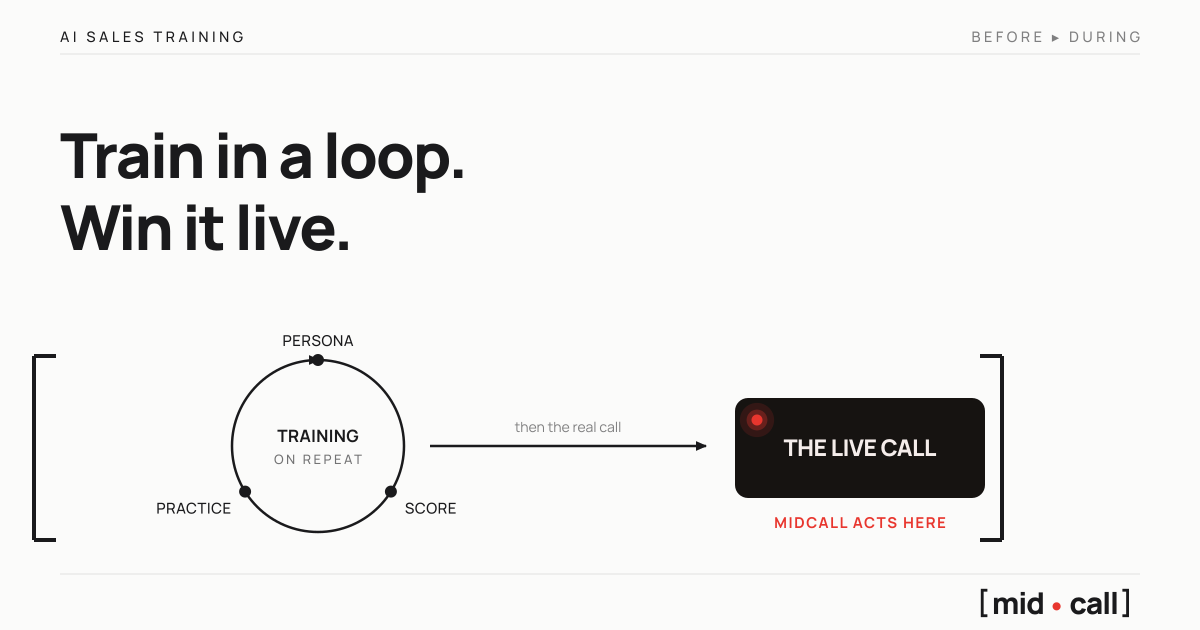 AI & Sales7 min
What is AI sales training, and does it actually make reps better?
AI sales training lets reps practice calls against a simulated buyer, get feedback and ramp faster. What it does, what it doesn't, and how to roll it out.
Read →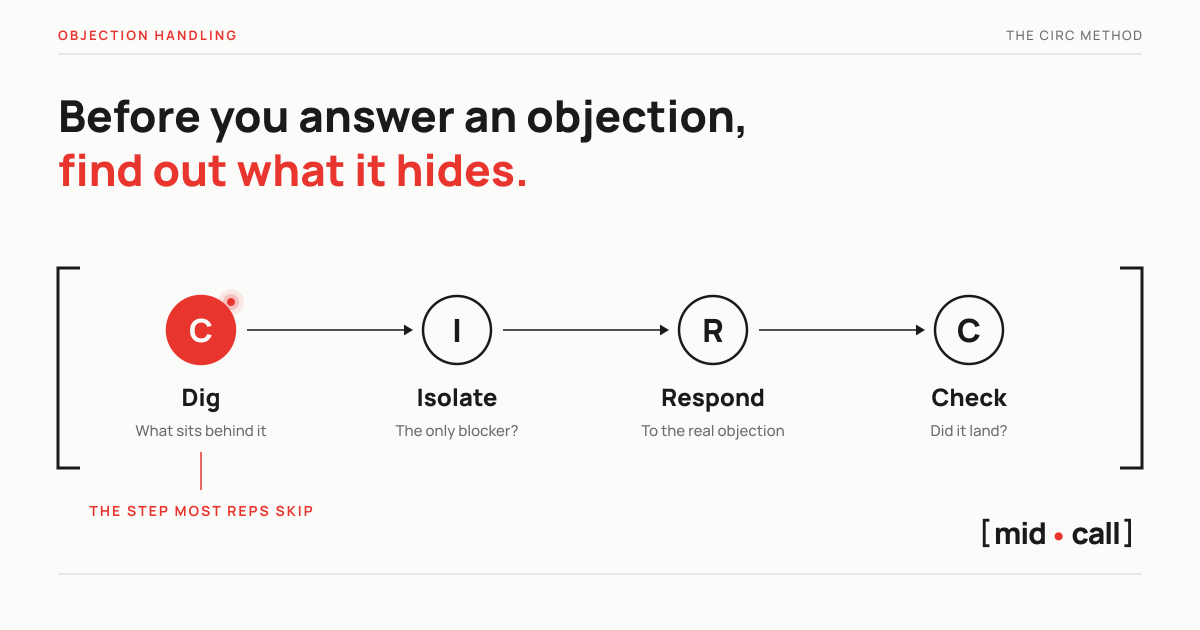 Methods9 min
How do you handle objections in sales, with real examples?
How to handle sales objections with the CIRC method, the 12 most common B2B objections and what to ask first, plus the mistakes that cost you the deal.
Read →
Frequently asked questions
How can AI help a sales rep during a live call?
The coach transcribes the conversation continuously, identifies what is happening (an objection, a technical question, a competitor mention, a buying signal) and displays the right response or action on the rep's screen in under a second. It never speaks to the prospect and does not join the meeting: it prompts the rep, who stays in control.
Can an AI sales coach answer technical questions during a sales call?
Yes, provided it knows your product. A coach connected to your feature catalogue, documentation and integrations surfaces the precise answer to the question asked. That is what removes the "let me come back to you on that" which adds a week to the sales cycle and cools the prospect's momentum.
Does real-time sales coaching work on Teams and Zoom?
It depends on the tool, and it is worth confirming before you sign. Midcall is a browser extension that works on Google Meet, Microsoft Teams and Zoom, with no bot added to the meeting. It coaches with the same depth in English and in French, which matters if your team sells across both markets.
How long does a new sales rep take to ramp, and can AI shorten it?
The Bridge Group's SaaS benchmark puts average AE ramp at 5.3 months, with a median of 6 and longer on larger deals. A real-time coach acts on the part of that delay caused by missing conversational reflexes: the junior immediately has the answers their experienced colleagues took months to internalize. It does not replace market knowledge, which still takes time.
Do calls have to be recorded to use a real-time AI coach?
No, these are two separate things. Live analysis can happen without retaining a recording: through the extension, Midcall transcribes on the fly and creates none. In meeting-assistant mode a recording does exist, but it is captured by our provider and deleted automatically no later than five days after the meeting, with no copy kept by Midcall. Worth checking with every vendor, since many tools keep the audio by default and indefinitely.
What is the difference between a real-time coach and a conversation intelligence platform?
The moment help arrives. Conversation intelligence platforms record and analyze calls once they are over, feeding scoring, manager coaching and forecasting. A coach intervenes during the call, on the deal in progress. The two are complementary: one drives improvement over time, the other helps win today's call.
Does an AI sales coach replace the sales manager?
No. It does what a manager cannot: be present on every call of every rep, simultaneously. The manager keeps long-term skill development, account strategy and the human relationship with the team.
When is a real-time AI coach not the priority?
When call volume does not justify it: below roughly ten video calls per week per rep, a post-call coaching tool covers most of the need, and the real project is filling the calendar with meetings. Live coaching is a volume lever: its value multiplies with the number of conversations it steps into.
What is sales call coaching?
Sales call coaching is the practice of improving how reps handle sales calls. It spans three complementary moments, training before the call with role-play and drills, real-time guidance during the call from a coach the prospect never sees, and post-call review that feeds scoring and manager feedback. Most teams only work the third moment, while the deal in progress is decided in the second.
Can AI coach practice or mock sales calls?
Yes, that is the before-call family of AI coaching, role-play against a simulated prospect, pitch repetition and objection drills. It helps onboarding because a junior can practice without burning real deals. It is a different job from real-time coaching, which assists the rep in front of a real prospect, and from post-call analysis, which reviews the conversation afterwards. Midcall focuses on the during-call moment.
See the live AI coach on one of your calls.
15 minutes. We plug Midcall into a real scenario from your team, you decide.