How do you apply the Challenger sales methodology on real calls?
The Challenger sales methodology means teaching customers something they did not know about their own business, tailoring that message to each stakeholder, taking control of the conversation including on money, and holding constructive tension throughout. Its practical application sits in a six-step teaching sequence whose first five steps never mention your product. Here are the four skills, the sequence in full with a worked example, the mistake that ruins most attempts, and the situations where this method works against you.
What is the Challenger sales methodology?
The Challenger sales methodology is a B2B approach built on the idea that the best sellers win by teaching their customer something new, challenging their assumptions and guiding them through a complex decision. It was formalised by Matthew Dixon and Brent Adamson in The Challenger Sale, from a CEB, now Gartner, study of more than 6,000 reps.
It sits in direct opposition to the classic relationship approach, which builds rapport, answers the stated need and hopes the quality of the relationship carries the decision. The Challenger does the reverse. They arrive with a point of view, they contest how the customer frames their own problem, and they accept the tension that creates.
The approach earns its credibility from a measured finding. The Challenger profile makes up the majority of top performers in complex sales, far ahead of the relationship profile, a gap we break down in our guide to sales rep profiles and their performance.
What is the Challenger methodology built on?
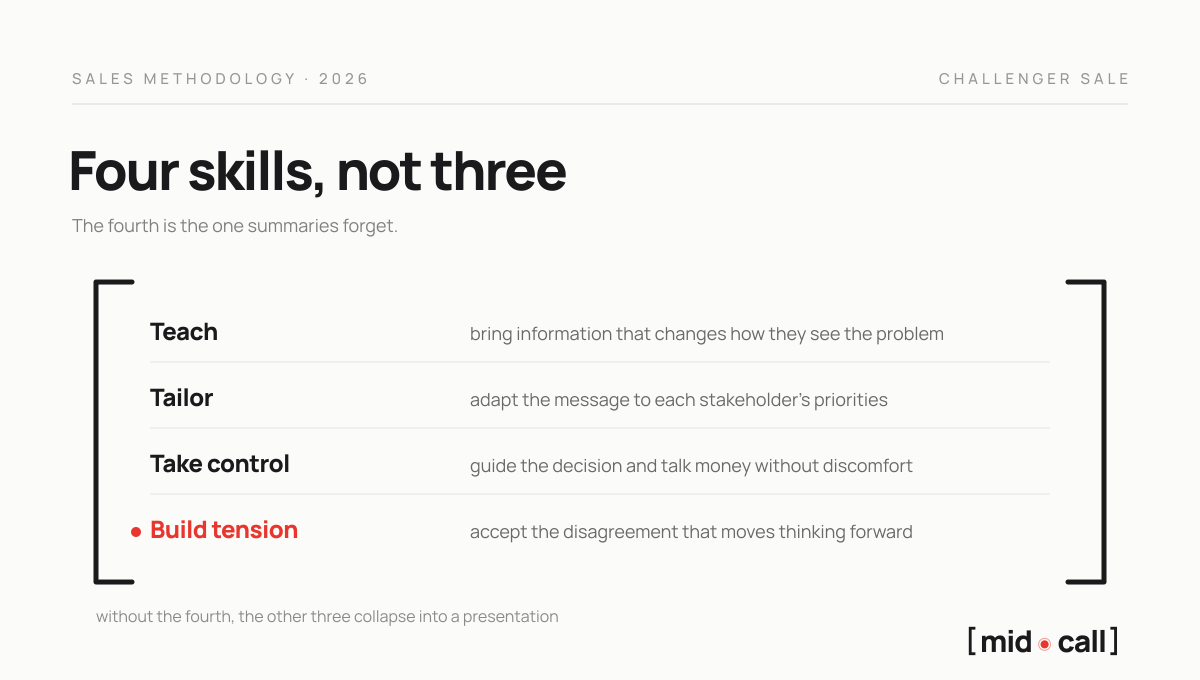
Four skills, not three as most summaries repeat. The official source describes four, and the fourth is what holds the other three together.
Teach. Deliver what the method calls a Commercial Insight, information that changes how the customer understands their own problem. Not information about your product, information about their business, and it has to be surprising and painful.
Tailor. Adapt that message to each stakeholder's priorities. The same insight is not told the same way to a CFO, an operations lead and an end user, because they do not carry the same risk.
Take control. Guide the buying process, talk about money without discomfort, make clear recommendations and push toward a decision rather than waiting for one.
Build constructive tension. This is the skill popular summaries forget, and yet it is what separates a Challenger from a merely well-informed seller. It is not conflict, it is accepting a moment of disagreement because it moves the customer's thinking forward.
How do you build a Challenger pitch in six steps?
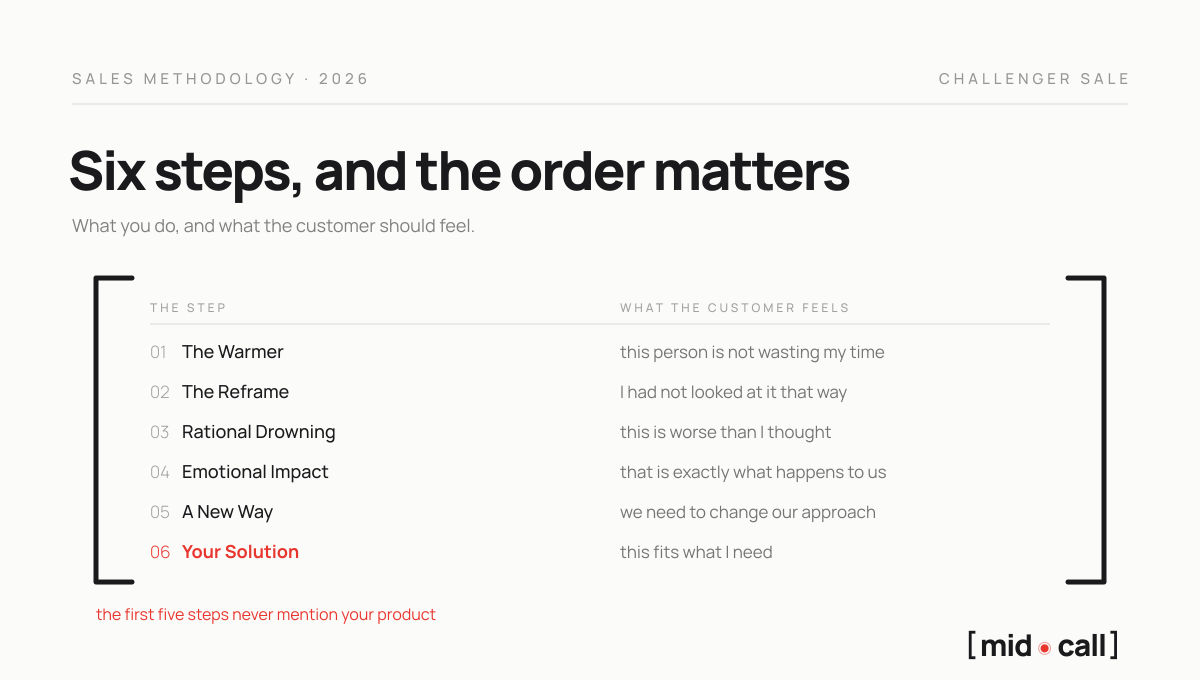
Here is the applicable core of the method, what Challenger calls the commercial teaching sequence. It runs in this order, and the order matters as much as the content, a sequencing also laid out in detail by Gong.
| Step | What you do | What the customer should feel |
|---|---|---|
| 1. The Warmer | You show you know their business and their pressures | This person is not wasting my time |
| 2. The Reframe | You connect their problem to a larger cause they had not seen | I had not looked at it that way |
| 3. Rational Drowning | You quantify what that problem actually costs them | This is worse than I thought |
| 4. Emotional Impact | You tell a story from a company like theirs | That is exactly what happens to us |
| 5. A New Way | You describe what would need to change, without naming your product | We need to change our approach |
| 6. Your Solution | You position your offer as the best way to get there | This fits what I need |
Two points on this sequence deserve detail, because they separate a Challenger pitch from an ordinary presentation.
The Warmer runs on what you know, not on questions
This is the most counterintuitive part of the method, and it contradicts what classic discovery teaches. Where a consultative seller opens with questions, the Challenger opens by stating what they have understood about their counterpart's sector. The official source is explicit, they lead with knowledge rather than with questions, so the customer immediately feels their time is not being wasted.
That does not remove discovery, it moves it. You verify a reading instead of starting from a blank page, which assumes serious preparation before the call.
The first five steps never mention your product
This is the discipline almost everyone breaks, and it is the number one cause of failure. As soon as the insight starts to land, the pull toward a demo becomes strong. Give in, and you turn teaching into a pitch, and the customer snaps straight back into evaluation mode.
Your product appears at step six only, once the customer has concluded on their own that the approach has to change.
A full worked example
Take a vendor selling field service management software to maintenance companies.
The Warmer. "On multi-site maintenance, what comes up most with your peers is the time spent rescheduling jobs cancelled the day before."
The Reframe. "What actually costs money is not the rescheduling. It is that technicians who travel without the right part have to come back a second time. The real issue is not scheduling, it is preparation."
Rational Drowning. "On a fleet like yours, a second visit costs twice a first one once travel is counted. At three jobs a week, that is an annual budget most management teams have never isolated."
Emotional Impact. "What follows is always the same. Technicians start carrying parts just in case, stock balloons, and finance tightens budgets exactly when the field needs them most."
A New Way. "The teams that get out of this changed one thing. They qualify the fault before dispatching the technician, instead of on site. That means capturing the information during the customer call."
Your Solution. "That is precisely what we do, and here is how."
The figures in this example are illustrative, they exist to show the mechanics. In a real pitch they come from your own customer data. Notice above all that the product appears only in the last line, and that by then the customer has already accepted that something has to change.
What ruins a Challenger pitch?
Challenging with nothing behind it. This is the most frequent and most expensive failure, because it damages the relationship without delivering anything.
A reframe is only worth something if it is true, specific and evidenced. Contest an executive's view of their own business with a generality you could have told anyone, and you do not come across as an expert, you come across as someone reciting. The tension turns destructive, and the prospect shuts down.
The test is simple. Does your insight survive the question "where does that come from". If the answer is a vague "we see it a lot", it is not ready. A good reframe rests on what you observe across comparable companies, on numbers you can name, or on a mechanism the customer can verify themselves.
When should you not use the Challenger methodology?
On transactional sales, and it is a nuance the guides almost always skip.
The original study data shows the Challenger profile dominating in complex sales but losing its edge on short high-volume cycles, where the Hard Worker profile produces the most top performers, a flip we quantify in our guide to sales rep profiles. The reason is logical. Building a Commercial Insight takes preparation, and that preparation only pays back on deals with enough value.
Three situations where the method costs more than it returns.
| The situation | Why Challenger fails | What works better |
|---|---|---|
| Very short cycle, need already defined | The customer wants an answer, not a rethink | Answer fast and well, then lock the next step |
| Stakeholder with no decision latitude | Tension produces nothing but discomfort | Push for access to the real decision-maker |
| Contract renewal | Contesting an existing customer's view carries disproportionate risk | Consolidate the value already delivered |
On complex cycles, by contrast, the method combines well with a qualification framework. Challenger tells you how to run the conversation, a framework like MEDDIC tells you what you must have verified before moving forward. They do not compete, they operate at different levels.
| The method | What it solves | When it helps most |
|---|---|---|
| Challenger | How to run the conversation and create the need to change | The customer already thinks they know what they need |
| SPIN | How to get the customer to articulate the problem themselves | The customer has not yet measured what the problem costs |
| MEDDIC | What you must have verified before advancing | Long cycle, several decision-makers, formal buying process |
How does Midcall help you execute the Challenger methodology?
The Challenger methodology is easy to understand and hard to execute. Between the moment your rep knows the sequence and the moment they hold it under pressure, twenty minutes into a call, there is a gap that training alone does not close.
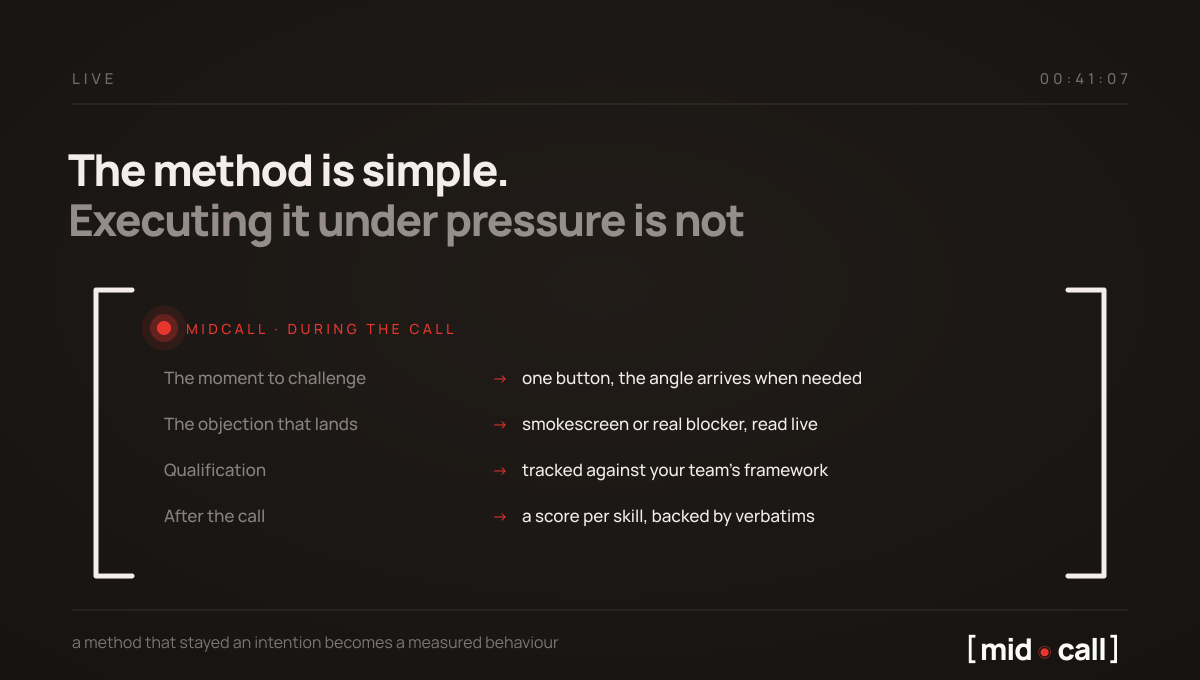
Midcall coaches during the call, inside the Google Meet, Teams or Zoom window, and tracks qualification against the framework your team runs, Challenger included, alongside SPIN, SPICED, BANT, MEDDIC and MEDDPIC. In practice the help lands where the method breaks most often, at the moment of tension. A challenger button lets the rep call up the angle at the exact moment they need it, rather than waiting for a prompt to surface on its own, alongside the objection and closing buttons. And when a price objection lands, the tool reads the situation live and tells a smokescreen from a real objection, instead of letting the rep concede to protect the relationship.
After the call, the summary scores every call out of 100 by skill, framing, discovery, selling the value, objection handling and closing, with each score backed by the exact sentences spoken and paired with what it would have taken to reach 100. For a sales leader rolling out Challenger, that finally answers the question training leaves open, are my reps actually applying it on calls, and which one drops off at which step. You then coach on evidence rather than impression, and you watch the method take hold rep by rep.
Midcall is a young product and I will not promise you an improvement percentage we do not yet measure. What the mechanics deliver is concrete. A method that stayed an intention becomes a measured behaviour, call after call.
How do you roll the method out across a team?
Not with a one-day training. Three conditions come up in the teams that succeed.
The first is the material. Without a documented Commercial Insight, written down, quantified and shared, every rep improvises their own reframe and the method dilutes. That is collective work, not individual, and it comes before training.
The second is sequencing. You do not deploy the four skills at once. Teaching first, because it conditions everything else, tailoring next, taking control last, because it demands the most confidence.
The third is measurement. A method nobody measures fades within six weeks. Decide what you observe in calls, a reframe delivered, a cost of the problem quantified, an explicit decision request, and track it as an execution indicator rather than as a training box ticked.
Edward, co-founder of Midcall. Former AE, co-founder of Meteor, a B2B prospecting agency. I write about what actually happens on sales calls, and what the best teams do with it.
Frequently asked questions
What is the Challenger sales methodology?
A B2B sales approach formalised by Matthew Dixon and Brent Adamson, holding that the best sellers win by teaching customers something they did not know about their own business rather than by building a relationship. It rests on four skills, teaching, tailoring the message per stakeholder, taking control of the conversation, and building constructive tension.
What are the steps of a Challenger pitch?
Six steps in a set order. The Warmer, where you show you know the customer's business. The Reframe, where you connect their problem to a larger cause. Rational Drowning, where you quantify what it costs them. Emotional Impact, where you tell a story from a comparable company. A New Way, where you describe what would have to change. And finally Your Solution, the only step where your product appears.
What is the difference between Challenger and SPIN selling?
SPIN leads the customer to realisation through successive questions, situation, problem, implication, need-payoff. Challenger delivers a point of view the customer did not have, without waiting for them to articulate it. The first makes them discover, the second teaches them. SPIN fits when the customer has not yet measured their problem, Challenger when they already think they know what they need.
Does the Challenger methodology work for every type of sale?
No. It dominates in complex sales, with a long cycle, several stakeholders and a high ticket, because preparing a Commercial Insight pays back there. On short high-volume cycles it loses its edge to plain cadence, and it can actively hurt with a stakeholder who has no decision latitude, or on a contract renewal.
How do you find a good Commercial Insight?
By starting from what you observe across your customers and your prospects do not yet know. A good insight connects a visible symptom to a cause the customer has not identified, it is specific to their sector, and it survives the question "where does that come from". It gets built as a team from your call summaries and your lost-deal reviews, not individually the night before a meeting.
Can a rep be trained to become a Challenger?
Yes, because the method describes behaviours rather than a personality trait. The difficulty is not the theory, which takes a day, but execution under pressure on a live call. That is why the rollouts that stick are the ones measuring execution inside calls instead of stopping at training.
See the live AI coach on one of your calls.
15 minutes. We plug Midcall into a real scenario from your team, you decide.