What are the different types of sales reps, and which one performs?
There are five selling profiles identified by research, the Hard Worker, the Challenger, the Relationship Builder, the Lone Wolf and the Problem Solver, not to be confused with the roles on a sales team, SDR, AE, AM or CSM, which describe a job rather than a way of selling. Among top performers, 39% are Challengers against 7% Relationship Builders. Here is what each profile actually does on a call, its strengths, its weaknesses, and above all which one performs given the type of sale you run, because the answer flips entirely.
Role or selling profile, what is the difference?
Most articles on this subject blend two unrelated things, and that is the first source of confusion.
The role is the job held in the organisation. An SDR opens conversations, an AE turns them into contracts, an AM grows existing accounts. A role is written on a job description and changes with a promotion.
The selling profile is the natural way someone runs a sales conversation. Two AEs in the same job, on the same market, with the same leads, do not sell the same way. One debates and pushes, the other protects the relationship and avoids tension. That difference is what the research measured, and it explains the performance gaps.
So a rep has both, a role and a profile. You hire on the role, you perform on the profile.
What are the roles on a sales team?
Five main jobs structure a B2B team, each with its mission and its metric.
| The role | Its mission | What it is measured on |
|---|---|---|
| SDR or BDR | Open conversations, qualify inbound or prospect cold | Qualified meetings handed to AEs |
| AE, account executive | Run the sales cycle through to signature | Closed revenue and win rate |
| AM, account manager | Grow and renew existing accounts | Expansion and retention |
| KAM, key account manager | Run strategic, usually multi-stakeholder accounts | Growth of major accounts |
| CSM, customer success manager | Make the customer successful after the sale | Adoption, satisfaction and renewal |
These roles combine differently by team size. In a startup one person often carries SDR and AE at once, and the founder carries both until the first sales hire. In an established organisation, specialisation becomes the norm.
With that settled, here is what actually decides performance.
What are the five sales rep profiles?
They come from a study that became the reference in the field. Matthew Dixon and Brent Adamson, for CEB now part of Gartner, analysed more than 6,000 reps across 90 companies on 44 behavioural attributes. The results produced five distinct profiles, each defined by a cluster of dominant behaviours rather than by a personality trait.
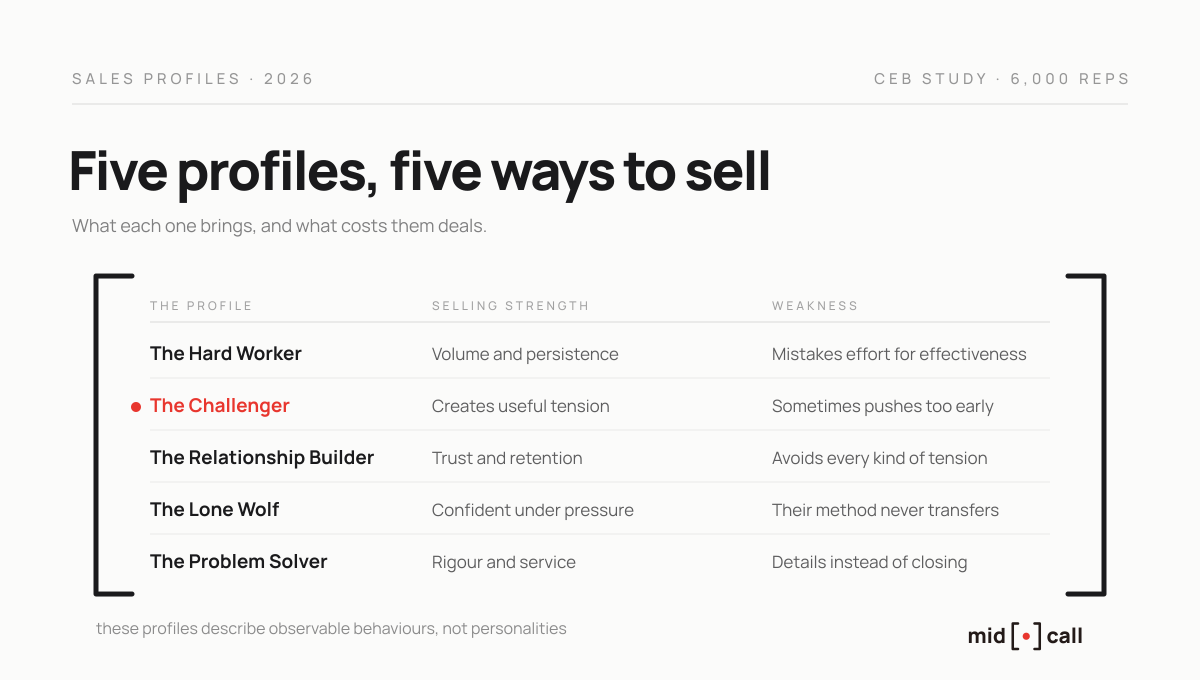
The Hard Worker
They always do more. More calls, more follow-ups, more hours. They do not get discouraged by a refusal, they ask for feedback and they apply it.
Their selling strength is volume and persistence. They keep the pipeline active and they follow up where others give up, which matters since many deals close after several touches.
Their weakness is mistaking effort for effectiveness. They multiply interactions without always learning from them, and they sometimes apply methods they have never questioned.
The Challenger
They know their customer's business and they are not afraid to contradict them. They bring a point of view, reframe how the prospect sees their problem, and take control of the conversation, money included.
Their selling strength is creating constructive tension. They do not just answer the stated need, they surface one the prospect had not articulated, which pulls them out of price comparison.
Their weakness is calibration. Pushed too early, before they have the substance on the customer's context, the challenge reads as arrogance and the prospect closes up.
The Relationship Builder
They build rapport, they are available, they help. This is the classic consultative profile, the one most managers describe when asked to picture a good salesperson.
Their selling strength is trust and retention. They create a climate where customers come back and refer, and they navigate relationship-driven organisations well.
Their weakness is that they avoid tension. They will not hold the price line, contradict a mistaken stakeholder, or ask for the decision. This is the profile that performs worst in complex sales, by a wide margin.
The Lone Wolf
They follow their instincts, ignore the playbook, skip the CRM and skip training. They hit their numbers, so their way of working is tolerated.
Their selling strength is confidence and the ability to hold tense situations. They decide fast and they do not need carrying.
Their weakness is that they are neither transferable nor manageable. Their method never gets documented, so it never replicates across the team, and their manager runs blind.
The Problem Solver
They are reliable and detail-oriented. They answer everything, make sure every point is handled, and stay heavily involved after the sale.
Their selling strength is rigour and service. The customers they own are well looked after and details do not slip.
Their weakness is retreating into detail instead of closing. They spend so much time fixing existing problems that they stop generating new business.
Which type of sales rep performs best?
The Challenger, but not in every case, and that is the nuance almost nobody writes.
The study compared how the profiles are distributed across the general rep population with how they are distributed among top performers, defined as the top 20% of a sales force measured against goal. The result is blunt. The protocol is documented by Challenger, which notes that core performers spread across all five categories while stars concentrate in one.
| The profile | Share of the population | Share of top performers |
|---|---|---|
| The Challenger | 27% | 39% |
| The Lone Wolf | 18% | 25% |
| The Hard Worker | 21% | 17% |
| The Problem Solver | 14% | 12% |
| The Relationship Builder | 21% | 7% |
Two things jump out. First, profiles are spread almost evenly among average performers, so there are five ways to be average and one dominant way to be excellent. Second, the Relationship Builder, one rep in five and the profile everyone describes as ideal, supplies only 7% of the best.
Which profile for which type of sale?
Here is the data that summaries of the study systematically leave out, and it changes the conclusion.
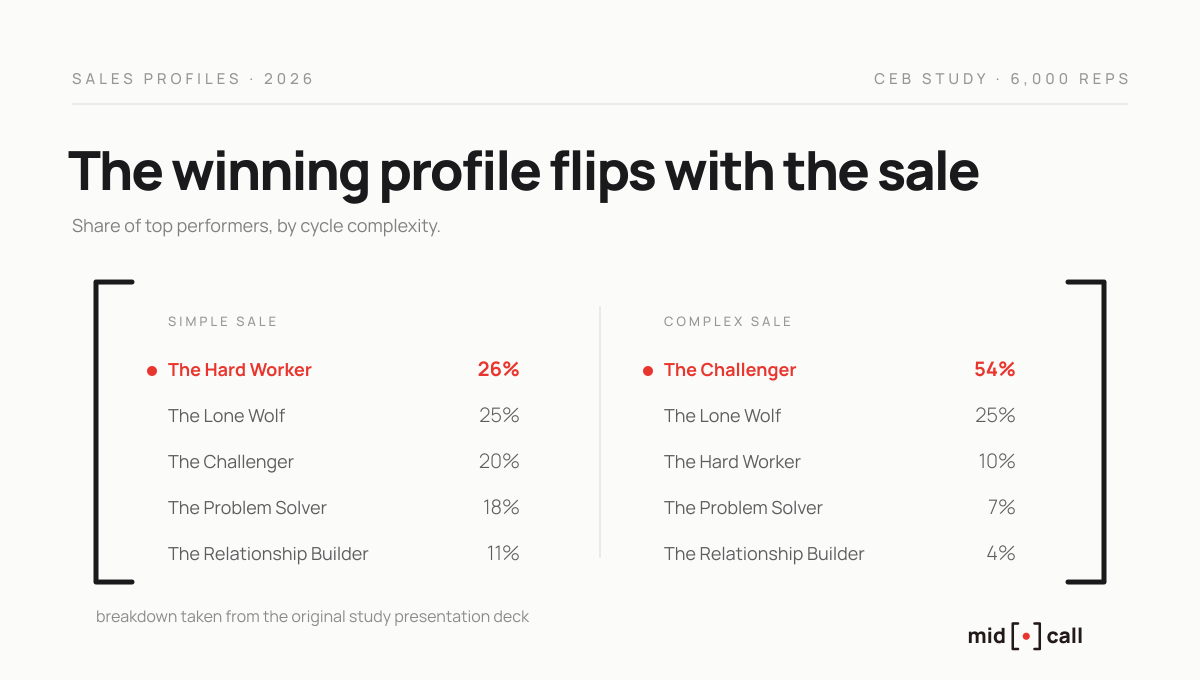
The researchers separated simple sales from complex ones, and the gap is striking. The breakdown below comes from the original study deck published by CEB, not from a secondary summary, which is why it rarely appears online.
| The profile | Top performers, simple sale | Top performers, complex sale |
|---|---|---|
| The Challenger | 20% | 54% |
| The Lone Wolf | 25% | 25% |
| The Hard Worker | 26% | 10% |
| The Problem Solver | 18% | 7% |
| The Relationship Builder | 11% | 4% |
In complex sales, long cycle, several stakeholders, high ticket, the Challenger dominates with 54% of the best. But in transactional sales, short cycle and high volume, they drop to 20% and the Hard Worker takes the lead at 26%.
In other words, the universal advice to hire Challengers is wrong. On a high-volume motion, persistence and cadence produce more than strategic debate. On a complex cycle, the reverse. Before choosing a profile, look at your average deal size, your cycle length and how many people take part in the decision.
Are these profiles fixed?
No, and that is the most useful point for a sales leader. The study looks at observable behaviours, not personality traits. The researchers say so explicitly, they measured clusters of skills and attitudes in selling situations rather than psychological types.
Behaviour can be worked on. A Relationship Builder can learn to ask for the decision. A Hard Worker can learn to prepare a point of view instead of adding calls. A Lone Wolf can be equipped so their method becomes transferable without forcing a process they will reject.
The real obstacle is not the capacity to change, it is measurement. As long as you judge your reps' profiles by ear, on the handful of calls you happened to hear, you coach on impression and you aim at the wrong target. That is the subject of our guide to sales performance management.
How does Midcall help each profile close more?
This is where live coaching earns its keep, because it does not do the same thing for every rep.
Midcall coaches during the call, inside the Google Meet, Teams or Zoom window, and the summary then scores every call out of 100 by skill, framing, discovery, selling the value, objection handling and closing. Since the five profiles do not share the same weaknesses, the support they get is not the same either.
| The profile | What costs them deals | What Midcall gives them |
|---|---|---|
| The Hard Worker | They run call after call without learning from them | A scored summary after every call, turning volume into measured progress |
| The Challenger | They push before they have the substance on context | Live qualification tracking, showing what is still missing before challenging |
| The Relationship Builder | They neither hold the price line nor ask for the decision | The prompt surfaced at the objection, and a closing score that makes avoidance visible |
| The Lone Wolf | They document nothing, so their method never transfers | Summary and next steps flow into the CRM on their own, with no data entry |
| The Problem Solver | They get lost in detail and forget to close | The reminder to lock a dated next step before hanging up |
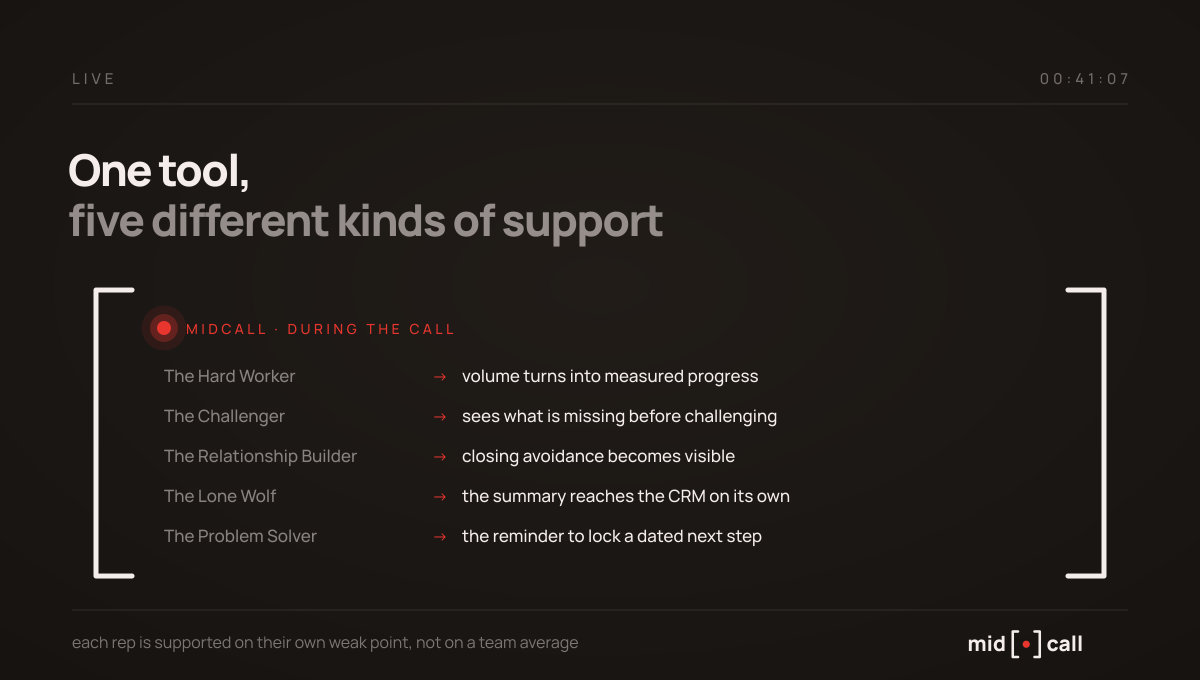
The guidance sharpens call after call as it adapts to each person's style, and it tracks the framework your team actually runs, SPIN, SPICED, BANT, MEDDIC, MEDDPIC or Challenger. For a sales leader the benefit sits elsewhere but it is substantial. You finally see, rep by rep and on evidence, which skills carry them and which cost deals, which replaces hours of listening back with an objective diagnosis. You know what to push on with each person, instead of giving the same advice to five different profiles.
Midcall is a young product and I will not promise you an improvement percentage we do not yet measure. What the mechanics guarantee is simpler. Each rep is supported on their own weak point, and you watch them improve on it.
How do you identify your reps' profiles?
Not with a personality questionnaire, but by watching their calls. Three questions are enough to place someone.
Do they bring a point of view the prospect did not have, or do they only answer the questions asked? Do they hold their line when price is challenged, or do they concede to protect the relationship? Do they end calls with a dated next step, or with "I'll get back to you"?
The answers map a profile far better than a test, because they cover real behaviour rather than self-image. And they tell you immediately what to coach, which connects to our levers to increase your close rate.
Edward, co-founder of Midcall. Former AE, co-founder of Meteor, a B2B prospecting agency. I write about what actually happens on sales calls, and what the best teams do with it.
Frequently asked questions
What are the different types of sales reps?
Two classifications coexist. By role, you have the SDR or BDR who opens conversations, the AE who runs the cycle to signature, the AM and KAM who grow existing accounts, and the CSM who drives customer success. By selling profile, research identifies five types, the Hard Worker, the Challenger, the Relationship Builder, the Lone Wolf and the Problem Solver.
Which type of sales rep performs best?
The Challenger, at 39% of top performers against 27% of the general population. But the answer depends on the type of sale. In complex sales they rise to 54% of top performers. In transactional sales they fall back to 20% and the Hard Worker takes the lead at 26%, because cadence then matters more than strategic debate.
Why does the Relationship Builder perform poorly?
Because they avoid tension, and complex sales demand it. They do not hold the price line, they do not contradict a mistaken stakeholder, and they rarely ask for the decision, for fear of damaging the relationship. They supply only 7% of top performers, and just 4% in complex sales, while making up roughly one rep in five.
What is the difference between an SDR and an AE?
The SDR opens conversations, through outbound prospecting or by qualifying inbound demand, and hands over qualified meetings. The AE takes over and runs the sales cycle through to signature. The first is measured on the number and quality of meetings generated, the second on closed revenue and win rate.
Can a rep change selling profile?
Yes, because these profiles describe behaviours rather than personalities. The researchers measured skills and attitudes in selling situations, not psychological types. The difficulty is not the capacity to change, it is knowing precisely which behaviours actually show up in calls, which requires objective measurement rather than impression.
Which profile should a startup hire?
It depends on your motion. On a complex cycle with several stakeholders, look for Challenger behaviours, the ability to bring a point of view and to discuss money without discomfort. On a high-volume transactional sale, the Hard Worker's persistence produces more. For a very first hire, the profile question comes after the timing question, which is settled on evidence rather than on running out of hours.
See the live AI coach on one of your calls.
15 minutes. We plug Midcall into a real scenario from your team, you decide.