How to increase your close rate: the levers that actually work in B2B
Your pipeline is full, your demos go well, and the signatures still lag. Before blaming the market or your pricing, look at where your deals actually die.
Your close rate, also called win rate, measures the share of qualified opportunities that become signed customers. Benchmarks put the B2B average around 21% of all opportunities and 29% of qualified ones. To move it, five levers work: disqualify earlier, dig discovery down to the cost of the problem, handle objections the moment they land, ask for the decision explicitly, and lock a dated next step before hanging up.
Everything else, pitch included, weighs far less than most teams believe.
This guide is an action plan, not a lecture. Every lever ends with something to do this week.
What is a good close rate in B2B?
The most recent benchmark data puts the average B2B win rate at 21% across all opportunities and 29% on qualified-only opportunities, and the rate drops as deal size grows: roughly 25 to 35% under $50K ACV, and 12 to 22% above $250K, according to the same study. Treat these as third-party reference points: your right number depends on your ticket, your cycle and your definition of an opportunity.
Which is the first trap: a close rate means nothing if the denominator is fuzzy. Calculate it on qualified opportunities (a confirmed need, a plausible budget, an identified decision-maker), not on every lead that entered the pipeline. Otherwise you are measuring your prospecting, not your closing.
Do this this week: compute three separate rates, by lead source, by rep, and by pipeline stage. A blended rate always hides the real problem. One AE at 35% and another at 12% on the same leads is not a market problem.
Before the levers: an autopsy of your last ten lost deals
Do not pick a lever at random. Pull your last ten lost opportunities and ask each rep one question: at which exact moment did this deal tip? Not the CRM loss reason, the real moment.
The answers almost always fall into four buckets, and each calls for a different fix.
| What you hear | The real problem | The lever |
|---|---|---|
| "They never had budget anyway" | Targeting or qualification | Lever 1 |
| "They didn't see the value" | Shallow discovery | Lever 2 |
| "They said it was too expensive and it stopped there" | Objection mishandled live | Lever 3 |
| "They were supposed to get back to me, then silence" | Close never attempted, next step never locked | Levers 4 and 5 |
If your losses cluster on the last two rows, note this: your problem is not in your CRM or your deck. It is inside the conversation.
Lever 1: disqualify earlier, without remorse
The most counterintuitive lever, and the fastest. A deal that will never sign and drags through your pipeline for three months does double damage: it crushes your rate, and it burns selling time your winnable deals deserved.
Adopt one rule: by the second meeting at the latest, every opportunity needs three verified answers. Who decides and who signs. What event forces a decision (contract renewal, hiring plan, quarterly target). What happens if they do nothing. No answers, and the deal exits the pipeline or moves back a stage. Benchmark data backs the discipline: teams with fully documented qualification criteria such as MEDDIC correlate with 40% higher close rates.
Do this this week: run your current pipeline through those three questions. Every deal without answers gets requalified on the next call or cut. Your rate rises mechanically, and your forecast becomes honest again. To equip that triage, the MEDDIC framework gives you the full grid, question by question.
Lever 2: dig discovery down to the cost of the problem
A prospect does not buy because they understood your product. They buy because they measured what their problem costs them. The difference between the two is decided in discovery.
Most discovery stops at the symptom: "we lose time on meeting notes". A solid close requires going three levels deeper: how many hours, for how many people, and what it prevents them from doing. When the prospect says "that's roughly half a headcount" in their own words, the late-stage price objection is already half dead, because your price will be compared to a number they set themselves.
Do this this week: add one mandatory question to your discovery script: "if you change nothing for a year, what does it cost you?". You will reuse the answer word for word at closing time.
Lever 3: handle the objection the moment it lands
Go back to the third row of the autopsy. A deal that dies on "it's too expensive" almost never died on price: it died on the answer given in the ten seconds that followed.
The reflex that changes everything: qualify the objection before answering it. "It's too expensive" covers two opposite situations. The smokescreen, when budget is not the real blocker, is tested with one question: "if price were not a topic, would you start tomorrow?". If the answer is no, the real blocker comes out, and that is what you treat. The genuine budget objection calls for substance instead: the cost of the problem set in discovery, and an entry option sized to the actual budget.
The trouble is that this reflex is easy to write down and hard to execute in minute twelve of a live call, under pressure. Which is exactly where a copilot like Midcall comes in: it reads the situation live, tells a smokescreen from a real objection, and feeds the rep the right question at the exact moment they need it. The help is personalised: an AE who is weak on objection handling gets more support there than one who already masters it.
Do this this week: list your three signature objections (every market has its own), and write for each the qualifying question that separates smokescreen from real blocker. Have the team rehearse them in your next meeting.
Lever 4: ask for the decision, explicitly
It feels almost embarrassing to write, yet it is one of the most common causes of loss: the close is never attempted. The call ends on "I'll send you a recap", the polite formula for not asking.
Asking for the decision is not pressure, it is clarity. A clean version has two beats: recap the value using the prospect's own numbers ("you estimated the problem at half a headcount, the solution costs a fifth of that"), then ask a closed question with a date ("shall we confirm a start in early March?"). The prospect can say no. A clean no beats six weeks of silence: it frees your time or surfaces the real objection.
Do this this week: forbid your team from ending a late-stage call without a decision question. Listen to three recorded calls and count: you will be surprised how often nobody asks for anything.
Lever 5: lock the next step before hanging up
B2B deals rarely die on a refusal. They die in silence, in the gap between two exchanges. The fix is mechanical: no call ends without a dated next step, placed in the prospect's calendar before hanging up, with a precise object.
"I'll follow up" is not a next step. "Thursday the 15th at 11, with your CTO, to close out the integration questions" is one. And single-threaded deals make this worse: engaging three or more contacts per deal correlates with 2.4x higher close rates, so the next step is often the moment to bring the next stakeholder in.
Do this this week: add one line to your call scorecard: dated next step, yes or no. It is the most reliable leading indicator of your close rate three months out.
How do you actually close a deal?
Closing a deal is not a final move, it is a sequence of confirmed micro-commitments. The five levers above tell you what to fix. Here is how they chain together on a real deal, from qualified opportunity to signature.
The principle holding the whole sequence together fits in one sentence. A good close surprises nobody. If your prospect discovers at the end of the call that you are waiting on a decision, a step was skipped earlier.
| Step | The move | The green light to move on |
|---|---|---|
| 1 | Check the conditions are met | Need validated, decision-maker identified, an event forcing a decision |
| 2 | Read the buying signals | The prospect asks about implementation, timing or terms |
| 3 | Recap the value in their own numbers | They confirm the figure they set themselves in discovery |
| 4 | Ask for the decision | A straight answer, yes or no, not "I'll get back to you" |
| 5 | Handle the last objection | It gets named and treated, not sidestepped |
| 6 | Lock the commitment | A date, an object, a person, placed in their calendar |
Steps 2 and 3 are the ones reps skip most often. Skipping the signals means asking for the decision at random, too early or too late. Skipping the recap means asking for a decision on your pitch instead of asking for it on the prospect's own numbers.
A complex deal does not close like a simple one
This is the nuance that costs the most deals, and it is rarely spelled out. The sequence above holds in both cases, but what you ask for at step 4 changes completely.
On a simple deal, one contact and a short cycle, the person in front of you decides. Your close happens inside your call, and the expected move is to ask for the decision.
On a complex deal, several stakeholders and a long cycle, the person in front of you does not decide alone. They will carry your case into a meeting you will not attend. So your close does not happen in your call, it happens in that meeting. Asking for a signature from someone who cannot give it always produces the same answer, "I'll raise it internally", followed by silence.
| Simple deal, one contact | Complex deal, several stakeholders | |
|---|---|---|
| Who decides | The person in front of you | A committee, usually without you |
| Where the close happens | Inside your call | In an internal meeting you do not attend |
| What you ask for | The decision | Access to the other stakeholders and the decision process |
| The green light | The prospect pictures themselves using it | Your contact can defend the case without you |
| The classic mistake | Never asking | Asking for a signature from someone who cannot give it |
On a complex deal, your real closing work is therefore to arm your contact. Three questions prepare them better than any follow-up. Who else has to say yes for this to move forward. What could make that person say no. And what do you need from me to defend this without me in the room. The third one changes everything, because it turns a polite contact into an equipped ally.
On the exact phrasing of the ask, several approaches work depending on the buyer, and we cover them in our guide to closing techniques.
Do this this week: take your three most advanced deals, place each on the six-step sequence, and for any deal with more than one contact, ask the third question at your next exchange. The deal stuck for three weeks is almost always parked at step 4, never crossed.
The thread running through these five levers
Read the list again: qualify, dig, handle the objection, ask, lock. Four of these five moves happen during the call, live, under pressure.
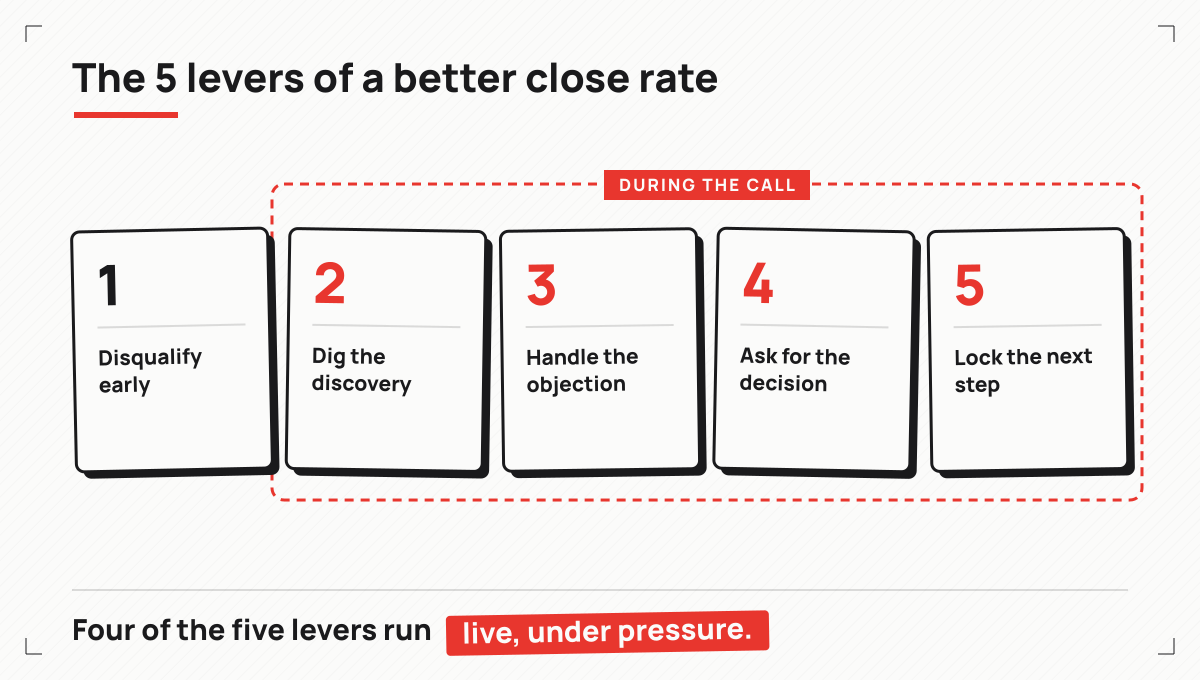
That is why close rates barely move when teams only invest in pre-sales tooling and post-call analysis: they improve everything except the moment the deal is decided.
That is Midcall's bet: put a copilot on your reps' screen at the moment those moves must be executed, on Google Meet, Teams and Zoom, invisible to the prospect. Qualification tracks live, objections are read and handled on the spot, and every call ends scored. It coaches with the same depth in English and in French.
Where to start
Not with all five levers at once. Run the autopsy on your last ten lost deals this week, find the dominant row in the table, and work that lever for a month while measuring it. If your dominant row is a mishandled objection or a next step never locked, your problem lives inside your calls, and that is exactly where Midcall works. And to make those reviews stick week after week, our sales coaching cadence gives you the rituals and the agendas.
And before you pick a lever at all, the autopsy of your lost deals deserves its own method: our guide to win-loss analysis shows where the real reason lives.
Edward, co-founder of Midcall and of the outbound agency Meteor. Former AE. I spend my days in sales calls: I built Midcall because it was missing from mine.
Frequently asked questions
What is a good close rate in B2B sales?
Benchmarks put the average around 21% of all opportunities and 29% of qualified ones, with SMB deals converting higher (25 to 35% under $50K) and enterprise deals lower (12 to 22% above $250K). These are third-party averages: a high ticket with a long cycle pulls the rate down without it being a problem, and a very high rate can simply mean you are not prospecting wide enough.
How do you calculate a close rate correctly?
Divide won deals by closed deals (won plus lost) over the same period, counting only qualified opportunities. And always segment by source, by rep and by stage: segmentation is what reveals the lever to pull, a blended rate says almost nothing.
Why do my deals die on "let me think about it"?
Because "let me think about it" is rarely a real request for time. It is most often an unspoken objection (price, internal legitimacy, fear of change) that the call never surfaced. The fix happens before hanging up: "of course, and so I understand, what would make you say no today?". The answer is the real objection, and it gets handled live.
How do you close a deal in B2B?
By following a sequence rather than hunting for the perfect closing line. Check the conditions are met, read the buying signals, recap the value in the prospect's own numbers, ask for the decision explicitly, handle the last objection and lock a dated next step. A good close surprises nobody, and if the prospect discovers at the end that you were waiting on an answer, a step was skipped earlier.
How do you close a deal with multiple decision-makers?
By no longer asking your contact for a signature they cannot give alone. On a complex deal the close happens in an internal meeting you do not attend, and your job is to arm your contact for it. Ask who else has to say yes, what could make that person say no, and above all what they need from you to defend the case without you in the room.
When should you ask for the decision?
When the prospect has measured what their problem costs them and the nature of their questions has changed. As long as they ask why, they are evaluating. When they ask how, by when and on what terms, they are picturing it, and that is the moment. Too early, the question lands on someone with nothing to decide on. Too late, the energy has gone and the deal drifts into silence.
Is a CRM enough to improve close rate?
A clean CRM improves tracking and forecasting, and it prevents forgotten deals. But it does not act on the four moves that happen inside the conversation: live qualification, discovery, objection handling and asking for the decision. Which is why teams with excellent CRM hygiene still carry mediocre close rates.
See the live AI coach on one of your calls.
15 minutes. We plug Midcall into a real scenario from your team, you decide.