How do you handle objections in sales, with real examples?
Handling an objection in sales means finding out what the prospect really means before you answer, then answering that. Most objections are not a no, they are a doubt, a fear or a missing piece of information. The reps who close more are not the ones with the best comebacks, they are the ones who ask the right question first.
What is a sales objection?
A sales objection is a concern or a reason a prospect gives for not moving forward, such as price, timing, an existing tool or a missing decision maker. It is not a refusal. A prospect who objects is still in the conversation, and is telling you what stands between them and a yes.
This guide covers objections on discovery calls and demos, where the prospect has agreed to a meeting and is evaluating your solution. Cold call objections are a different game, raised to end an unwanted call in its first seconds, and they are handled differently, as our cold call script guide explains. In discovery they reveal how the prospect sees the problem. During a demo they are often questions about risk, and at the end of the call they cluster around price, terms and who signs. Objection handling is the skill of answering them in a way that moves the deal forward instead of stalling it.
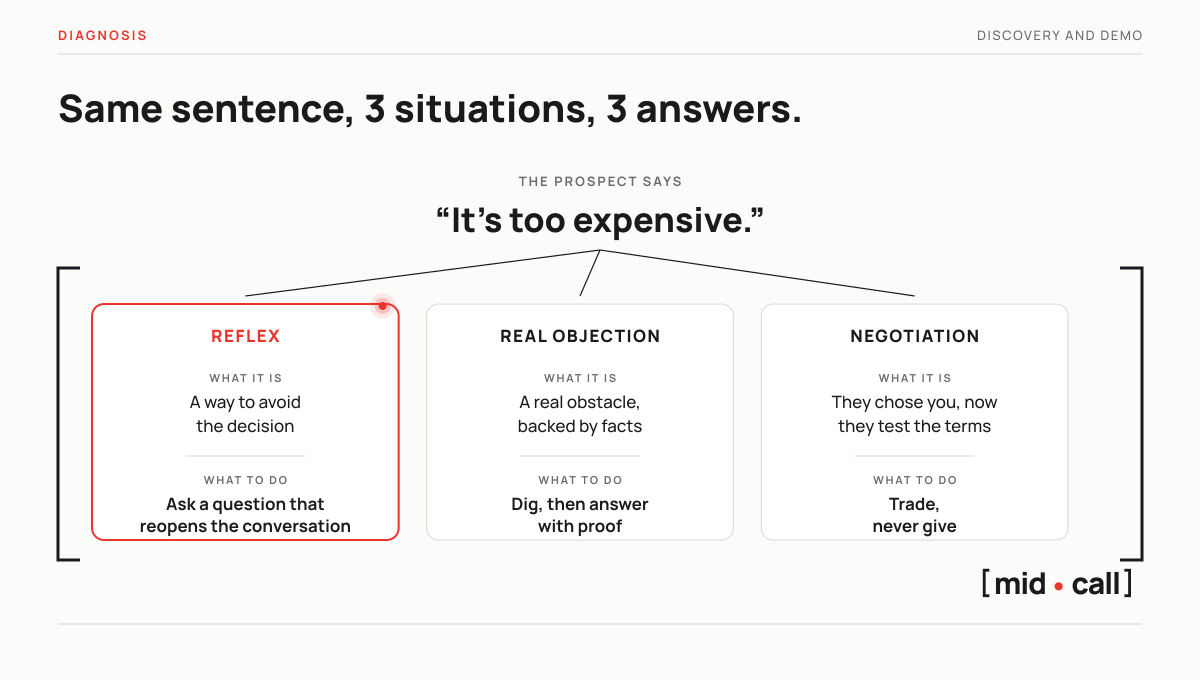
Is it a reflex, a real objection or a negotiation?
Before you answer anything, work out which of these 3 you are facing, because each one calls for a different response.
| Type | What it sounds like | What it really is | What to do |
|---|---|---|---|
| Reflex or smokescreen | "Send me the deck", "Looks great, I'll get back to you", "It's too expensive" said before the value is clear | A way to end the conversation or avoid a decision, not a blocker | Do not argue, ask a question that reopens the conversation |
| Real objection | "We signed a 2-year contract with another vendor in March" | A concrete obstacle to buying, stated with facts | Dig into it, then answer with proof or adapt the proposal |
| Negotiation | "If you drop the price by 15%, we sign this month" | A buyer who has decided and is now discussing terms | Trade, never give, and negotiate terms rather than price alone |
The first type is far more frequent than most reps think, even in a meeting the prospect agreed to. The French podcast Cbm Manager, drawing on the method of Shannen Louiz Boutaleb, founder of the sales school SforSales Academy and a former rep at Skello and HubSpot, puts it at 80% of objections hiding a fear, a doubt or a lack of clarity, with only 20% being founded. Whatever the exact share on your calls, the lesson is the same. If you answer the words instead of the meaning, you answer the wrong objection.
The classic example is price. "It's too expensive" can mean the budget really is not there, that the prospect does not yet see enough value, that they are comparing you to a cheaper tool, or simply that they are not the person who decides. 4 situations, 4 different answers.
How do you handle objections in sales?
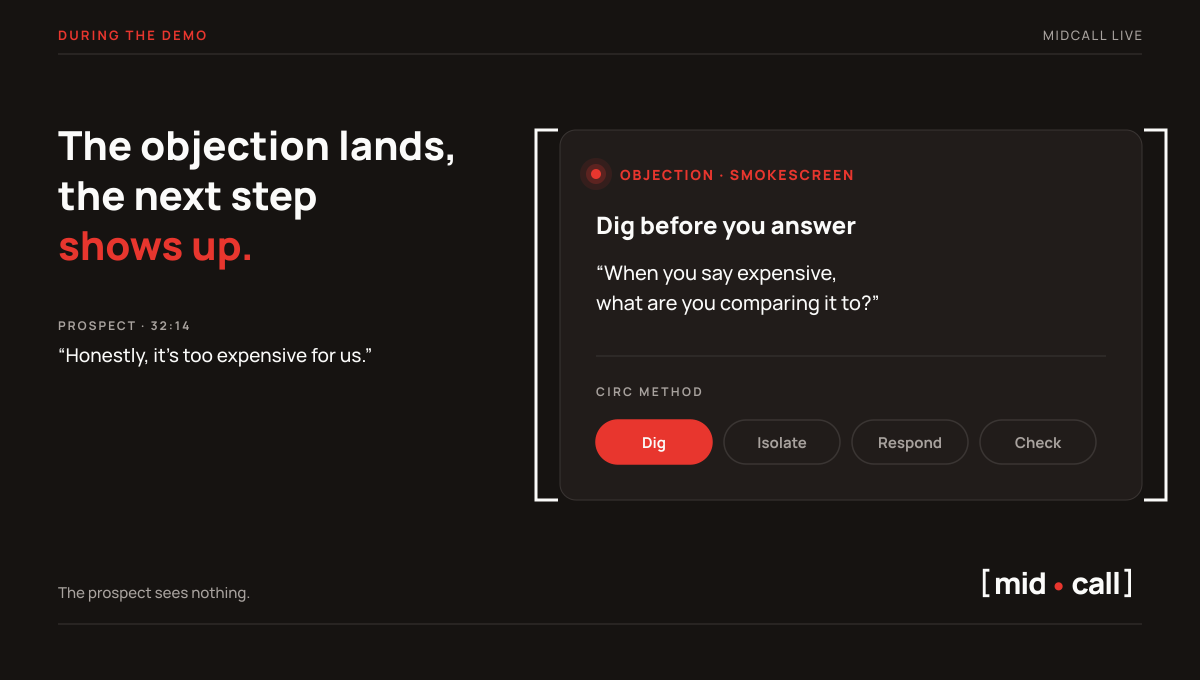
Use a method, so you do not improvise under pressure. The one we recommend, and the one Midcall applies on live calls, is CIRC, the method taught by Shannen Louiz Boutaleb. It is a variant of the CRAC method long taught in French sales schools (Dig, Rephrase, Argue, Check). CIRC stands for the 4 French words Creuser, Isoler, Répondre, Contrôler, in English dig, isolate, respond and check.
- Dig. Ask an open question to find what sits behind the objection. This is the step most reps skip, and the one that tells you whether you face a reflex, a real objection or a negotiation.
- Isolate. Check that this is the only thing stopping the prospect. If it is not, you want to know now, not after you have spent 5 minutes answering the wrong concern.
- Respond. Answer the real objection, not the words, with proof tied to what the prospect told you earlier in the call, a number, a customer example, a screen.
- Check. Ask whether your answer settled the concern. If it did, move to the next step. If not, dig again.
Here is what it sounds like on a demo call, with a prospect who has just seen the product.
Notice what the dig did. Without it, the rep would have defended the price in general. With it, the rep learned that the prospect was comparing 2 different categories of tools, and answered that.
The data backs this approach. Gong's analysis of 67,149 recorded demo calls found that average reps respond to an objection with a knee-jerk monologue of about 21 seconds and speed up, while top reps pause, slow down and respond by asking questions. CIRC turns that behaviour into a routine. Other frameworks you will meet, such as LAER or feel, felt, found, share the same backbone. Listen and understand before you answer.
For the 2 objections that come back most often at the end of a call, we have dedicated guides on handling "too expensive" and on answering "I need to think about it".
What are the most common sales objections, and how do you answer them?
These are the 12 objections that come back most often on B2B SaaS discovery calls, demos and closing calls. For each one, the table gives what it often means and the first question to ask, the dig step of CIRC. The answer itself depends on what the prospect says next.
| Objection | What it often means | First question to ask |
|---|---|---|
| "It's too expensive." | The value is not clear yet, or the prospect compares you to something else | "When you say expensive, what are you comparing it to?" |
| "We don't have the budget right now." | Not a priority this quarter, or the budget sits with someone else | "If the budget were there, would this be the right solution for you?" |
| "I need to think about it." | A doubt the prospect has not voiced | "Of course. What part would you like to think through, the solution, the timing or the price?" |
| "Send me a proposal and I'll get back to you." | A polite way to end the call without deciding | "Happy to. To make it useful, which part matters most to you?" |
| "We already use another tool." | Switching feels risky, or the gap is not visible | "What do you like about it, and what would you change if you could?" |
| "It's not a priority right now." | The cost of the problem has not been quantified | "What happens if nothing changes in the next 6 months?" |
| "I need to talk to my manager." | The prospect is not the decision maker, or wants cover | "What will they want to know, and should we present it together?" |
| "We'll build it in-house." | Underestimated cost, or a technical team that wants control | "How long would it take your team, and what would they stop working on?" |
| "Your competitor is cheaper." | A price negotiation, or a comparison on different scopes | "Are you comparing the same scope, and what made you shortlist us?" |
| "We're locked into a contract." | A real timing constraint | "When does it end, and when would you need to decide to switch on time?" |
| "My team won't use it." | Fear of a failed rollout | "What happened with the last tool you rolled out?" |
| "We have concerns about security and GDPR." | A real requirement, often from legal or IT | "Which requirements does your security team check, so I bring the right answers?" |
This table is a set of first questions, not a script to recite. First, every question is open, so the prospect talks and you learn. Second, none of them argues. You are not trying to prove the prospect wrong, you are trying to understand what would make them say yes.
How do you handle an objection during a demo, or at the end of the call?
The moment changes the answer. During the demo, an objection is usually a question about risk. Will my team adopt it, does it connect to our CRM, what if it does not work. Handle it on the spot with CIRC and show proof on screen when you can. If it needs a deep dive, park it visibly, write it down in front of the prospect and come back to it before the end of the call.
At the end of the call, once price is on the table, objections are more often negotiation. The prospect has seen enough to want the product and is now testing the terms. Do not answer with a discount reflex. Trade instead, a lower price against a longer commitment, a smaller first scope against a faster rollout, and negotiate the terms of the deal, scope, number of licences, contract length, rollout calendar and payment terms, rather than the price alone.
The best objection is the one you have prevented. Most late objections were visible in discovery. A prospect who never quantified the cost of their problem will find you expensive, and one who never mentioned the economic buyer will need to talk to their boss. A good discovery surfaces these points early, when they are easy to address, instead of at the end, when they stall the deal. The buying signals work the same way in reverse. When a prospect asks about rollout or contract length right after an objection, your answer has landed and it is time to move to the next step.
What mistakes turn an objection into a lost deal?
Answering too fast. A rep who fires back a prepared answer before the prospect has finished shows they were not listening, and often answers the wrong objection. This is the 21-second monologue Gong measured in average reps.
Arguing. "Actually, we are not expensive" puts the prospect on the defensive. You can be right and still lose the deal.
Skipping the objection. Moving on to keep the demo on track tells the buyer their concern does not matter. It will come back at decision time, when you can no longer address it.
Discounting at the first push. A price cut offered without anything in return teaches the prospect that your price was never real, and it rarely solves the actual doubt.
Treating every objection as real. Spending 5 minutes on a reflex like "send me the deck" gives it a weight it never had.
Never checking. Without the last step of CIRC, you do not know whether the concern is gone or simply unspoken, and an unspoken objection kills more deals than a spoken one.
How do you build your team's objection library?
Start from your real calls, not from a list found online. Collect every objection your reps heard over the last 3 months, group them into families, price, timing, incumbent tool, decision process, risk, and rank them by how often they come up and how many deals they cost. In most teams, a handful of families cover most of the objections heard in discovery and demos, and those are the ones to prepare first.
For each family, write the dig question, the most frequent real meanings and the proof that answers each one, a customer example, a number, a screen. Keep it short enough to be used, 1 page per family is plenty. Then review it every month with the team, using real call excerpts. A new objection that shows up 3 times in a month deserves its own entry. This library is also the backbone of sales onboarding, since a new rep who knows your 5 most frequent objection families is ready for most real calls. The manager's role is covered in more depth in our sales coaching guide.
How do you get better at handling objections, call after call?
By getting help at the moment the objection lands, and a clear read of how you handled it afterwards. That is exactly what Midcall does on your discovery calls and demos, on Google Meet, Microsoft Teams and Zoom.
During the call, Midcall detects the objection as the prospect says it and reads whether it is a real objection or a smokescreen. Then it suggests the next CIRC move, one line at a time on your screen, the dig question when you are about to answer too fast, the isolation question, the proof that fits what the prospect said earlier, the check before you move on. If you freeze, the objection button gives you a suggestion immediately. The prospect sees nothing, and you stay in control of the conversation.
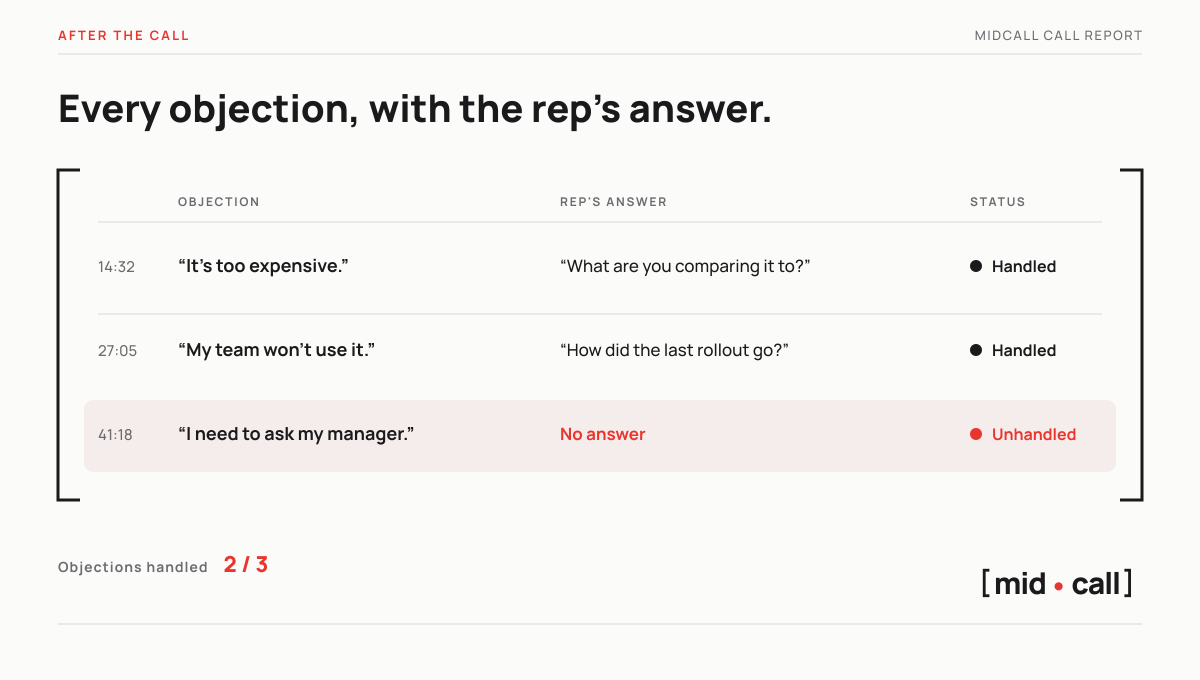
After the call, Midcall lists every objection raised, with the answer the rep gave and the ones left unhandled, and scores objection handling as a competency with the exact verbatims behind the score. For the manager, the team view groups objections by family and shows how each rep progresses on them over time. You see which objection costs the team the most deals, which rep needs help on price and which one on timing, and the coaching is personal to each rep rather than one generic session for everyone. Your objection library stops being a document nobody opens and becomes the live picture of what your prospects actually say.
Edward Labruyère, co-founder of Midcall. Former B2B SaaS AE, co-founder of Meteor, a B2B prospecting agency. I write about what actually happens inside sales calls, and what the best teams do about it.
Frequently asked questions
What are the 4 steps of objection handling?
In the CIRC method, the 4 steps are dig, isolate, respond and check. You ask an open question to understand what sits behind the objection, you make sure it is the only blocker, you answer the real concern with proof, then you check that your answer settled it before moving on.
What is the difference between CIRC and CRAC?
Both come from French sales training and start and end the same way, digging into the objection and checking the answer. CRAC rephrases the objection before arguing. CIRC isolates it instead, checking that it is the only blocker before responding, which avoids spending time on a concern that hides another one.
What is the most common sales objection?
Price comes up in most demos and closing calls, usually as "it's too expensive" or "we don't have the budget". It is also the objection most often misread, since it frequently means the value is not clear yet, or that the prospect is comparing you to a different kind of tool.
How do you tell a smokescreen from a real objection?
Ask a question and listen to the answer. A smokescreen stays vague and changes when you dig, while a real objection comes with facts, a contract end date, a budget figure, a technical requirement. Isolating the objection also helps, since a prospect with a real blocker will confirm it is the only one.
Should you handle objections before the prospect raises them?
Yes, for the ones you hear on almost every call. If price comes up in most of your demos, address the cost of the problem during discovery, so the prospect has already quantified what inaction costs them when the price appears. Pre-empting works for recurring objections, not for every possible one.
Can AI help reps handle objections during a call?
Yes. A real-time sales coach like Midcall detects the objection as the prospect speaks, reads whether it is a real one or a smokescreen and suggests the next question or answer on the rep's screen. After the call, it lists each objection with the rep's answer, so the rep and the manager know exactly what to work on.
See the live AI coach on one of your calls.
15 minutes. We plug Midcall into a real scenario from your team, you decide.