How do you respond to "I need to think about it"?
Respond to "I need to think about it" by digging before you follow up. Ask what specifically is still open, check that it is the only thing holding the decision, then agree on a dated next step before you hang up.
This line rarely means the deal is moving to a competitor. It means the deal is sliding toward inaction, and inaction is what you have to treat.
What does "I need to think about it" really mean?
It means your contact does not have what they need to carry the decision, not that they are leaving to compare you against the market. That comparison happened long before they spoke to you.
The 6sense 2025 Buyer Experience Report, built on 4,510 B2B buyers who each made a purchase of at least $25,000, puts the point of first contact at 61% of the buying journey. In 95% of cases the winning vendor was already on the day-one shortlist, and four deals out of five go to the pre-contact favorite. Corporate Visions places the buyer 60 to 80% of the way through their decision process by the time you are talking to them.
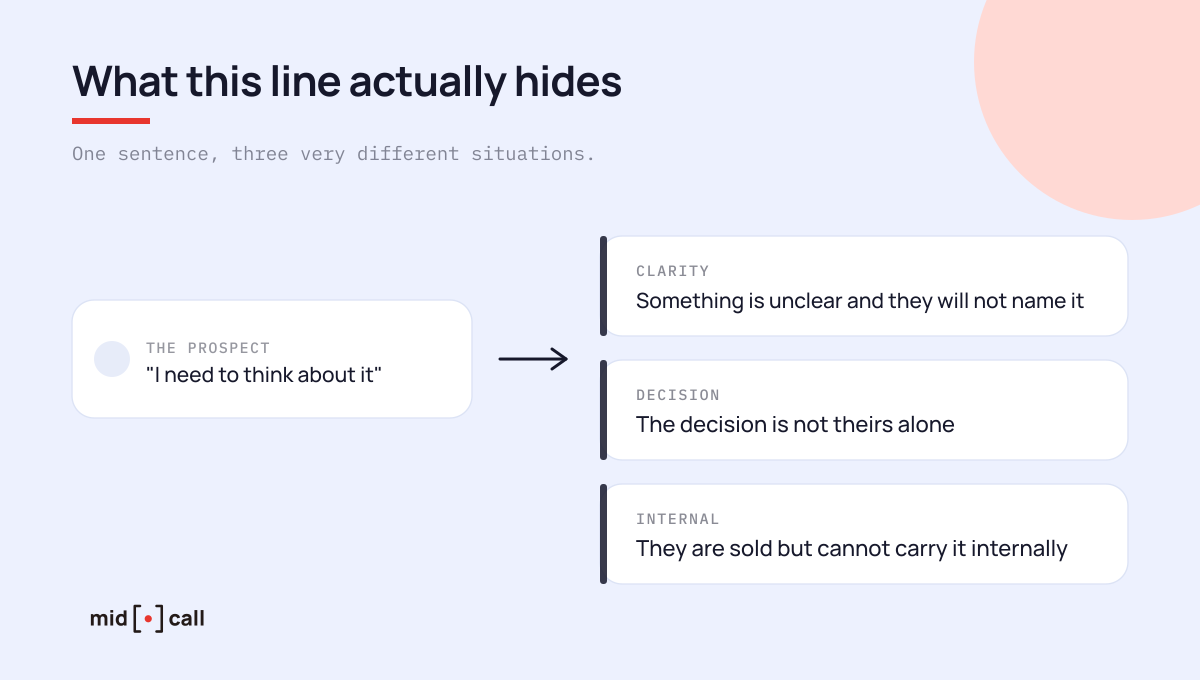
In practice, when the line lands at the end of a call, it covers one of three situations. Something specific is unclear and your contact will not name it. The decision is not theirs alone and they have to carry it to others. Or they are sold, but they do not know how to justify the change internally.
Does this objection lose you the deal?
No, it slows it down, and that has been measured. The data team at Modjo analysed 11,356 opportunities and found that the "I need to think about it" objection does not hurt win rates, but stretches the sales cycle by close to 173%. Your prospect really is thinking. They are simply thinking for a very long time.
So your opponent is not the competing vendor, it is inertia. The work of Amos Tversky and Daniel Kahneman on loss aversion explains why. The pain of a loss weighs more than the pleasure of an equivalent gain, which makes safety, not improvement, a buyer's first motivation. Researcher Christopher Anderson isolated four reasons people stay put, relayed by Corporate Visions.
| The cause of inaction | What it looks like on your call |
|---|---|
| Preference stability | Your contact already formed a view and dislikes changing it |
| Anticipated regret or blame | They fear being held responsible if the decision goes wrong |
| Cost of change | Migrating, training and reorganising feels too heavy |
| Selection difficulty | Too many options push them back toward what they already have |
Each of these four causes calls for a different answer. None of them is solved by following up harder next week.
What do you say in the next thirty seconds?
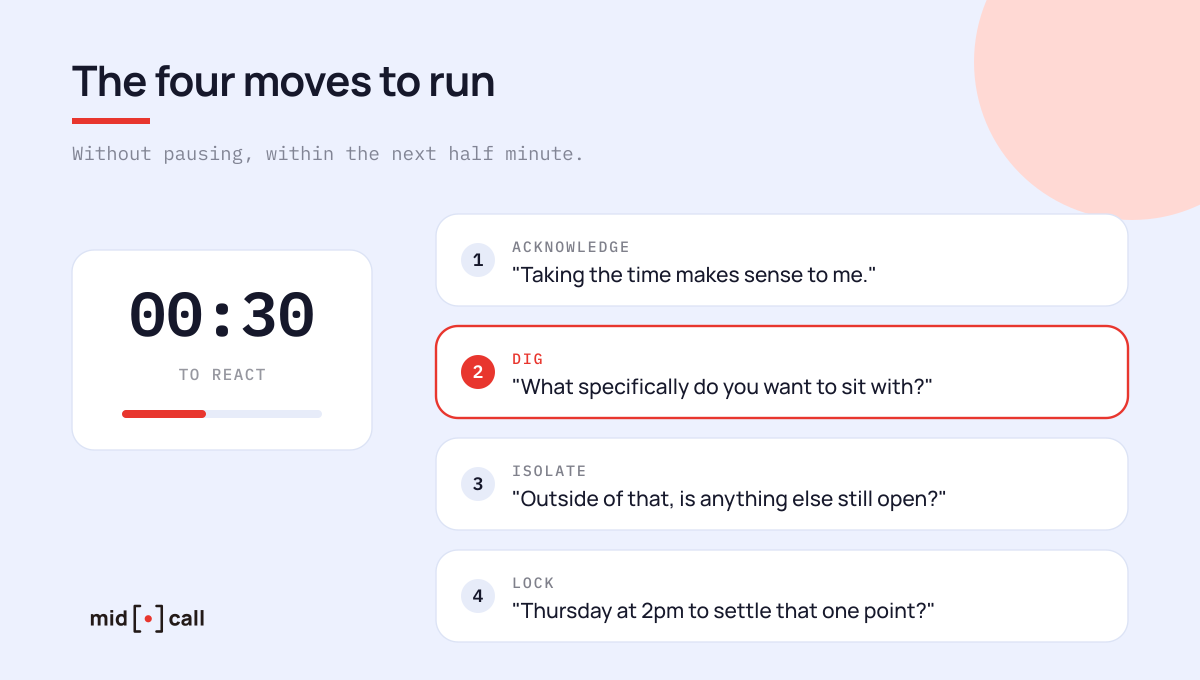
Run four moves without pausing, acknowledge, dig, isolate, then lock the next step. The first two take the pressure off and surface the real issue, the last two stop the deal from drifting.
| The move | What you say |
|---|---|
| Acknowledge | "Taking the time makes sense to me." |
| Dig | "What specifically do you want to sit with?" |
| Isolate | "Outside of that, is there anything else still open?" |
| Lock | "How about we speak Thursday at 2pm to settle that one point, does that work?" |
The digging question is the only one that truly matters. Until your contact has named what they are hesitating on, you have nothing to work with. Our piece on how to close without being pushy goes deeper into that reflex.
One detail changes a lot. After you ask, stop talking. The silence that follows is uncomfortable for you and productive for the deal.
Which replies should you avoid?
Avoid every reply that closes the conversation down, either by putting your contact on the defensive or by leaving you without the information you need.
| Do not say | The problem | Say instead |
|---|---|---|
| "What do you need to think about?" | Confrontational, your contact shuts down | "What specifically do you want to sit with?" |
| "No problem, I'll follow up next week" | You leave the call knowing nothing | "What would have changed by then?" |
| "What can I do to help you decide?" | You take ownership of their decision | "What is missing for this to be obvious?" |
| "If I improve the price, do we sign today?" | You turn hesitation into a price negotiation | Nothing about price until the real blocker is named |
| "You are the decision maker, right?" | They will say yes even when it is not true | "How did it go the last time you bought something like this?" |
That last line connects to a common mistake on pricing, which we cover in our article on the "it's too expensive" objection.
Does the answer change depending on the stage?
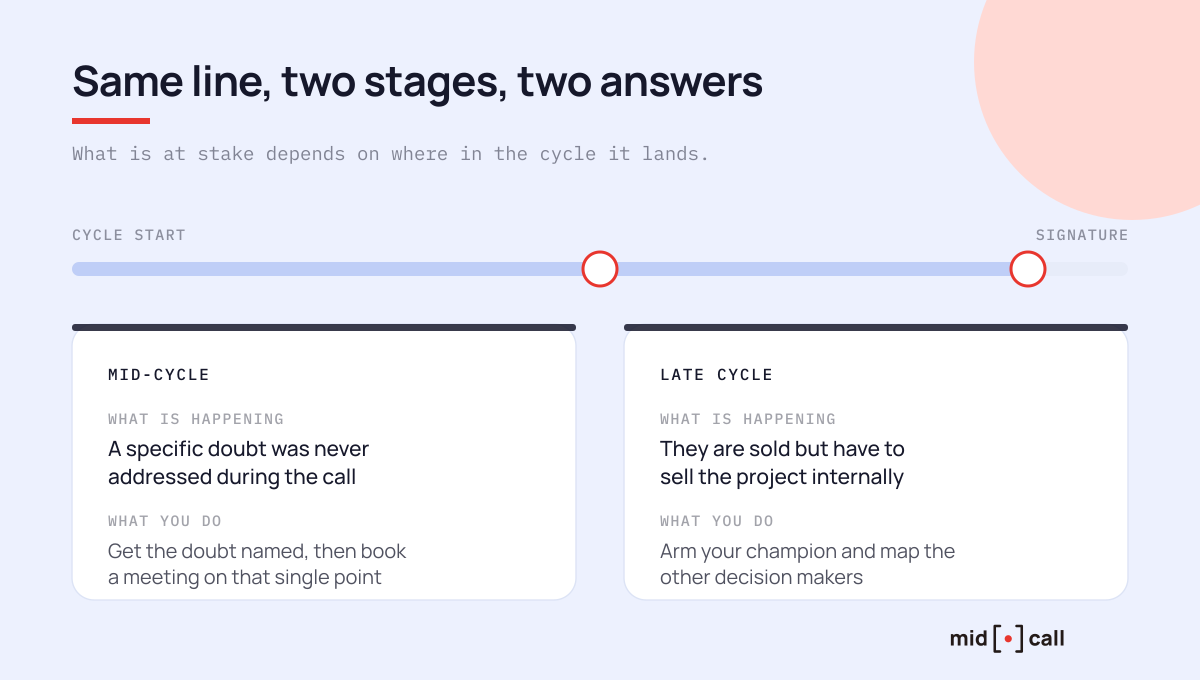
Yes, and it is the most overlooked variable. The same sentence does not mean the same thing at the second meeting and the week before signature.
| The stage | What is actually happening | What you do |
|---|---|---|
| Mid-cycle | A specific doubt was never addressed during the call | Get the doubt named, then book a meeting dedicated to that single point |
| Late cycle | Your contact is sold but has to sell the project internally | Arm your champion, map the other decision makers and their likely objections |
In the first case, pushing on value is pointless because the value is understood. In the second, adding arguments aimed at your contact is even more pointless, because they are not the person who needs convincing. What they need is a one-page document they can forward to their CFO without having to rebuild your reasoning from memory.
How do you stop it from coming up at all?
Bring it up earlier yourself, on purpose. An objection that surfaces in the middle of discovery gets handled calmly, while the same one at the end of a demo catches you off guard.
Three habits are enough. Put a number on the cost of inaction during discovery rather than at the end, by asking what the problem costs every month if nothing changes. Announce the next step at the start of the call instead of the finish, so nobody discovers it as they reach for the leave button. And ask a pre-close question before your recap, something like "what would make you say no today". Our discovery call framework and our closing techniques cover both moments.
Why is this so hard to do live?
Because it all plays out in a few seconds, at the end of a call, exactly when your attention is somewhere else. You are closing your notes, thinking about the recap, and the line lands. You have the length of one breath to choose between digging and nodding, and most reps nod.
That is the gap Midcall fills. Our extension listens to the call on Google Meet, Teams and Zoom, tells a smokescreen from a real objection, and surfaces the question to ask while it is still worth asking. The help is personalized per rep, someone who lets the end of calls slide is not supported in the same place as someone who already digs well. You can explore the wider topic of real-time sales coaching if the principle interests you.
One point of honesty is due. Midcall is a young product and I will not promise you a percentage of saved deals that we do not yet measure. The mechanical benefit is certain though. A question asked during the call beats a follow-up sent three days later, once your contact has filed the topic away.
"I need to think about it" is one case of a wider skill. To handle any objection the same way, our guide walks through the CIRC method step by step.
Edward, co-founder of Midcall. Former AE, co-founder of Meteor, a B2B prospecting agency. I write about what actually happens on sales calls, and what the best teams do with it.
Frequently asked questions
What do you say when a prospect says they need to think about it after a demo?
Do not try to convince them further, get them to name what they are hesitating on. Wording such as "what specifically do you want to sit with" opens the conversation where pushing closes it. Then check that it is the only blocker, and leave the call with a date booked to settle that point.
How long should you wait before following up with a prospect who is thinking?
The right answer is not a delay, it is a meeting. Leave the call with a date in both calendars rather than an intention to follow up. A deal without a dated next step rarely moves, and the memory of your conversation fades fast on your contact's side.
How do you know if "I need to think about it" is really a no?
Ask directly, while offering a way out. Wording such as "if this is not the right time, tell me, it will not offend me" frees your contact to be honest. A clear no now is worth more than a maybe that sits in your pipeline for six months.
Is this objection more common on video calls?
The format matters less than the ending. On video, leaving is easier for your contact since one click does it, which leaves less room for silence and for the informal conversation that used to close a meeting. Building five explicit minutes of wrap-up into your agenda offsets most of that effect.
What do you do when several people have to approve the decision?
Stop convincing your contact and start equipping them. Ask who really decides, how the last comparable purchase went, and which objections the other stakeholders will raise. Then hand over a short document they can forward as is, without having to reconstruct your case from memory.
See the live AI coach on one of your calls.
15 minutes. We plug Midcall into a real scenario from your team, you decide.