Which sales closing techniques actually work? Buying signals, scripts and data
Search for "sales closing techniques" and you will find the same lists everywhere: the assumptive close, the end-of-month urgency, the discount if you sign today. Those lists have a problem: the data from real calls does not back them up.
The closing techniques that work are not magic sentences at the end of a call. Gong's analysis of 42,945 closing calls shows that won and lost calls are nearly identical in the seller's behavior at the moment of closing: what sets them apart is the signals the buyer sends, and the mechanics built across the previous calls. Closing means recognizing those signals, locking a dated next step on every call, and asking one direct question at the right moment.
Here are the signals that show a prospect is ready, the techniques the data supports with their scripts, and the ones that cost deals.
Why do classic closing techniques barely make a difference?
Because by the time you close, most of the game has been played. The analysis of 42,945 closing calls, out of more than a million calls studied by Gong, lands on a finding that is uncomfortable for the entire sales training industry: on talk ratio, questions asked or speaker switches, won and lost closing calls look almost identical on the seller's side. The difference does not come from the seller's last sentence. It comes from what the buyer brings into the conversation, and from everything built before it: the pain priced during discovery, the qualification kept honest, the objections handled.
That finding does not make closing optional. It relocates it: closing skill is not a secret move at the end of a call, it is the ability to recognize the moment the prospect tips over, and not to waste it.
What buying signals show a prospect is ready to sign?
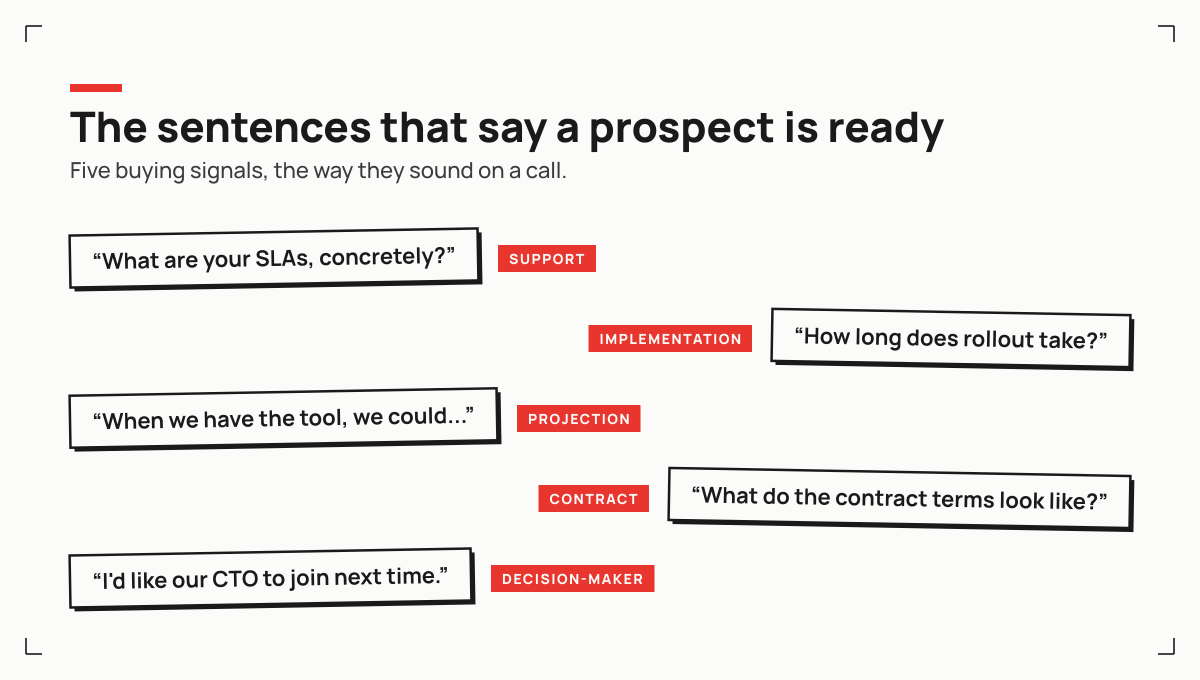
A prospect ready to buy changes register: they stop evaluating your solution and start projecting themselves into it. The same study calls these pre-purchase questions, and they are recognizable.
| The signal | What it means | What you should do |
|---|---|---|
| Questions about SLAs, support, onboarding | They are imagining the life after: they want reassurance, not convincing | Answer plainly, factually, and stop selling |
| Questions about implementation and timelines | They are already planning the rollout inside their organization | Walk through the implementation plan, with dates |
| Questions about contract terms | The subject has left the "if" and entered the "how" | Switch to logistics: who signs, when, what |
| "When we have it" phrasing instead of "if we went with you" | The mental switch has happened, often without them noticing | Ask the closing question, now |
| A decision-maker invited by the prospect themselves | They are selling internally on your behalf | Prepare that meeting as the most important call of the cycle |
The classic mistake in front of these signals: keeping on arguing. A prospect asking about implementation timelines does not need a fifth product benefit, they need a plain answer and a hand extended toward signature. Every extra minute of pitch after the signal reintroduces doubt where there was none left.
Which closing techniques work, and what do you say word for word?
Three techniques survive the data, all built on the prospect's commitment rather than on pressure.
| The technique | The script | Why it works |
|---|---|---|
| The committed recap | "Let me summarize: [the problem] costs you [their number], the solution meets [their criteria], and your process takes us to a signature by mid-September. Is that accurate?" | The prospect validates the case themselves: they are the one saying the interim "yes" |
| The direct closing question | "On your side, what is missing for us to move forward? Nothing? Then shall we start the paperwork this week?" | It forces an answer: a yes, or a real objection you are better off hearing now |
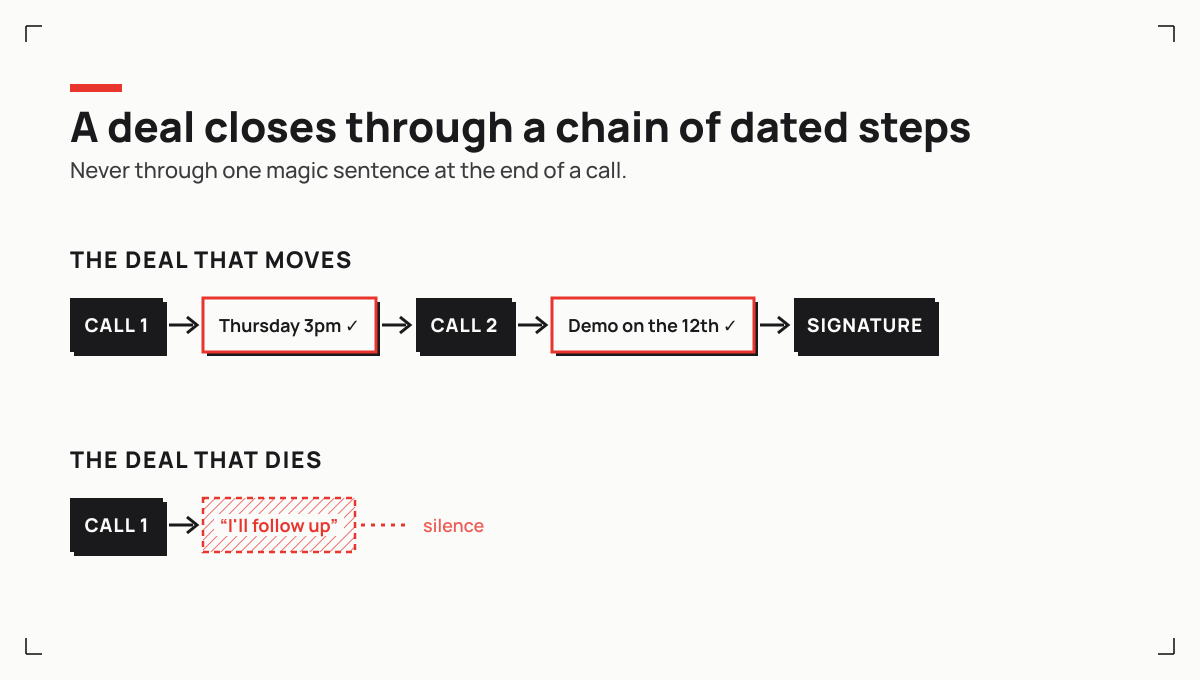
| The locked next step | "I suggest Thursday 3pm with [the decision-maker] to validate the scope, and I will send the contract beforehand. Does that hold?" | A dated step with the right people is a commitment, not an intention |
The third one is the most underrated, and yet the best documented: in the fastest-closing deals, sellers spend 53% more time discussing next steps from the very first meeting. Closing is not a final event: it is the sum of the steps locked on every call. An"I'll follow up" is a lost step; at the end of a cycle, deals rarely die of a no, they die of a string of soft call endings.
Follow-up counts as much as the call itself: sellers who reply within one business day and clear all their open action items shorten their deals by 11% on average, and buyers mirror your response speed.
Which closing techniques cost you deals?
| The technique | Why it costs the deal |
|---|---|
| Fake urgency | "The offer expires Friday" on an offer that does not expire: the prospect can tell, and trust does not come back |
| The signing discount | "10% off if you sign today" teaches the prospect that your price is negotiable and that month-end is their leverage |
| The forced assumptive close | Acting as if it were signed in front of a prospect who has not tipped over stiffens them instead of carrying them |
| Bolted-on social proof | Logos and references drawn at the end of a call correlate with a 22% lower close rate: poorly targeted, the reference says "you are a customer like any other" |
| Pitching after the signal | Selling to a prospect who is already convinced reintroduces doubt and delays the only question that matters |
These techniques share one trait: they try to manufacture a decision instead of collecting one. In B2B, facing buyers who compare and do their homework, pressure does not create urgency, it creates distrust. The only urgency that works is the one the prospect priced themselves: the cost of their inaction, established in discovery and recalled at closing, including when the price objection lands.
Why is closing won or lost during the call?
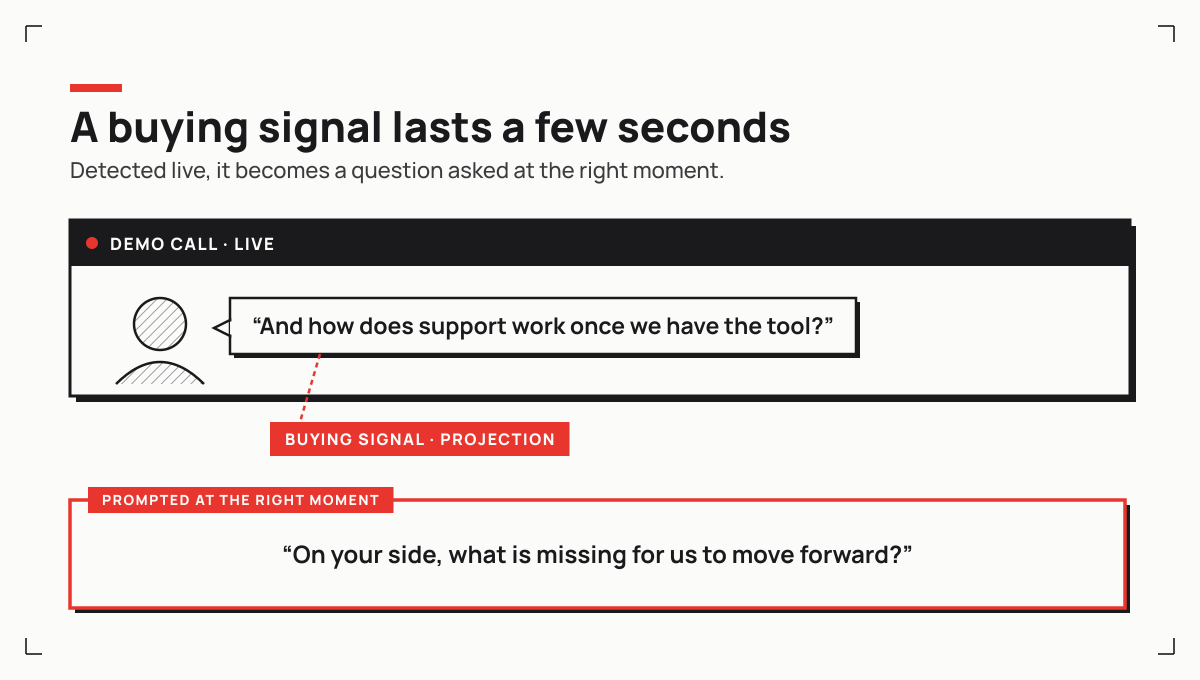
Because buying signals are perishable. The "when we have it" slipped mid-demo, the support question dropped in casually: those moments last a few seconds, and a rep focused on their pitch walks straight past them. A missed signal cannot be recovered from the notes: the moment to ask the closing question was there, and it is gone.
That is what Midcall changes during your discovery and demo calls. Midcall spots buying signals in what the prospect says, live, and prompts the closing question at the moment it is most likely to land, one line at a time, only when the confidence threshold is met. The help is personalized per rep: the one who lets call endings drift without a next step gets support exactly there. On the manager side, each call's summary and score show you, rep by rep, where deals slow down: your work on close rate runs on facts. Midcall is a young product and I will not promise you a percentage of extra deals won. What changes for certain: the buying signal that used to go unnoticed becomes a question asked at the right moment.
Most of these techniques land in the last ten minutes of a demo, and our guide on how to end a sales demo shows how to move from the recap to a dated next step.
Edward, co-founder of Midcall. Former AE, co-founder of Meteor, a B2B prospecting agency. I write about what actually happens on sales calls, and what the best teams do with it.
Frequently asked questions
What is the best sales closing technique?
The next step locked on every call: a date, a goal and the right people, agreed before hanging up. Gong's data shows the fastest-closing deals spend 53% more time on next steps from the very first meeting, while last-minute closing lines do not separate won calls from lost ones.
How do you know when a prospect is ready to buy?
They change register: their questions shift to SLAs, implementation, timelines, support or contract terms rather than the product, and their phrasing moves from "if we went with you" to "when we have it". These pre-purchase questions signal a prospect projecting themselves and seeking reassurance: the right response is plain, factual, and followed by a closing question.
Should you use pressure to close a sale?
No, and the data suggests the opposite: fake urgency, signing discounts and bolted-on social proof at the end of a call correlate with lower close rates, the last one with a 22% gap. The only effective pressure is the one the prospect put on themselves by pricing the cost of their inaction during discovery.
When should you ask the closing question?
As soon as a buying signal appears, and not before answering plainly the question that carried it. Waiting until the end of the call out of politeness lets the signal cool down; asking before any signal stiffens the prospect. The safest phrasing stays conditional: "what is missing, on your side, for us to move forward?"
Can closing be learned?
Yes, but not as a repertoire of lines: as a skill of reading the prospect and a discipline of call endings. Team call reviews on real closing moments, practice at recognizing buying signals and the habit of never hanging up without a dated step build the skill faster than any list of techniques.
What are the most reliable buying signals in B2B sales?
The most reliable buying signals are pre-purchase questions: SLAs, support, implementation timelines and contract terms, plus the shift from "if we went with you" to "when we have it" and a decision-maker invited by the prospect themselves. These signals show a prospect projecting themselves into the solution rather than evaluating it. The right response is to answer plainly, stop selling and ask a closing question.
See the live AI coach on one of your calls.
15 minutes. We plug Midcall into a real scenario from your team, you decide.