The MEDDIC framework, and why qualification happens during the call
Everyone knows the acronym. Six letters recited in job interviews, six fields in the CRM, and forecasts that slip anyway. The problem is almost never the framework: it is when you apply it.
MEDDIC is a B2B sales qualification framework that scores a deal on six verifiable facts about the buyer: Metrics (the number the prospect wants to move), Economic buyer (the person who frees the budget), Decision criteria (how they will judge you), Decision process (who signs what, and when), Identify pain (the problem that costs money today) and Champion (the insider who sells for you). A deal is qualified when every letter rests on evidence, not on an impression.
What is the MEDDIC framework?
MEDDIC was born in the 1990s at PTC, an American software company, driven by Dick Dunkel and Jack Napoli. Over the years the sales team ran this discipline, PTC grew from around 300 million to more than a billion dollars in revenue, and the framework spread through B2B SaaS until it became the standard for complex sales.
One clarification that prevents many failed rollouts: MEDDIC is not a sales process, it is a qualification methodology. Your process describes the stages a deal moves through. MEDDIC measures something else: at each stage, does this deal rest on facts?
What does each letter of MEDDIC mean?
Each letter is a fact to establish about the buyer, never an action to tick off on your side. Here is the full grid, with the question that validates each letter on a call and the signal that should worry you.
| Letter | What you are looking for | The question to ask on the call | Red flag |
|---|---|---|---|
| Metrics | The target result, as a number | "Which metric are you trying to improve, and by how much?" | "Improving efficiency": a goal without a number |
| Economic buyer | Who frees the budget alone | "Who will sign off on the investment? When can we involve them?" | You have never met them |
| Decision criteria | How they will judge the options | "What criteria will you use to compare solutions?" | You discover them at the proposal stage |
| Decision process | Who signs what, and when | "Once you've made your choice, what steps remain before signature?" | No dates on the buyer's side: your close date is an invention |
| Identify pain | The pain, priced and dated | "What happens if you change nothing this year?" | Real but painless pain: pleasant conversations, no deal |
| Champion | The insider who fights for you | "Are you ready to defend this project internally?" | They take your calls gladly, they have never risked anything |
The costliest confusion sits on the last line. A friendly contact who keeps you informed is a coach. A champion spends their own credibility in the meetings you are not invited to.
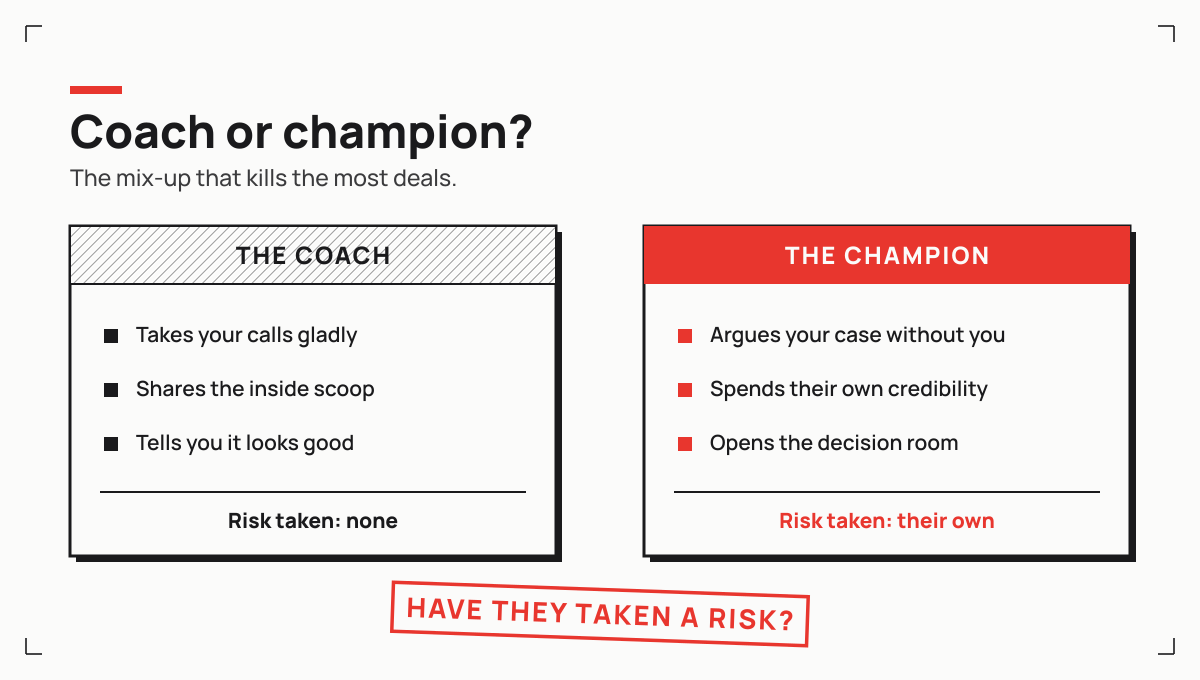
You can have three enthusiastic coaches on a deal and zero champions: the deal will feel warm right up to the day it dies.
MEDDIC, MEDDICC or MEDDPICC: which one should you use?
Choose based on the complexity of your deals: all three variants share the same spine.
| Variant | Added letters | When to adopt it |
|---|---|---|
| MEDDIC | None | SaaS cycles of a few weeks, tight decision group |
| MEDDICC | + Competition | Contested market: a deal won on the merits can still be lost to a rival you never asked about |
| MEDDPICC | + Paper process and Competition | RFPs, procurement, legal or security reviews on every deal |
If your deals routinely go through procurement or a security review, the extra letters earn their place. Otherwise, MEDDIC is enough.
Why do your deals die in no decision?
Because most lost deals are not taken by a competitor: they fade out. The research of Matthew Dixon and Ted McKenna, built on 2.5 million sales conversations, shows that between 40 and 60% of qualified deals end in "no decision": the prospect goes through the whole cycle, then chooses to do nothing.
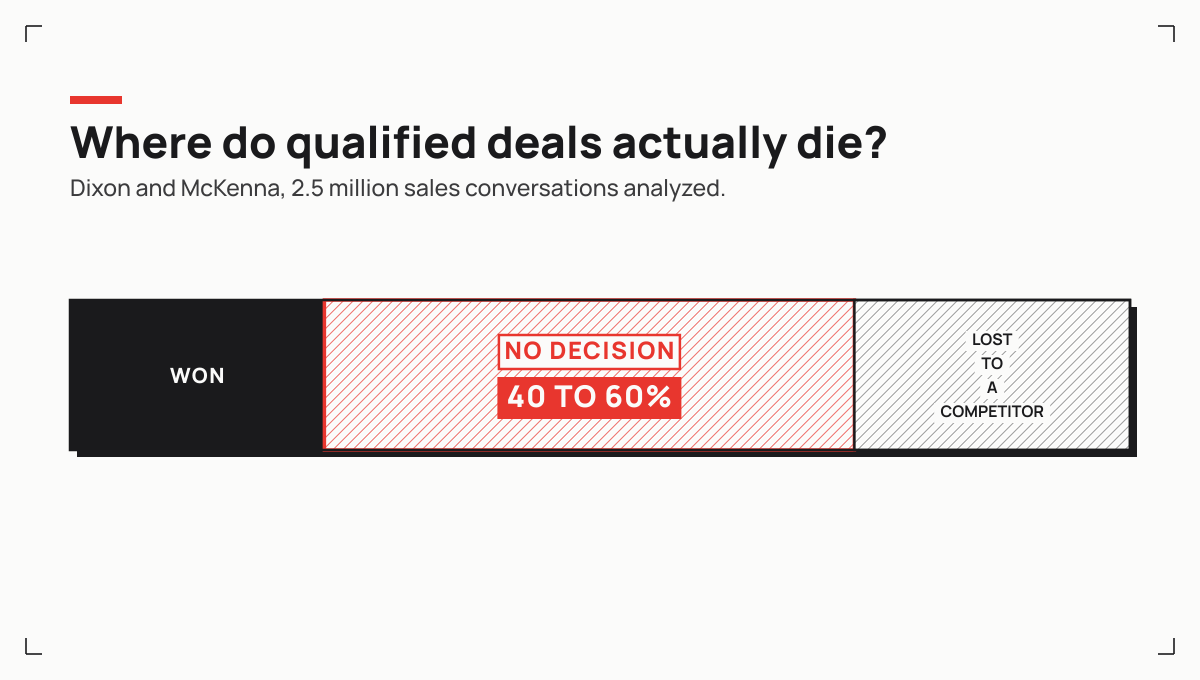
Read against the MEDDIC grid, that number becomes a diagnosis: those dead deals almost always had real but unpriced pain, a coach mistaken for a champion, a decision process nobody ever mapped. And the window for establishing those facts keeps shrinking. According to Gartner, B2B buyers spend only about 17% of their buying journey in contact with all suppliers combined, with a decision group of 6 to 10 people. Meanwhile, 59% of deals skip the qualification and discovery stages entirely according to Fullcast's 2026 GTM benchmark. The MEDDIC facts get extracted during the rare moments the prospect is talking to you. Nowhere else.
Why is MEDDIC in the CRM not enough?
Because a CRM field stores an answer: it does not verify it, and it does not produce it. The classic scenario: your rep gets off a discovery call, jumps straight onto the next one, and fills in their MEDDIC fields on Friday, from memory. "Economic buyer: confirmed" sometimes means they met them, sometimes that they hope they exist. And above all, the moment has passed: the Decision process box is empty, but the prospect who could fill it hung up three days ago.
| MEDDIC in the CRM, after the call | MEDDIC live, during the call | |
|---|---|---|
| When the grid fills in | On Friday, from memory | As the conversation unfolds |
| What an empty box triggers | A follow-up task, one more email | A question asked within the minute |
| What a ticked box measures | The rep's optimism | An answer from the prospect |
| What it changes for the deal | Nothing: the call is over | The gap closes while it can still be closed |
That observation is what shaped Midcall. During your discovery and demo calls, Midcall tracks MEDDIC qualification live: the six boxes fill in as the conversation unfolds, and your rep sees what is missing while the prospect is still there to answer. When the moment is right, it prompts the question that closes the gap, one line at a time, only when its confidence threshold is met.
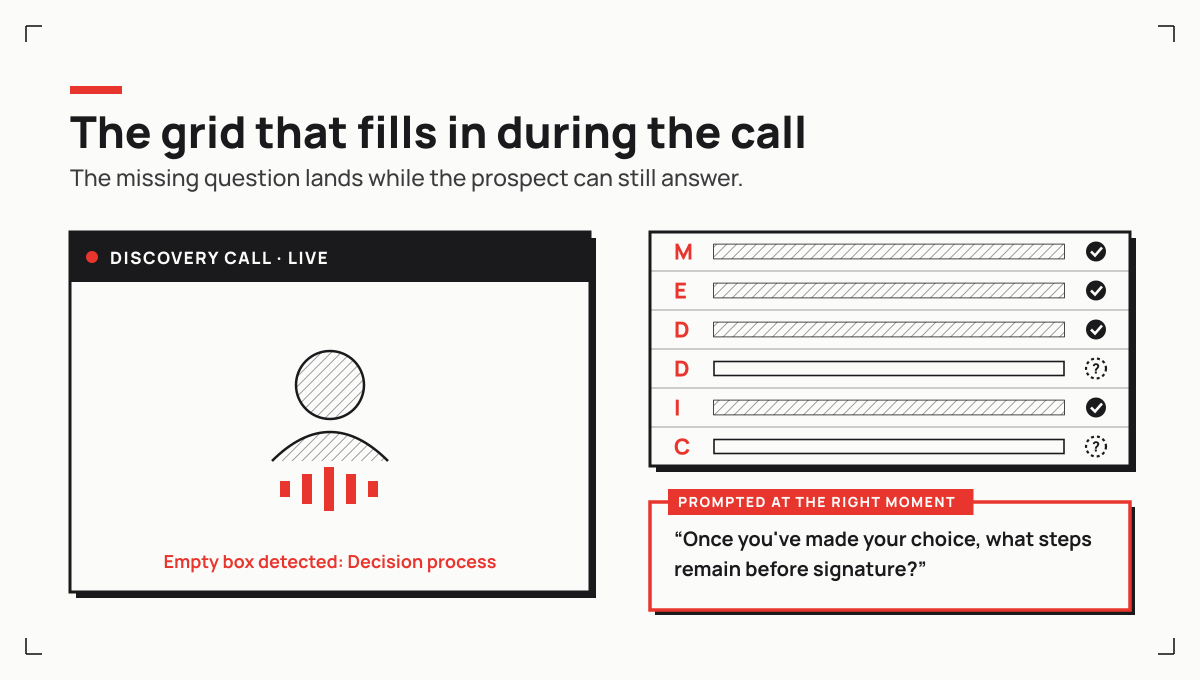
On the manager side, every call produces a summary with the state of qualification, and the per-rep dashboard shows you who systematically leaves which boxes empty. Midcall is a young product and I will not promise you a percentage of deals saved. What the live grid changes for certain: a qualification gap becomes visible at the only moment it can still be fixed. For the full picture of the copilot, see our guide to real-time AI sales coaching. And for the day the "too expensive" still lands, our guide to the price objection covers every case.
How do you roll out MEDDIC across your team?
Four decisions, and none of them is another CRM field.
- Pick your variant and freeze the vocabulary. The same definitions for everyone: what "champion confirmed" means in your team must be written down.
- Define the proof required for each letter. A box only gets ticked on a fact. Everything else is "unknown", and "unknown" is the most useful word in the framework: it says exactly where the deal is blind.
- Manage the unknown boxes, not the ticked ones. In pipeline review, the right question is not "is the MEDDIC filled in?" but "which letters are missing, and what question are you asking on the next call?"
- Anchor the grid in your coaching rituals. The monthly call review and the weekly 1:1 are the right places to replay a failed qualification, and your work on close rate starts exactly there: a well-qualified deal is one you know how to win, or how to walk away from early.
Edward, co-founder of Midcall. Former AE, co-founder of Meteor, a B2B prospecting agency. I write about what actually happens on sales calls, and what the best teams do with it.
Frequently asked questions
What does MEDDIC stand for?
MEDDIC stands for Metrics, Economic buyer, Decision criteria, Decision process, Identify pain and Champion. Each letter names a verifiable fact about the buyer: the number they want to move, the person who frees the budget, their evaluation criteria, their decision path, the pain that justifies acting, and the insider who argues your case.
What is the difference between MEDDIC and BANT?
BANT (Budget, Authority, Need, Timeline) is a fast first-call triage: it quickly screens out prospects that are off target. MEDDIC is a deep qualification that runs across the whole cycle on complex deals. The two combine well: BANT to filter upstream, MEDDIC to steer the deals that actually enter the pipeline.
Is MEDDIC worth it for short sales cycles?
Partially. On a short cycle with a single decision-maker, running all six letters on every deal is overkill: keep the three that silently kill deals, the priced pain, access to the decision-maker and the steps to signature. MEDDIC earns its full value as soon as the cycle stretches past a few weeks and involves several stakeholders.
Who created the MEDDIC framework?
MEDDIC was developed in the 1990s at PTC, an American software company, by Dick Dunkel, with Jack Napoli as its first evangelist. It then spread across B2B SaaS, carried by PTC alumni who became sales leaders elsewhere.
How should you fill in MEDDIC in the CRM?
As soon as possible after each call, and ideally during it. The rule that matters more than the tool: a box only gets filled on evidence from the conversation, never from memory three days later, never by deduction. If your team uses real-time AI sales coaching, the grid builds itself during the call and data entry becomes proofreading.
What does a filled-in MEDDIC grid look like?
Take a fictional SaaS deal. Metrics: cutting ticket handling time by 20%. Economic buyer: the VP Support, met on the second call. Decision criteria: Zendesk integration and rollout within a month. Decision process: security review then CFO signature, planned for mid-October. Identify pain: three full-time equivalents absorbed by repetitive tickets. Champion: the support lead, who built the internal case. Every box rests on an answer from the prospect, never on a deduction: that is what separates a filled grid from a ticked one.
See the live AI coach on one of your calls.
15 minutes. We plug Midcall into a real scenario from your team, you decide.