The sales coaching cadence top sales leaders run every week
You run a team meeting on Monday, you hold 1:1s whenever the calendar allows, and your reps still plateau. The problem is probably not your commitment. It is your structure: managing a sales team takes a system, not more hours.
A sales coaching cadence is a system of recurring rituals on a fixed schedule: a short weekly team meeting, a weekly 1:1 with each rep, a pipeline review kept separate from everything else, a monthly call review and a quarterly career conversation. Each ritual has a single purpose, a minute-by-minute agenda and one golden rule: the conversation about numbers, the one about deals and the one about skills never happen in the same meeting.
This article walks through that cadence, ritual by ritual, with agendas you can put on the calendar this Monday.
Why do reps plateau even when you meet with them constantly?
Because in most teams, coaching does not really happen. The State of Sales Coaching 2026 study by MySalesCoach, based on more than 3,700 sales professionals, found that 41% of reps are never or rarely coached, and only 28% are coached weekly. The Sales Management Association reaches the same conclusion from another angle: managers average 36 minutes of one-on-one coaching per rep per week, and coaching represents only about a quarter of their individual interactions. The rest is deal inspection and reporting.
That is the trap. You walk out of a pipeline meeting feeling like you coached: you weighed in on three deals, challenged a forecast, suggested a follow-up. Your rep walks out of a status update. Nobody talked about what they actually said on a call, the objection they fumbled on Tuesday, the discovery question they never asked. Pipeline reviews manage activity. Coaching builds skill. They are two different conversations, and when they merge, coaching is always the one that disappears.
The stakes are anything but cosmetic. In the same MySalesCoach study, 76% of reps coached weekly hit quota, versus 56% when coaching happens monthly. Objective Management Group, drawing on 11,078 sales evaluations, measures a 9-percentile performance gap in favor of reps coached weekly, rising to 17 percentiles when coaching happens several times a week. Coaching frequency is the performance gap.
What does a weekly sales coaching cadence look like?
Here is the full system, calibrated for a manager running 5 to 12 reps. Five rituals, each with a single purpose.
| Ritual | Frequency | Length | Single purpose |
|---|---|---|---|
| Weekly team meeting | Weekly, Monday | 30 min | Align the team and train one skill |
| One-on-one | Weekly, per rep | 30 min | Move the rep forward on one specific skill |
| Pipeline review | Weekly, per rep or in pairs | 15 min | Keep the forecast honest and unstick deals |
| Call review | Monthly, per rep | 45 min | Break down one full demo or discovery call together |
| Career conversation | Quarterly, per rep | 60 min | Talk trajectory, never deals |
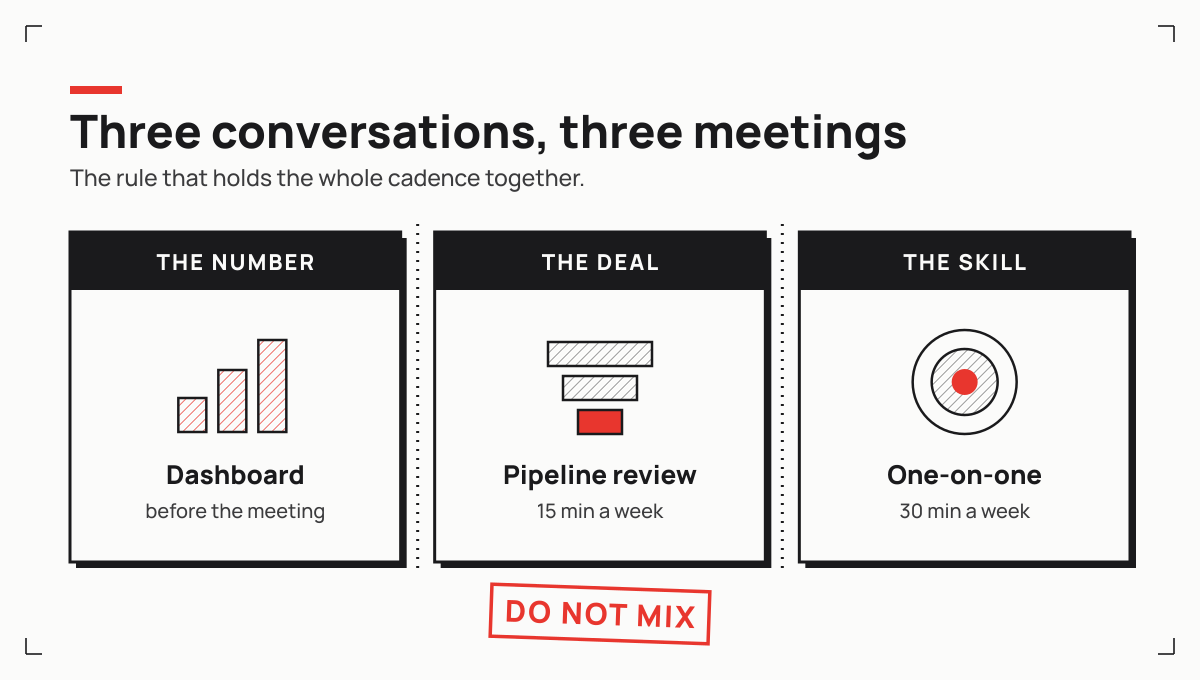
Two rules hold the whole thing together. First: every ritual is protected on the calendar at a fixed time, and a canceled ritual gets rescheduled within the week, never dropped. Consistency beats duration. Second: if a meeting can be replaced by a Slack message or a dashboard, it should be. A meeting earns its slot only for what a document cannot do: force a decision, unstick a deal, train a skill.
Run the math before you commit. With 8 reps, this cadence adds up to roughly 6 hours and 30 minutes of individual and team rituals per week. If you cannot carve that out, the problem is not the cadence. It is your span of control, or the share of your week that reporting has swallowed.
How should you structure a sales one-on-one?
An effective 1:1 lasts 30 minutes, happens every week and follows an agenda your rep knows by heart. Here is the one I recommend:
- Check-in (3 min). How they are doing, actually. A demotivated rep makes progress on nothing else.
- Skill of the week (15 min). One skill topic, picked in advance:handling a recurring objection, qualifying the economic buyer, closing out discovery calls. You work on specifics: what they said, what they could have said, and you role-play it if needed.
- Blockers (7 min). What they need from you: a decision, an intro, a resource.
- Commitments (5 min). One commitment from them, one from you, written down, reviewed at the next 1:1.
The rule that changes everything: the rep talks 70% of the time. Your job is to ask questions that lead them to their own answer, not to deliver yours. And numbers stay out of this meeting entirely: they have their own.
How do you run a weekly sales team meeting that is not a status round-robin?
The round-robin where each rep reads out their numbers is the degraded version of the team meeting: everyone waits for their turn, nobody listens, nothing gets decided. Numbers belong on a dashboard, not in a meeting. The version that works fits in 30 minutes:
- Wins (5 min). Two or three wins from the week, told by the reps who closed them. Not for morale: to spread what worked.
- The number of the week (5 min). One team metric, shared before the meeting, and the decision it calls for.
- Two deals (10 min). The two most instructive deals of the week, not the biggest. What unlocked one, what is blocking the other.
- Practice (10 min). Ten minutes on a real situation from the week: an objection several reps heard, a competitor announcement, a new use case. It is the segment teams cut first, and the only one that makes everyone better at the same time.
Send the agenda the day before with the numbers already filled in. The meeting is for deciding and practicing, not for data entry.
How do you coach objectively from your reps' calls?
This is the weak spot of almost every cadence, including the good ones. We are talking about real sales meetings here, the discovery, demo and negotiation calls of 30 minutes to an hour where deals are actually won and lost. You coach on what you have seen, and you see very little: two or three of those calls per rep per month at best, rarely the most representative ones. So the 1:1 runs on gut feel, the rep pushes back on the diagnosis, and the skill of the week gets picked on intuition. One data point shows the size of the blind spot: objection handling would receive only 2% of sales training time, despite being one of the highest-impact skills on performance (third-party estimate compiled by CuePitch).
That is exactly the gap Midcall closes for the manager. Midcall assists your reps live during their discovery and demo calls, and every call produces a score and a summary. On the manager side, you get both levels: the detailed summary of each call, and a per-rep dashboard that aggregates their score over time, their strengths, their areas of work and the objections they face most often. Your 1:1 changes in nature: you no longer open the conversation with an impression, you open it with a fact. This rep hits the budget objection three times a week: that is the skill of the week. That one excels at discovery but loses deals at the close: their coaching will not look like their neighbor's.
And during the calls, where you cannot be, Midcall coaches each rep in real time, with help personalized to their weak spots: a rep who struggles with objections gets far more support on that ground than a rep who has it handled. The product is young and I will not promise you an invented improvement percentage. What I do see is that managers who use it coach on data, and their junior reps ramp much faster.
Your first week
Do not roll out all five rituals at once. This week: put the 1:1s on the calendar at fixed times, send the team next Monday's agenda with the numbers pre-filled, and pick one single skill to work on for each rep. The monthly call review and the career conversation start next month. A month in, your team will know what happens every week, who prepares what, and what each person is getting better at. That is what a well-run cadence feels like. For the skills side, our field guide on increasing your team's close rate breaks down the five levers that matter.
A coaching cadence is also the backbone of a sales enablement program: it is where a score per competency turns into concrete coaching. Our guide to AI sales enablement shows how the two fit together.
Edward, co-founder of Midcall. Former AE, co-founder of Meteor, a B2B prospecting agency. I write about what actually happens on sales calls, and what the best managers do with it.
Frequently asked questions
How much time should a sales manager spend coaching?
Plan on 30 minutes of 1:1 per rep per week, plus the 10-minute practice block in the team meeting and one 45-minute call review per rep per month. For 8 reps, that comes to roughly 6 hours and 30 minutes a week. The Objective Management Group data shows that weekly frequency, more than total hours, is what produces the performance gap.
What is a sales coaching cadence?
A sales coaching cadence is the fixed schedule of recurring conversations a manager holds with each rep and with the team: weekly 1:1s, a weekly team meeting, separate pipeline reviews, monthly call reviews and quarterly career conversations. The cadence exists so that skill development happens by design, not whenever the calendar happens to allow it.
Should the pipeline review happen inside the 1:1?
No, and it is probably the most important rule in this article. When the two merge, the deal conversation absorbs everything and skill development disappears. High-performing teams keep the two meetings strictly separate, even if they sit back to back on the calendar: 15 minutes of pipeline, a break, then the 1:1.
What should a weekly sales meeting agenda look like?
An effective weekly team meeting lasts 30 minutes, happens at a fixed time on Monday and serves a single purpose: aligning the team and training one skill. It never mixes the three conversations of sales management: the number, the deals and the skills each have their own dedicated ritual. Deal reviews belong in the pipeline review, 15 minutes per rep, and individual progress in the 1:1, which keeps the weekly short and useful.
How do you structure a sales one-on-one agenda?
An effective sales 1:1 is weekly, lasts 30 minutes per rep and serves one purpose: moving the rep forward on one specific skill, identified from their real calls. It is not the place to review the pipeline, which has its own ritual, nor to discuss career, which deserves its quarterly conversation. The simplest agenda holds in three parts: one strength to anchor, one weakness to work on, one dated commitment for the week.
How do you coach a remote sales team?
The same cadence applies, with two adjustments. The rituals become non-negotiable, because remote work removes the informal touchpoints that used to compensate for a loose routine. And call-based coaching becomes your main contact with reality: remotely, you no longer overhear a conversation from the next desk, so you need data from the calls, AI-assisted sales coaching or both.
How do you keep a sales team motivated week to week?
Durable motivation comes less from bonuses than from visible progress. The rituals deliver it directly: the wins block spreads recognition in front of the team, the 1:1 shows each rep they are improving at something specific, and the quarterly career conversation gives them a trajectory beyond quota. A rep who feels themselves getting better stays, and sells better.
See the live AI coach on one of your calls.
15 minutes. We plug Midcall into a real scenario from your team, you decide.