What are buying signals during a sales call?
A buying signal, on a sales call, is a phrase or a question that shows your prospect is picturing life with your product before they've said yes. "How does it work if we add users mid-year?", "Can I trial this with two of my reps?", "Your price is high compared to what we use today." These three lines don't look alike, but they say the same thing. The prospect has stopped weighing whether your product is interesting. They're already living with it. The trap is that these signals land at the exact moment you're focused on what you're saying, not on what your counterpart just gave away. There are two families of buying signals that almost everyone blends together, the prospecting kind that tells you who to contact and the in-call kind that tells you when to close. This article is mostly about the second.
What are buying signals during a sales call?
A buying signal is a cue, verbal or behavioral, that your counterpart is moving toward a decision to buy. On a sales call, that cue is almost always verbal. The prospect asks a question that assumes the solution is already theirs, they speak in the future tense, they ask you for a concrete projection, or they raise an objection that compares instead of dismisses. A buying signal guarantees nothing. It simply tells you the window is open, and that you should stop running your pitch and listen to what just happened.
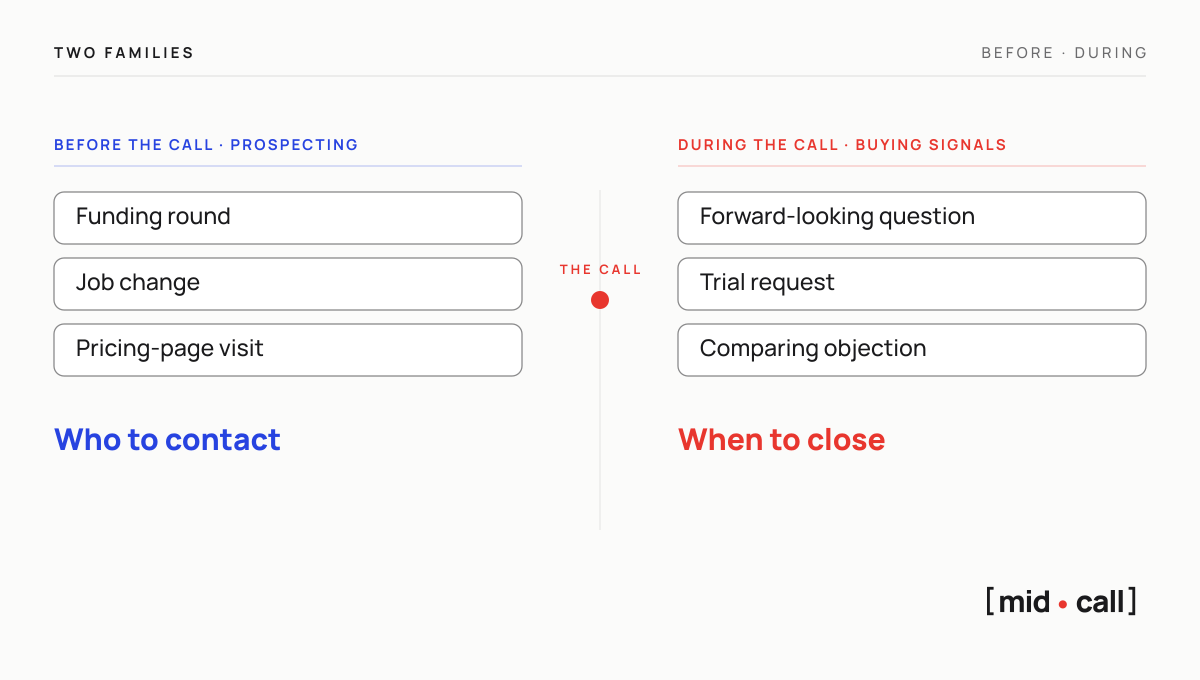
The most common confusion pits two very different things against each other. There are the signals that help you know who to contact and when to open a conversation, and the ones that help you know when to close a conversation that's already open. The first live in your prospecting tools. The second live in the call, and nobody catches them for you.
What's the difference between prospecting signals and buying signals?
The difference is timing. Prospecting signals come before the call, buying signals during it. A job change, a funding round or a repeat visit to your pricing page tells you an account is entering a buying window, so you should reach out. That's the territory of prospecting and intent-data tools like Apollo, Clay or ZoomInfo. A forward-looking question, asked on the call while you're presenting, tells you the person across from you is deciding, so you should close. That's a different exercise, and it plays out live.
The phrase "real time" muddies it. When an intent-data vendor talks about real-time signals, it means an alert that fires the day a prospect visits your site. Useful, but it isn't the call. Real time on a sales call is the half-second between the prospect's question and your answer. The two families are complementary. One fills your pipeline, the other moves it forward.
| Prospecting signals | In-call buying signals | |
|---|---|---|
| When | Before the first conversation | During the conversation |
| Nature | Account behavior and data | What the prospect says |
| Examples | Funding round, job change, pricing-page visit | Forward-looking questions, trial requests, comparing objections |
| What they tell you | Who to contact, when to open | When to close, what to lock down |
| Where they live | Intent-data tools and CRM | The call, live |
Which buying signals should you watch for on a call?
In-call buying signals fall into three moves the prospect makes without thinking. They ask questions that assume they've already bought, they talk about their own rollout, and they bring other people into the conversation. A question about onboarding, annual billing or migrating their data isn't an evaluation question. It's an owner's question. When a prospect asks how deployment works, more often than not they're already picturing themselves past the sale.
The tense of the verb is the best filter you have. A prospect speaking in the conditional is still evaluating. A prospect who shifts to the future or the present has already folded you into their day-to-day. "Could this work for us?" doesn't carry the same weight as "How do we wire this into our CRM?". The first is thinking, the second is organizing. These signals show up sooner when your discovery was solid, because a prospect you've understood well projects earlier. We covered that stage in our piece on the discovery call framework.
| What the prospect says | The hidden signal | The right move |
|---|---|---|
| "How does rollout work on your side?" | They're picturing life after the sale | Describe the next step instead of re-pitching |
| "Can we trial this with two people?" | They're trying to lower their risk | Frame a trial with a clear success criterion |
| "I'd want to show this to my director" | They're assembling their buying group | Arm them to defend the case without you |
| "Do you bill annually or monthly?" | They're budgeting for it | Talk commitment and next steps |
| "We already use [tool], does it integrate?" | They're checking fit with their stack | Confirm, then lock the next step |
That last case, the deal decided in an internal meeting you're not invited to, is the heart of closing a complex deal. We broke it down in our article on how to increase your close rate.
Can an objection be a buying signal?
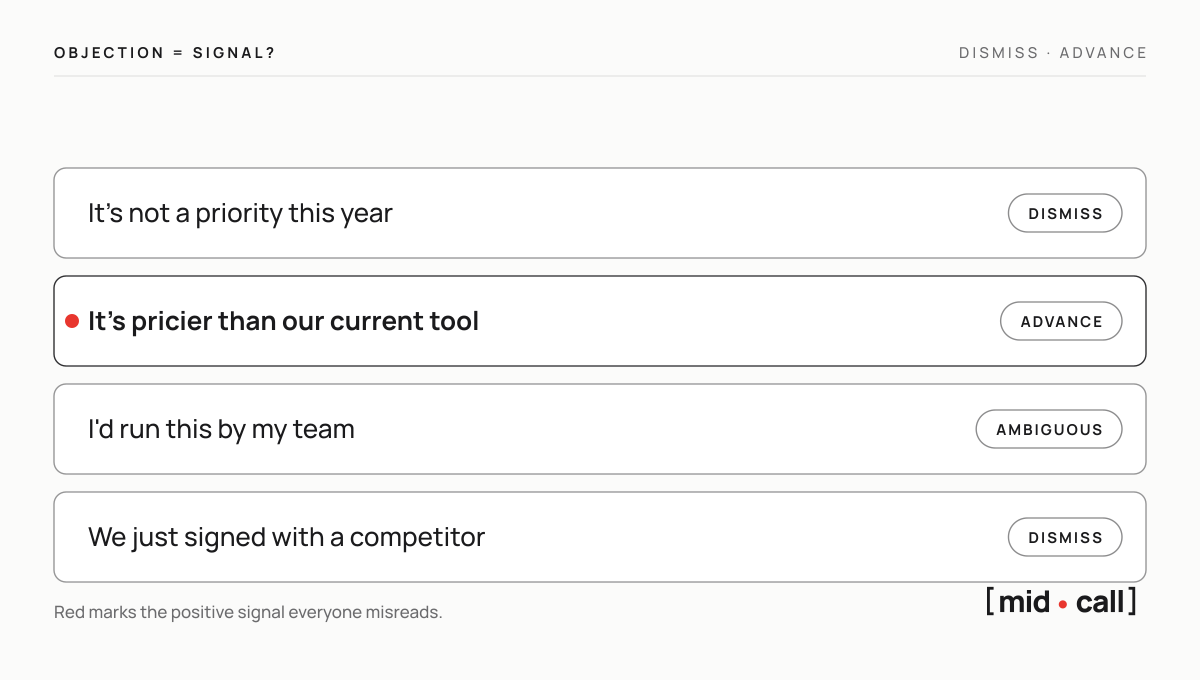
Yes, and it's the most misread signal of all. An objection that compares your offer to another isn't a refusal, it's proof of interest. When a prospect tells you your price is high compared to their current vendor, they're teaching you two things. They have a vendor, so a budget and a recognized need. And they're putting you in the same category, so they're considering you. A prospect with no intent to buy rarely bothers to compare, they cut it short.
It all comes down to the nature of the objection. An objection that dismisses shuts the door, like "this isn't for us" or "we don't work with tools like this." An objection that compares, negotiates or projects forward leaves it open, like "it's expensive," "I'm not sure my team will buy in" or "it would need to be ready before September." The second family is an invitation in disguise. The prospect is telling you what to clear for them to sign.
| The objection | Dismissing or advancing? | What it really reveals |
|---|---|---|
| "It's not a priority this year" | Dismisses | No buying window, requalify |
| "It's pricier than our current tool" | Advances | Budget and need already there, they're comparing |
| "I'd need to run this by my team" | Ambiguous | Consensus-building or a polite brush-off, the follow-up tells |
| "I'm not sure it'll work for us" | Ambiguous | A request for proof or a real doubt, probe it now |
| "We just signed with a competitor" | Dismisses | Window closed, re-engage later |
A single objection rarely settles anything on its own. What confirms whether the signal was real, or whether you were facing a polite exit, is how the prospect reacts to your follow-up. The price objection, though, deserves its own treatment, because it almost always shows up when interest is real. We took it apart in our article on the "it's too expensive" objection.
Why do great reps still miss these signals?
They miss them because human attention is a limited resource, and a call burns through it. While the prospect slips in their future-tense question, you're framing your next sentence, watching the clock, remembering the point you absolutely wanted to make. The signal lands in your blind spot. It isn't a skill gap, it's the structure of a live conversation. You can't talk, listen closely and analyze at the same time, especially under the pressure of a meeting that counts.
2026 sharpens the stakes. According to a March 2026 Gartner survey, 67% of B2B buyers say they'd rather move through a purchase without a rep, and the journey keeps getting more self-directed and digital. The prospect who shows up on the call has already compared, read your pages and often queried an AI. The call is no longer there to discover your product, it's there to validate a decision that's nearly made. Gartner also notes that 69% of buyers come back to a rep to validate what AI told them and to make the call at the moments that matter. Those moments are the buying signals. You get fewer of them than before, they weigh more, and you can't afford to miss one.
How do you spot buying signals live with Midcall?
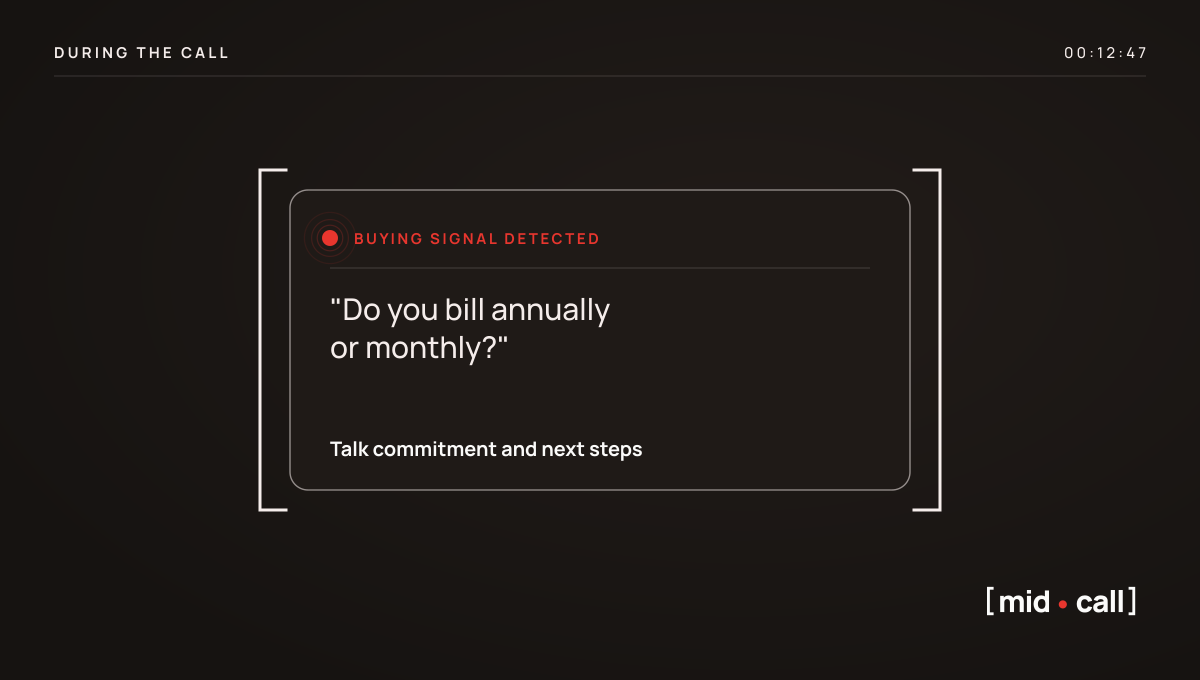
Midcall is a browser extension that coaches your reps during their calls, on Google Meet, Microsoft Teams and Zoom. While your rep is talking, Midcall reads the conversation live and detects buying signals the moment they land. When the prospect slips in a forward-looking question, a live advice card appears to flag it, without your rep taking their eyes off the person in front of them. Qualification tracking updates live against your team's framework, from BANT to MEDDIC, so you can see at a glance what's validated and what's left to lock down.
The help is personalized per rep. A rep who's comfortable in discovery but lets buying signals slip gets more support exactly there, while another is backed up on their objections. Midcall doesn't flatten your team's answers into one script, it reinforces each rep on what they're missing. After the call, you get a summary and a score that point to the signals caught and the ones that got past you, with the exact verbatim.
Let me be straight. Midcall is a young product, and I won't promise you a percentage of extra deals we don't measure yet. What I can tell you is that the buying signal that used to slip into the blind spot doesn't slip anymore, because a machine watches for it in your rep's place while they focus on the conversation. That's the difference between analyzing a dead deal the following week and saving it while it's still alive.
Where should you start reading buying signals?
Start with your lost calls. Re-listen to or reread your last three deals that didn't land and look for the moment the prospect projected forward, the future-tense question, the objection that compared, the trial request. You'll often find the signal was right there and the answer walked past it. It's the highest-return exercise for training your ear.
Next, name the three signal-questions specific to your market. Every sector has its recurring phrasings, about integration, about data security, about time to deploy. Write them down and share them with your team, so everyone recognizes them on the fly. Finally, agree on a shared reflex. The simplest rule fits in one line. When a buying signal lands, stop selling and move forward, by offering the concrete next step instead of one more argument.
Edward, co-founder of Midcall. Former AE, co-founder of Meteor, a B2B prospecting agency. I write about what actually happens on sales calls, and what the best teams do with it.
Frequently asked questions
What is a buying signal in sales?
A buying signal is a verbal or behavioral cue that a prospect is moving toward a decision to buy. In prospecting, it's an account event like a funding round or a pricing-page visit. On a call, it's mostly a phrase, a forward-looking question or an objection that compares instead of dismisses.
What are the most common buying signals during a meeting?
The most common are questions that assume the purchase is already made, about deployment, billing or data migration. Then come trial requests, which signal a wish to lower risk, and other people entering the conversation, which shows the prospect is building their buying group.
Is an objection a positive buying signal?
Often yes. An objection that compares your offer to another, or that negotiates price, proves the need and budget already exist. It leaves the door open. An objection that dismisses, like "this isn't for us," closes the window instead. The nature of the objection matters more than its mere presence.
What's the difference between intent signals and in-call buying signals?
Intent signals, or intent data, are account behavior before contact, surfaced by prospecting tools. In-call buying signals are what the prospect says once the conversation is open. The first tell you who to contact, the second when to close.
How do you avoid missing a buying signal on a call?
The main obstacle is attention, because when you're talking you listen less closely. Re-listening to lost calls trains your ear, naming your market's signal-questions helps you recognize them, and a live coaching tool like Midcall flags the signal the moment it lands so the rep doesn't have to track everything alone.
Can software detect buying signals in real time?
Yes, but you have to separate two kinds of real time. Intent-data tools detect account events in real time, like a site visit. A call copilot like Midcall detects what's being said in the conversation in real time, which is a different exercise and happens during the meeting.
See the live AI coach on one of your calls.
15 minutes. We plug Midcall into a real scenario from your team, you decide.