The AI sales stack in 2026: what to buy by team size, with real prices
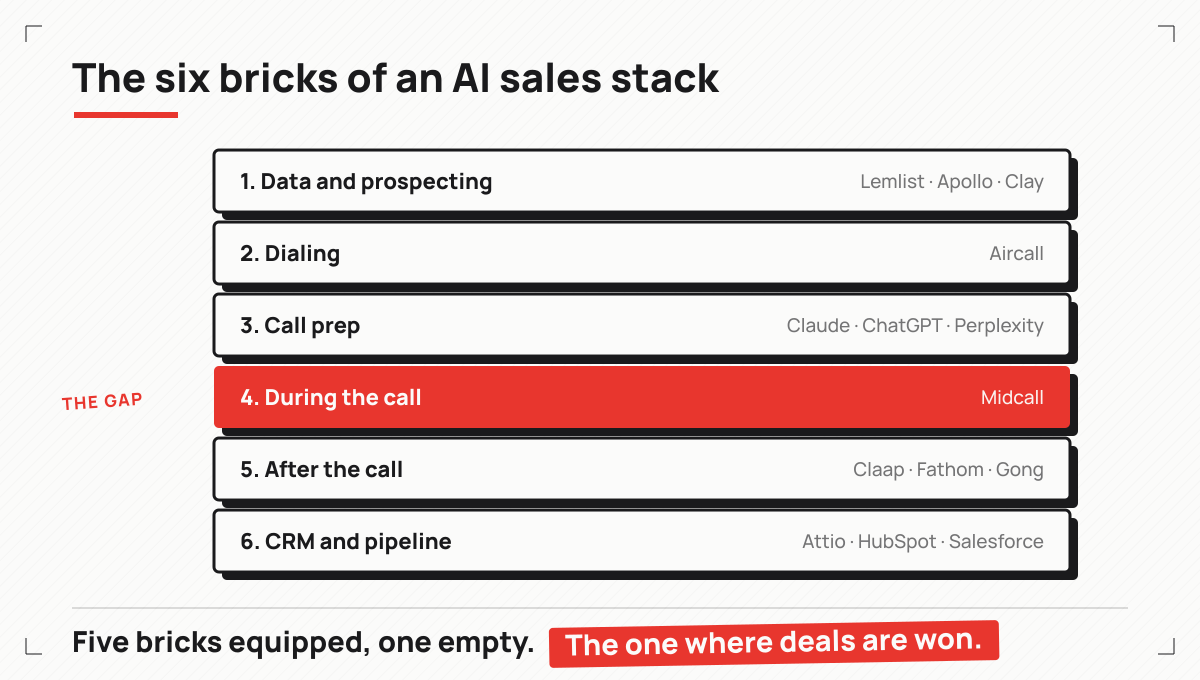
An AI sales stack has six bricks: finding and contacting prospects, dialing, preparing the call, getting help during the call, working the call afterwards, and tracking it in the CRM.
Most teams cover five of them and leave the most decisive one empty.
The numbers back that up. According to stack audits published by Prospeo, the average B2B sales stack runs 8.3 tools at about $187 per rep per month, and 73% of teams waste roughly $2,340 per rep per year on overlap between those tools. Almost all of that spend sits either before the call or after it.
I co-founded Midcall, and I also co-founded Meteor, an outbound agency. So I sell these tools and I pay for them. Here is our exact stack, with real amounts.
Prices below were checked in July 2026. Many vendors charge credits or platform fees on top, so always price the full contract before you sign.
This guide builds a full stack with our real budgets. For a tool-by-tool ranking, see The 11 Best AI Sales Tools in 2026.
The stack we run at Meteor
This is a team doing full-time outbound, so the stack is weighted toward the call and the conversation rather than reporting.
| Brick | Tool | What we pay |
|---|---|---|
| Prospecting and enrichment | Lemlist | €200 per month for the agency, not per user |
| Cold calling | Aircall | around €70 per licence |
| Live copilot during the call | Midcall | from €150 per licence |
| Recording and post-call | Claap | €50 per month |
| CRM | Attio | free tier |
For five reps that comes to roughly €1,350 per month, so €270 to €300 per rep, since Lemlist and Claap are shared. Add deep enrichment and a full conversation intelligence platform and you pass €1,000 per rep.
Two deliberate choices. Attio stays on the free tier because at our size a paid CRM would add nothing. And we put more budget into the conversation than into the data, because that is where our deals are decided.
Which stack by team size
| Size | Prospecting and dialing | During the call | After the call | CRM |
|---|---|---|---|---|
| 1 to 5 reps | Apollo or Lemlist | Midcall | Fathom or Claap | Attio free |
| 5 to 20 reps | Lemlist + Aircall | Midcall | Claap | Attio or HubSpot |
| 20 to 50 reps | Clay + Outreach or Salesloft | Midcall | Gong or Claap | HubSpot or Salesforce |
| 50 reps and up | Clay + ZoomInfo + Outreach | Midcall | Gong | Salesforce |
Below twenty reps you need tools that run without a dedicated RevOps function. Above that, value shifts toward consolidated analysis and forecasting, which is what justifies a heavy platform. The during-the-call brick does not change with size, because a startup junior and an enterprise AE hit the same objections.
1. Data and prospecting
| Tool | Best for | Indicative price |
|---|---|---|
| Apollo | Cheapest all-in-one, contact database included | from $49 to $59 per seat |
| Lemlist | Email and LinkedIn sequences with a database built in | $59 (Email Pro) to $99 (Multichannel) per seat |
| Clay | Waterfall enrichment across 100+ sources, RevOps teams | from $149 to $185 per month per workspace, unlimited users |
| Outreach, Salesloft | Sequencing at scale, no database included | Salesloft around $140 to $180 per user |
| ZoomInfo, Cognism | Databases for large teams | quote only |
This is the brick we tested most, and we settled on Lemlist because the multichannel sequence and the contact database live in the same tool, which saves stacking a data provider, a sending tool and a LinkedIn tool.
Two traps here. Clay's entry price hides the credit burn and the LinkedIn Sales Navigator subscription it effectively requires. And Outreach or Salesloft look reasonable until you add the separate data tool they assume you already have.
2. Dialing and cold calling
| Tool | Best for | Indicative price |
|---|---|---|
| Aircall | Cloud phone system, tight CRM integration, fast to deploy | around €70 per licence in our setup |
Invisible in most AI tool roundups, yet essential the moment you call cold. Choose on line quality and CRM integration, the rest is secondary.
3. Preparing the call
This is the brick where general-purpose AI is enough. Claude, ChatGPT or Perplexity will build an account brief, draft discovery questions and anticipate likely objections. We use Claude for this step, because it holds long documents and the nuances of a complex account better. Spend nothing here and write better prompts.
4. During the call: the brick almost nobody has
Look at the logic of your own stack. You invested to fill the pipeline and to analyse what happened. Between the two sits the call, where the deal is won or lost, and it usually has no tool at all.
That is not collective negligence, it was a technical constraint. Helping a rep mid-conversation means transcribing continuously, understanding a sales situation rather than keywords, and answering in under a second, all at once. Two years ago the models that could handle the second condition were too slow for the third. So the entire sales tech market optimised the before and the after. That ceiling has just broken.
Midcall is the tool for this brick, from €150 per licence. It is a browser extension that coaches the rep live during the call, on Google Meet, Microsoft Teams and Zoom. The prospect sees nothing.
| What it does | What it changes |
|---|---|
| The objection response appears the moment it lands | The AI reads the situation, not a keyword: facing "it's too expensive", it tells a smokescreen from a real budget objection |
| Help is personalised per rep | An AE who is weak on objection handling gets far more support there than one who already handles them well |
| The AI knows your company | Your offers, features and competitors, so no more "let me come back to you on that" on a technical question |
| Qualification is tracked live | Your MEDDIC framework shows during the call, with what still needs securing |
| The call is scored afterwards | Recap plus progression call over call |
Two design details decide adoption: the AI shows one line at a time and stays silent below its confidence threshold, and no audio recording is kept, with hosting in Europe. It coaches with the same depth in English and in French. For the detail, see our guide to real-time AI sales coaching.
5. After the call
Two sub-families of AI assistants that are easy to confuse, with a very large price gap between them.
Notetakers transcribe, summarise and push to the CRM.
| Tool | Strength | Indicative price |
|---|---|---|
| Fathom | Best free tier, cleanest summaries | free and unlimited, then about $18 to $28 |
| Fireflies | Deepest CRM integrations | free (800 min), Pro from $10, Business from $19 |
| Otter | Searchable archives, live transcript | free (300 min), Pro around $17 |
| tl;dv, MeetGeek | Generous free tiers | free, then quote based on usage |
| Granola | No bot in the meeting, Mac and Windows | quote only |
Conversation intelligence platforms add methodology scoring, a library of winning calls, deal health and structured manager coaching.
| Tool | Best for | Indicative price |
|---|---|---|
| Claap | Small teams and SMBs, public pricing, no bot | free, then €24 (Pro) or €48 (Business) |
| Gong | Large organisations, advanced forecasting | quote only, Vendr benchmarks put a 50-user deployment near $65K per year |
| Chorus | Teams already running on ZoomInfo data | quote only, sold inside the ZoomInfo suite |
We use Claap at Meteor, and that is a size decision rather than a quality one: at our headcount a full platform would cost five times more for governance features we do not need. Past twenty reps the trade-off flips. If you are looking to replace the tool you already run, we compared the options. If you are weighing the two market references, our Gong and Chorus comparison covers their strengths.
One limitation applies to the whole category: these tools produce data and wait for someone to work it. Without a weekly coaching routine you are paying a lot for a tape recorder.
6. CRM and pipeline
| Tool | Best for | Indicative price |
|---|---|---|
| Attio | Newer teams, usable free tier | free up to 3 seats, then $35 per user per month (Plus) and $79 (Pro) on annual billing |
| HubSpot | SMBs and scale-ups, marketing ecosystem | free up to around $150 per user |
| Salesforce | Large organisations, deep customisation | quote only |
All three ship an AI layer, genuinely useful for forecasting from about twenty reps. Below that, an attentive sales leader reads the pipeline better than a model trained on too little data.
The mistakes that waste an AI budget
Stacking without training. A tool nobody knows how to use produces an invoice, not performance. Two adopted tools beat six installed ones.
Confusing productivity with performance. Saving two hours a week is useful, winning more deals is a different question, and only the second moves your number.
The brick your stack is missing
You have tools to find prospects, to call them, to debrief and to track everything in the CRM. One question remains: what helps your rep while they are on the line with the prospect, at the minute the deal is decided?
If the answer is nothing, that is where your best return sits, and it is also the most direct lever to increase your close rate.
Edward, co-founder of Midcall and of the outbound agency Meteor. Former AE. I sell these tools and I pay for them: I built Midcall because it was missing from my own calls.
Frequently asked questions
How much does an AI sales stack cost?
Between €300 and more than €1,000 per rep per month depending on depth, which is well above the $187 per rep the average stack spends. In our agency the full configuration (Lemlist, Aircall, Midcall, Claap, Attio) runs about €1,350 per month for five reps. Shared tools bring the per-head cost down as the team grows, enterprise platforms push it far back up.
What is the best AI tool for a sales rep?
There is no single answer, because these tools do different jobs. For prospecting, Lemlist combines sequences and a database, and Clay takes over once enrichment gets complex. For help during the call you need a real-time copilot such as Midcall. For recaps, Fathom's free tier is enough for many teams.
What AI stack for a team under five reps?
Apollo or Lemlist for prospecting, Midcall for live help on calls, Fathom or Claap for recaps, and Attio's free tier as CRM. That is enough, and it avoids buying a platform designed for ten times your headcount.
Should you buy a tool for during the call or after the call?
They solve different problems. Post-call tools improve your reps over time and keep the CRM current. A real-time tool acts on the deal in progress. If your deals die in conversation, real time comes first, because no report produced tomorrow rescues a call lost yesterday.
See the live AI coach on one of your calls.
15 minutes. We plug Midcall into a real scenario from your team, you decide.