AI sales assistant: agent, copilot or real-time coach, which one do you need?
Search for "AI sales assistant" and you will find everything and its opposite: robots that make phone calls, note-taking software, analytics platforms. Three families of tools with almost nothing in common share the same name, and choosing without understanding the difference leads straight to the wrong purchase.
An AI sales assistant is software that supports selling with artificial intelligence, and the term covers three distinct families: the AI agent, which runs prospecting conversations in your place; the post-call assistant, which transcribes, summarizes and analyzes your calls after the fact; and the real-time coach, also called a sales copilot, which helps your reps during the conversation itself. The three do not solve the same problem, do not serve the same teams, and should not be compared against each other.
Here is the full taxonomy, what each family does, and the questions to ask before choosing.
What is an AI sales assistant?
An AI sales assistant is software that takes over or augments part of the selling work through artificial intelligence: prospecting, conversing, transcribing, analyzing, suggesting. Adoption has stopped being marginal: per Salesforce's State of Sales 2026 survey of more than 4,000 sales professionals, 87% of sales organizations currently use some form of AI, for tasks like prospecting, forecasting, lead scoring and email drafting.
Look at that list of tasks: every one of them happens before or after the conversation. The AI installed in sales today works massively around the call. It transcribes what was said, summarizes what happened, analyzes what failed. The conversation itself, the moment where the deal is won or lost, stayed out of reach for a long time, for one simple technical reason: latency. Analyzing a live conversation fast enough to help while it is happening only became possible recently. That fallen barrier is what created the third family.
AI agent, post-call assistant, real-time coach: what is the difference?
The distinction fits in one question: who holds the conversation, and when does the AI step in?
| AI agent | Post-call assistant | Real-time coach | |
|---|---|---|---|
| Who talks to the prospect | The AI, autonomously | Your rep, alone during the call | Your rep, helped during the call |
| When the AI acts | In your place, upstream of the cycle | After the conversation | During the conversation |
| What it produces | Qualified meetings on the calendar | Transcripts, summaries, analytics, deferred coaching | The right move at the moment it can still change the outcome |
| The problem it solves | Prospecting volume | Memory and learning | Live performance |
| Who it is for | High-volume outbound teams | Any team running calls | Teams whose deals are won in meetings |
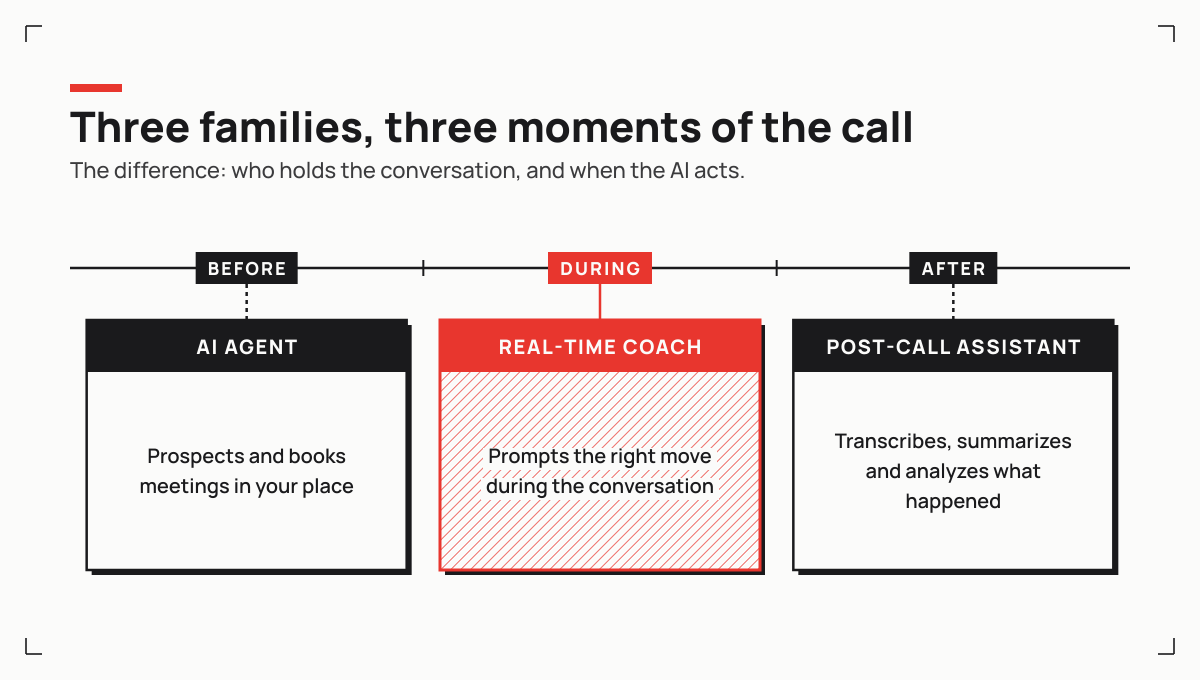
Confusions are expensive in both directions. Buying an AI agent hoping to improve your reps does not improve them: it bypasses them. Buying a post-call assistant hoping to help a struggling junior during their calls only helps after the fact, once the prospect has hung up. Each family answers one precise problem, and yours determines which aisle to shop in.
What does a real-time AI coach do during a sales call?
A real-time coach, the family the market also calls an AI sales copilot, listens to the conversation live, understands where the sale stands and suggests the right move at the useful moment. Concretely, during a discovery or demo call:
| The capability | What it changes on the call |
|---|---|
| Live reading of the sales situation | The tool tells a real objection from a smokescreen, a buying signal from a polite question |
| Suggestion at the right moment | The follow-up question or the objection response appears when it can still be asked, one line at a time |
| Live qualification tracking | The MEDDIC grid fills in as the conversation unfolds: the rep sees what is missing while the prospect can still answer |
| Buying-signal detection in what is said | The moment to ask the closing question becomes visible instead of being a hunch |
| Post-call summary and scoring | Every call produces its analysis: the manager coaches on facts |
A concrete example: mid-demo, the prospect slips in "and how does support work once we have the tool?". A rep focused on their shared screen walks right past it; the real-time coach flags the buying signal and prompts the question that turns that moment into a dated next step.
That is Midcall's family: a browser extension that assists your reps during their Google Meet, Microsoft Teams and Zoom calls, with help personalized per rep, a junior who struggles with objections gets more support than a senior who has them handled, and a manager dashboard that aggregates each rep's scoring, strengths and weaknesses. The category is young and I will not promise you a magic percentage: what a real-time coach changes for certain is that help arrives at the only moment it can still alter the outcome of the call, where the rest of sales AI steps in before or after.
How to choose an AI sales assistant: the six questions to ask
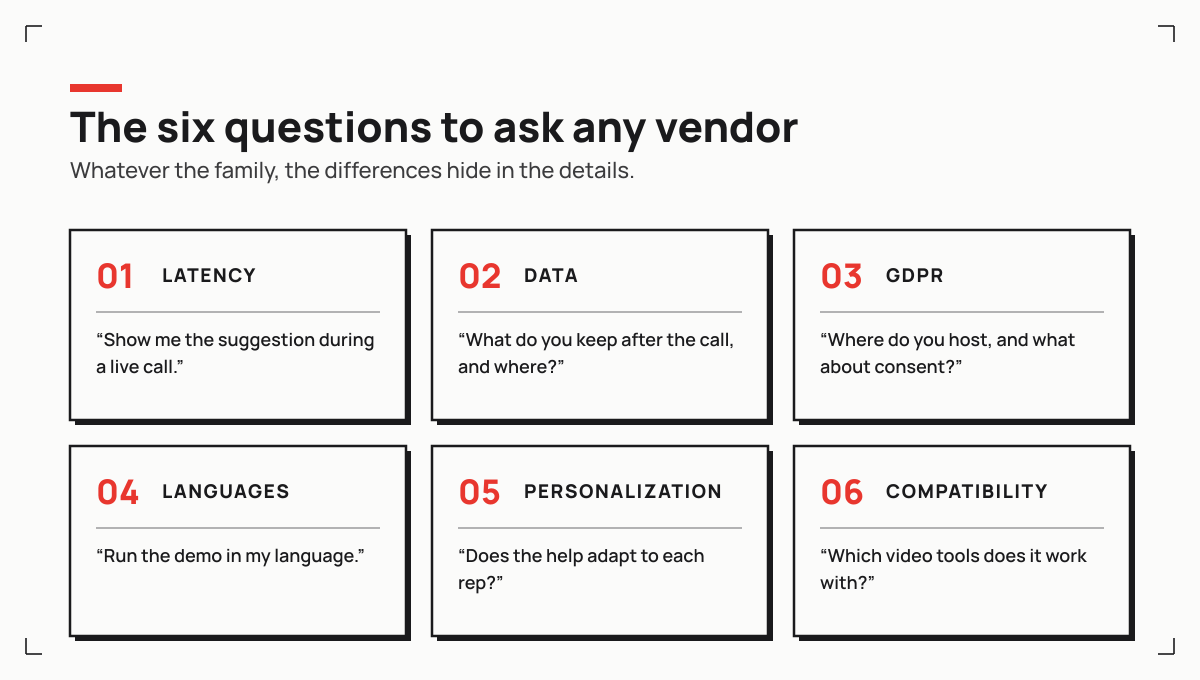
Whatever the family, the demos look alike and the differences hide in the details. Here is the checklist to run with any vendor.
| The criterion | The question to ask |
|---|---|
| Real latency | "Show me the suggestion appearing during a live call, not on a video." |
| Data retention | "What do you keep after the call? Are audio recordings stored, and where?" |
| Hosting and GDPR | "Where is the data hosted, and how do you handle participant consent?" |
| Languages | "Is accuracy the same across languages? Run the demo in mine." |
| Personalization | "Is the help identical for all my reps, or adapted to each one's weaknesses?" |
| Compatibility | "Which video tools does it work with, and what does it require installing?" |
Two of these questions filter fast: latency, because a suggestion that arrives ten seconds late is a useless suggestion, and data retention, because a tool that listens to your sales calls hears your entire pipeline. On that last point, one benchmark: through the Midcall extension no recording is created at all, and in meeting-assistant mode the recording is deleted automatically no later than five days after the meeting, with no copy kept by Midcall. That, plus hosting in Europe, is the standard to demand from the whole category.
Does real-time replace post-call tools?
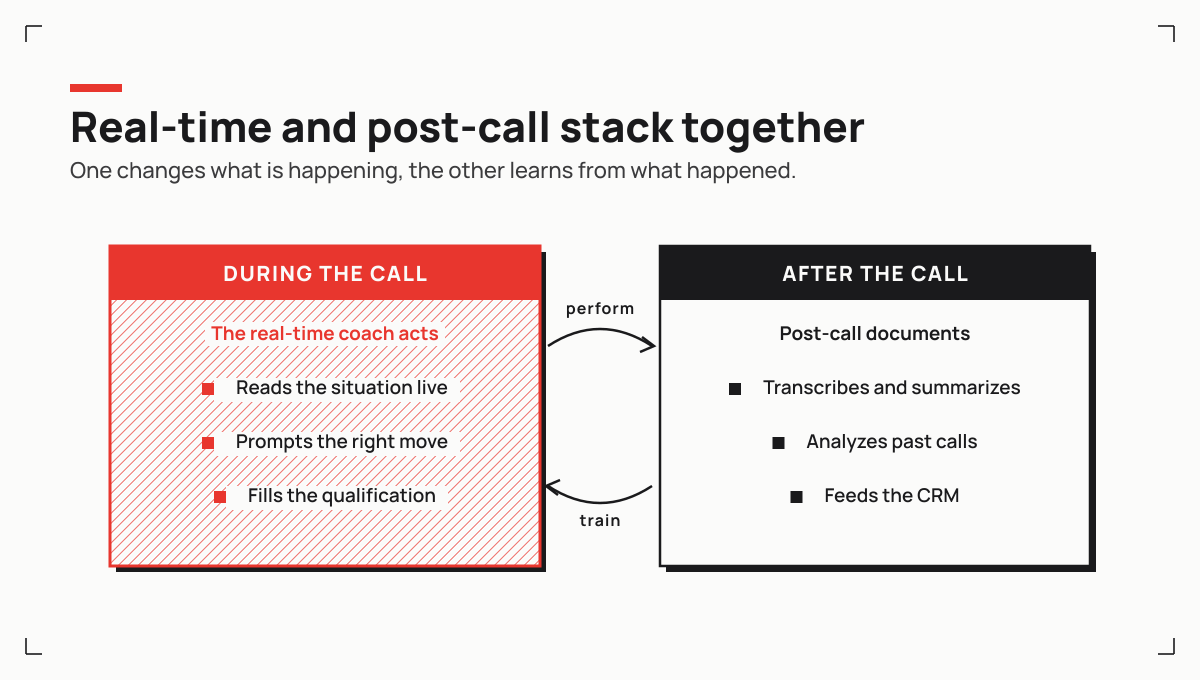
No, the two families complement each other, and the best stacks combine all three. Post-call assistants like Gong, Modjo, Claap or Fireflies document the team's commercial memory: summaries, analysis of past calls, libraries of best practices, CRM enrichment. The real-time coach acts on the conversation in progress. One learns from what happened, the other changes what is happening: a team that improves uses the after to train and the during to perform. Our AI sales stack guide details the combinations by team size, and our article on real-time AI sales coaching covers the method that goes with the tools.
Edward, co-founder of Midcall. Former AE, co-founder of Meteor, a B2B prospecting agency. I write about what actually happens on sales calls, and what the best teams do with it.
Frequently asked questions
What is an AI sales assistant?
An AI sales assistant is software that takes over or augments part of the selling work through artificial intelligence. The term covers three distinct families: the AI agent that runs prospecting conversations in your place, the post-call assistant that transcribes and analyzes your calls afterwards, and the real-time coach that helps your reps during the conversation.
What is the difference between an AI agent and an AI sales assistant?
The AI agent is autonomous: it holds the conversation with the prospect itself, by phone or email, and works instead of the rep. An AI sales assistant, strictly speaking, works for the rep: it helps before, during or after their own conversations without ever replacing them. The question to ask yourself is simple: do you want more conversations, or better conversations?
Is there an AI that helps sales reps during their calls?
Yes, that is the real-time AI coach family, the newest in sales AI. These tools listen to the call live, read the sales situation and suggest the right move at the useful moment: the discovery follow-up, the response to an objection, the closing question when a buying signal appears. Midcall is a real-time coach: it assists reps during their Google Meet, Teams and Zoom calls, with help personalized per rep.
What is an AI sales copilot?
AI sales copilot is the other name for the real-time coach: a tool that assists the rep during their own calls, as opposed to the AI agent that converses in their place. The term comes from aviation: the copilot does not fly the plane, they monitor the situation and call out, at the right moment, what the pilot cannot see alone.
Is an AI assistant that listens to calls GDPR compliant?
It can be, provided you check three points: participant consent to the processing of the conversation, where the data is hosted, and the retention policy. The requirements to set: European hosting and no audio recordings kept after the call. That is the standard Midcall applies, and the level to demand from any tool in the category.
How much does an AI sales assistant cost?
Prices vary widely by family and user volume, with most tools sold per seat per month. For the real-time family, Midcall starts at 150 euros per license per month. To compare the full cost of a stack, our AI sales tools guide details verified pricing, family by family.
See the live AI coach on one of your calls.
15 minutes. We plug Midcall into a real scenario from your team, you decide.