What are the best Gong alternatives in 2026?
The best Gong alternatives in 2026 are Chorus for teams already paying for ZoomInfo, Avoma and Claap for revenue teams that want conversation intelligence without an enterprise rollout, Fireflies and tl;dv when the need stops at meeting notes, and the native conversation intelligence inside HubSpot or Salesforce if you would rather not add a vendor.
These six options change what you pay and how deep the analysis goes. None of them changes when the help arrives, which is the point this comparison handles last because it is the one that matters most.
How this comparison was built
We have none of these tools to sell you. Midcall, the product we build, is not a Gong alternative and does not appear in the ranking. It shows up at the end, in its actual place, as the layer none of these tools replaces.
Pricing was checked in August 2026 against the vendors' own pages and public review data. Where a vendor quotes on request we write that instead of inventing a number, and where public sources disagree we say so. That is the difference with most comparisons on this query, where the publisher ranks itself first on its own list.
Why do teams leave Gong?
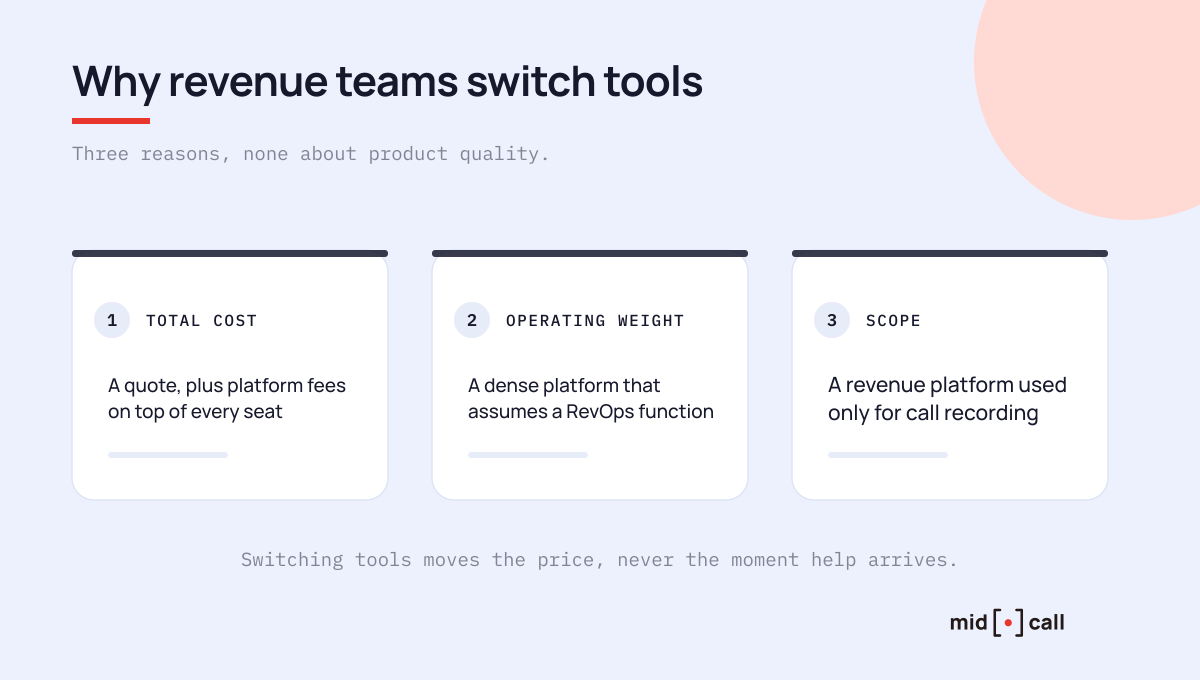
For three reasons that have little to do with product quality. The first is total cost. Gong prices on quote, and the licence line is not the whole bill, since platform fees sit on top of per-seat pricing and rarely appear in the sales conversation. The second is operating weight. The third is scope, when a team discovers it bought a revenue intelligence platform and only uses call recording.
On the operating weight, the pattern in public reviews is consistent. Verified reviews on G2 describe an interface that feels busy when you move between calls, deals and insights, and note a real learning curve before the tool pays off. The surface area is large enough that a team without someone whose job is to configure and drive adoption will under-use most of what it pays for.
None of that makes Gong a bad product. It makes it a badly sized one for a team of five.
When should you stay on Gong instead?
In three situations, switching costs you more than staying, and no comparison written by a competitor will tell you that.
The first is an active RevOps function. If someone already owns the configuration, the scorecards and the deal boards, you have solved the hardest problem in this category. Switching hands that work back to zero.
The second is forecasting that leadership actually uses. Most alternatives on this list analyse conversations well and forecast poorly. If your board reviews a Gong-driven forecast every month, replacing it is a finance project, not a tooling decision.
The third is a call library that carries your onboarding. Thousands of indexed, commented calls tied to enablement programmes do not migrate. You would not be changing tools, you would be starting over.
The comparison at a glance
Pricing checked in August 2026. Quote-based pricing is stated as such rather than guessed.
| Tool | Best for | Pricing |
|---|---|---|
| Chorus | Teams already inside the ZoomInfo ecosystem | On quote, usually bundled with ZoomInfo |
| Avoma | Mid-sized revenue teams that want coaching without an enterprise rollout | From $19 per seat per month annually, with paid intelligence add-ons on top |
| Claap | Teams of 2 to 20 reps analysing calls on a European budget | Free on Basic, then €24 per licence per month annually |
| Fireflies | Cross-functional teams that mainly want meeting notes | Free, then $10 per seat per month annually |
| tl;dv | Small multilingual teams on a tight budget | Free, then around $18 per seat per month annually according to converging public estimates |
| Native HubSpot or Salesforce | Teams already on the upper CRM tiers | Included in your higher CRM licences |
Which alternative fits which team?
Chorus
The original Gong competitor, now part of ZoomInfo. Recording, call scoring and deal analysis, with the real argument being consolidation rather than capability. If your team already pays for ZoomInfo data, Chorus arrives inside a contract you have already signed.
Best for North American teams already committed to the ZoomInfo stack. The limitation is that it was built for the US market, which shows in data residency and in support coverage if your team sells in Europe.
Avoma
An AI meeting assistant that grew into conversation intelligence, with strong transcription and a genuinely useful notetaking layer. It is also the tool where the sticker price and the real price diverge the most, and that deserves saying plainly.
The base plan starts at $19 per seat per month on annual billing, a figure confirmed on G2. The features that make it a sales tool rather than a notetaker, call scoring and deal intelligence, sit in paid add-on modules charged per seat, which several 2026 pricing analyses put around $29 each. A rep who needs coaching therefore lands near $77 per seat per month, not $19.
Best for revenue teams that want coaching and analytics without an enterprise implementation. The limitation is budget predictability, since the modules stack per seat and the tier structure changes often.
Claap
Call analysis built for teams without a RevOps function. Transcription, summaries, coaching against your own methodology, and a rollout measured in days rather than weeks. Claap was acquired by lemlist in 2026, which places it inside a wider prospecting ecosystem.
Best for teams of 2 to 20 reps that want call analysis on a European budget. The limitation is analytical depth against enterprise platforms, enough to coach, thinner to run a forecast on.
Fireflies
The automatic notetaker that joins meetings, transcribes, summarises and pushes action items, with search across the whole library. Deliberately generalist, and priced accordingly.
Best for never taking meeting notes again, in an organisation where the need goes beyond the sales team. The limitation is that it documents your calls without coaching your reps, which makes it a partial replacement rather than an equivalent.
tl;dv
A multilingual meeting recorder with a generous free tier that has moved upmarket toward coaching and CRM sync on its higher plans. Data now sits on European servers, though AI processing can still run elsewhere depending on your settings, which is worth checking if residency matters to you.
Best for small teams testing the category without commitment. The limitation is pricing legibility, since public 2026 figures diverge noticeably between sources, so confirm your own quote before signing.
Your CRM's native conversation intelligence
HubSpot Sales Hub and Salesforce Einstein Conversation Insights transcribe calls and surface keywords and key moments without an integration to maintain. This is the option every comparison forgets, and it settles the need for a real share of teams.
Best for organisations already on the upper tiers of their CRM with straightforward analysis needs. The limitation is customisation, since extracting structured data into your own fields stays thinner than with a dedicated tool.
What none of these alternatives changes
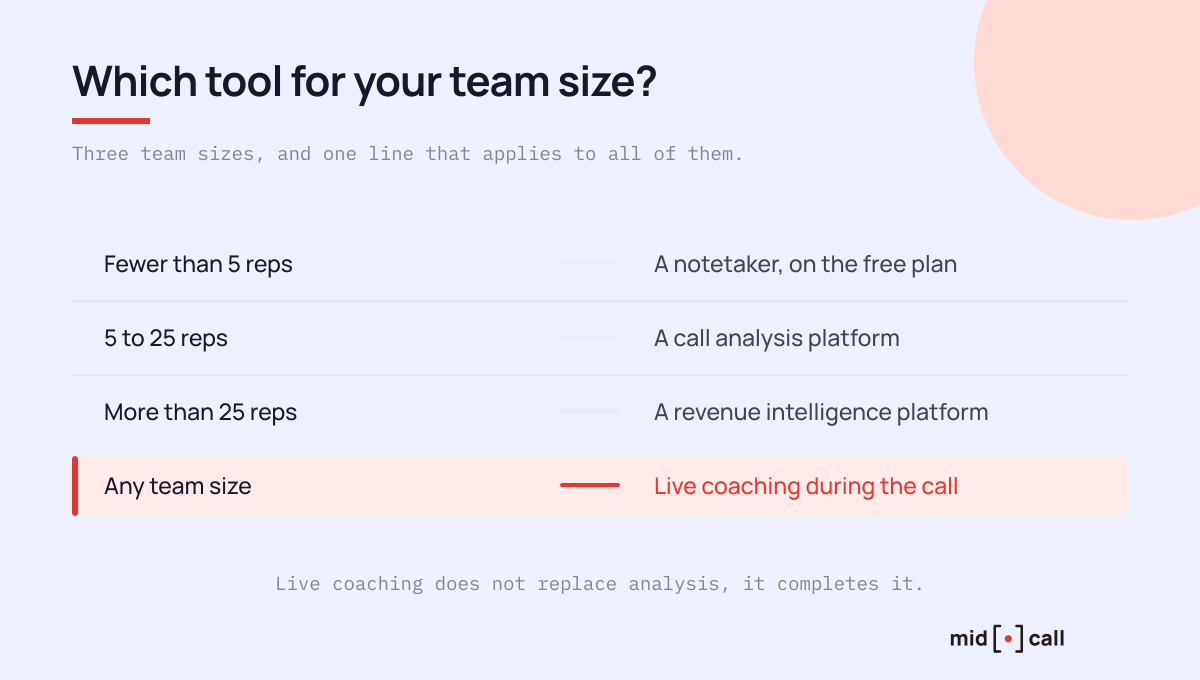
They all analyse the conversation once it is over. You are choosing between depths of analysis, price points and transcription quality, but the moment of the help is identical in all six cases. The summary arrives after, the scoring arrives after, the manager's coaching arrives after.
The deal is not decided after. It is decided when the prospect says the price is too high, when they say they need to think about it, when they ask the question nobody on your team had prepared an answer for. At that moment, none of these tools is there.
Midcall coaches during the call, then compounds it after
Midcall is a coaching tool, not another analysis platform. The difference fits in one sentence. The others show a manager what happened, Midcall makes the rep better while it is happening.
During the call, the extension puts the guidance inside the Google Meet, Teams or Zoom window. It reads the sales situation live, tells a smokescreen from a real objection, prompts the question that digs one line at a time, and tracks qualification against the framework your team actually runs. SPIN, SPICED, BANT, MEDDIC, MEDDPIC or Challenger, you set the default and switch when the context calls for it, because a short high-volume cycle does not get qualified like an enterprise RFP.
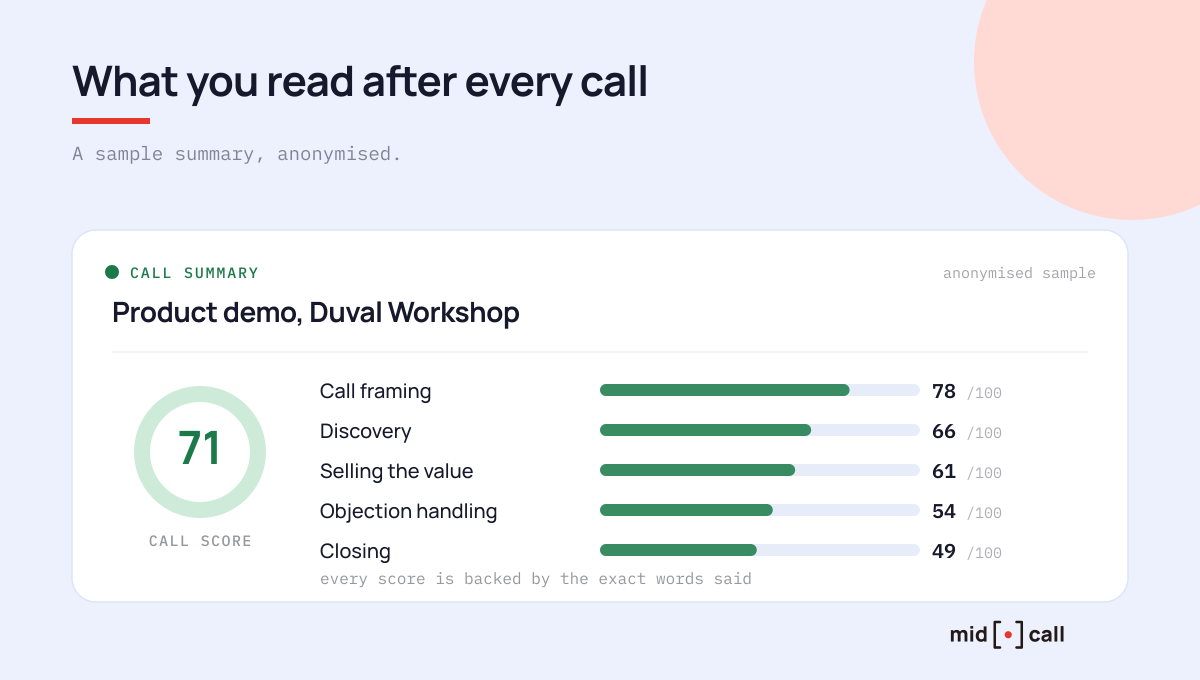
After the call, the summary does more than summarise. Every call is scored out of 100, broken down by skill, call framing, discovery, selling the value, objection handling and closing, then by dimension inside each one. Every score is justified with the exact sentences spoken on the call and ends with what it would have taken to reach 100. You also get the objections raised with the answer the rep actually gave, the next steps, monologues longer than a minute, talk time against a target, and the share of live prompts the rep applied.
What that changes for a sales leader
Coaching stops being a matter of opinion. Per rep and over the period you choose, you see the average score, the skills carrying the team, the ones costing deals, and the objection families your prospects raise most. You know where to push before you open a single call, which is several hours a week saved against listening back to recordings, and a diagnosis grounded in evidence rather than in whoever reviewed the call.
The help is personalised per rep, and it sharpens call after call as it adapts to each person's style. A rep who folds on objections is not supported in the same place as one who misses buying signals.
Midcall sits next to your analysis tool, not in its place
We do not replace Gong, Modjo or Claap, and we are not trying to. Midcall integrates with all three. The Midcall bot joins the call and passes the recording to the tool you already use, which means you never put two robots in front of a prospect. On the CRM side, everything flows into HubSpot, Salesforce or Attio, summaries and next steps included, which removes the data entry chore entirely.
One point of honesty to close. Midcall is a young product and I will not promise you a percentage of deals saved that we do not yet measure. Everything above is verifiable in twenty minutes on one of your own calls.
Which Gong alternative should you pick?
| Your situation | Where to start |
|---|---|
| Fewer than 5 reps, tight budget | Fireflies or tl;dv, starting free |
| 5 to 20 reps, coaching to structure | Claap, or Avoma if you accept the add-on math |
| You already pay for ZoomInfo | Chorus, inside the contract you have |
| You have an active RevOps function and a forecast leadership uses | Stay on Gong, switching costs more than it saves |
| You are already on upper-tier HubSpot or Salesforce | Test the native layer before adding a vendor |
| Your reps are on their own during calls | Midcall, alongside your analysis tool |
Edward, co-founder of Midcall. Former AE, co-founder of Meteor, a B2B prospecting agency. I write about what actually happens on sales calls, and what the best teams do with it.
Frequently asked questions
What is the best Gong alternative?
There is no single answer, it depends on your size and your stack. Below twenty reps, Claap and Avoma cover the need without an enterprise rollout. Inside the ZoomInfo ecosystem, Chorus arrives in a contract you already signed. For meeting notes alone, Fireflies or tl;dv are enough. Above twenty-five reps with a RevOps function, nothing on this list matches Gong's depth.
Is Gong worth it for a small sales team?
Rarely. Public reviews converge on a dense interface and a real learning curve, and the platform assumes someone whose job is to configure it and drive adoption. A team of five pays for a surface area it will not use, and platform fees sit on top of per-seat pricing. The product is excellent, the sizing is the issue.
How much do Gong alternatives cost?
From nothing to several hundred dollars per rep per month. Notetakers start free and run $10 to $20 per seat, conversation intelligence platforms sit between roughly €24 and $77 per seat once you account for add-on modules, and enterprise revenue intelligence is quoted on request with platform fees on top of licences.
Can your CRM replace Gong?
Yes if your need stops at transcription and a few coaching signals. HubSpot Sales Hub and Salesforce Einstein Conversation Insights do that work with no integration to maintain. The limit shows up as soon as you want structured data in your own fields or your own sales methodology applied, where dedicated tools keep a clear lead.
Does Midcall replace Gong?
No, and that is not its purpose. Midcall is a coaching tool that works during the call, where the others analyse after it. The integrations with Gong, Modjo and Claap are live, the Midcall bot passes the recording to your analysis tool so you never have two bots in one meeting, and everything syncs into HubSpot, Salesforce or Attio.
Which sales frameworks does Midcall track?
The main frameworks in use, SPIN, SPICED, BANT, MEDDIC, MEDDPIC and Challenger. Your team sets the default and switches when the deal calls for it, since a fast high-volume cycle is not qualified like a large enterprise bid. Tracking happens live during the call, and the post-call summary shows where qualification slipped.
Should you switch tools or add one?
Ask what the actual problem is. If nobody opens your call summaries, a new analysis tool changes nothing, the issue is adoption. If your reps lose deals on objections they mishandle live, no post-call platform solves it, because they all arrive afterwards. Plenty of teams do not need a replacement, they need the layer that is missing.
See the live AI coach on one of your calls.
15 minutes. We plug Midcall into a real scenario from your team, you decide.