Avoma vs Midcall: which one does your sales team need?
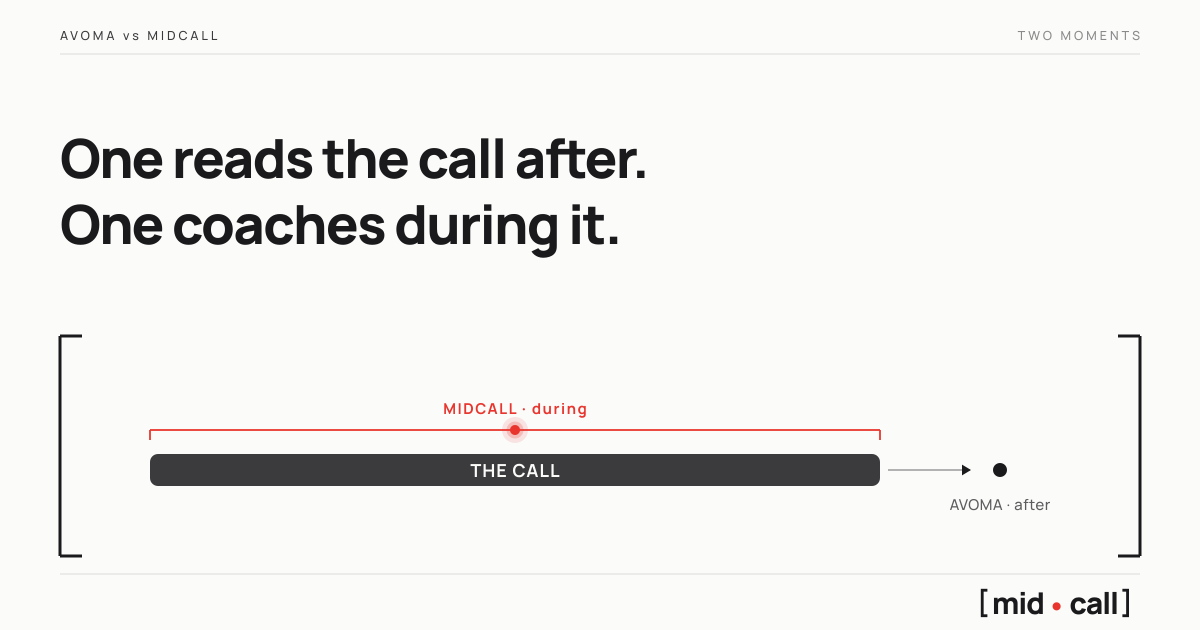
Avoma and Midcall are often compared, but they work at two different moments. Avoma records and analyzes a call after it ends. Midcall coaches the rep while the call is happening. This guide compares what each one does, what they cost, and which your team actually needs.
What is Avoma?
Avoma is an AI meeting assistant and conversation intelligence platform. A bot joins the call on Zoom, Google Meet or Microsoft Teams, records and transcribes it, writes a summary with action items, and syncs the result to the CRM. On top of that base, it offers conversation intelligence, call scoring, coaching analytics and deal tracking, so a manager can review calls and spot patterns after the fact.
It does that job well, and its base pricing is transparent, which is rare in this category. According to Avoma's published 2026 pricing, the base plans are billed per recorder seat and start at 19 dollars per seat per month on annual billing for Startup, 29 for Organization and 39 for Enterprise. The catch for a sales team is that the coaching features are not in the base plan. Conversation Intelligence and Revenue Intelligence are paid add-ons at 29 dollars per seat each, which is why several public pricing analyses put the real cost of a fully equipped sales seat at roughly 77 dollars per seat per month on annual billing, as of September 2026. Prices change, so confirm the current figure on Avoma's own pricing page before you budget.
What is Midcall?
Midcall is a real-time AI sales coach. It runs alongside a call on Google Meet, Microsoft Teams and Zoom, follows the conversation as it unfolds, and prompts the rep with the right line at the moment it is needed, one suggestion at a time so the rep stays focused on the buyer. It reads whether an objection is a real one or a smokescreen, tracks the qualification framework the team uses, whatever it is, and flags a buying signal the rep is about to talk past.
After the call it scores the conversation out of 100 and each competency, framing, discovery, value selling, objection handling and closing, with the exact verbatims behind each score and advice to do better next time. Managers get a team view with each rep's progression and the objection families that come up most. Midcall is built for the rep in the room and for the manager coaching them, and it works during the call, not only after.
Avoma vs Midcall: what is the real difference?
The difference is not a feature checklist, it is a moment. Avoma looks at the call after it ends and tells you what happened, which is the definition of conversation intelligence. Midcall works during the call and helps change what happens while the deal is still live. One is a mirror, held up after the conversation. The other is a coach, present in it.
That difference decides everything else. Post-call analysis is excellent for the manager reviewing deals on Friday and for the rep learning from last week. It cannot help the rep who freezes on an objection at 2pm on Tuesday, because by the time the analysis exists, the deal is already won or lost. Real-time coaching is the opposite: it does nothing for last week's calls, and everything for the one happening now.
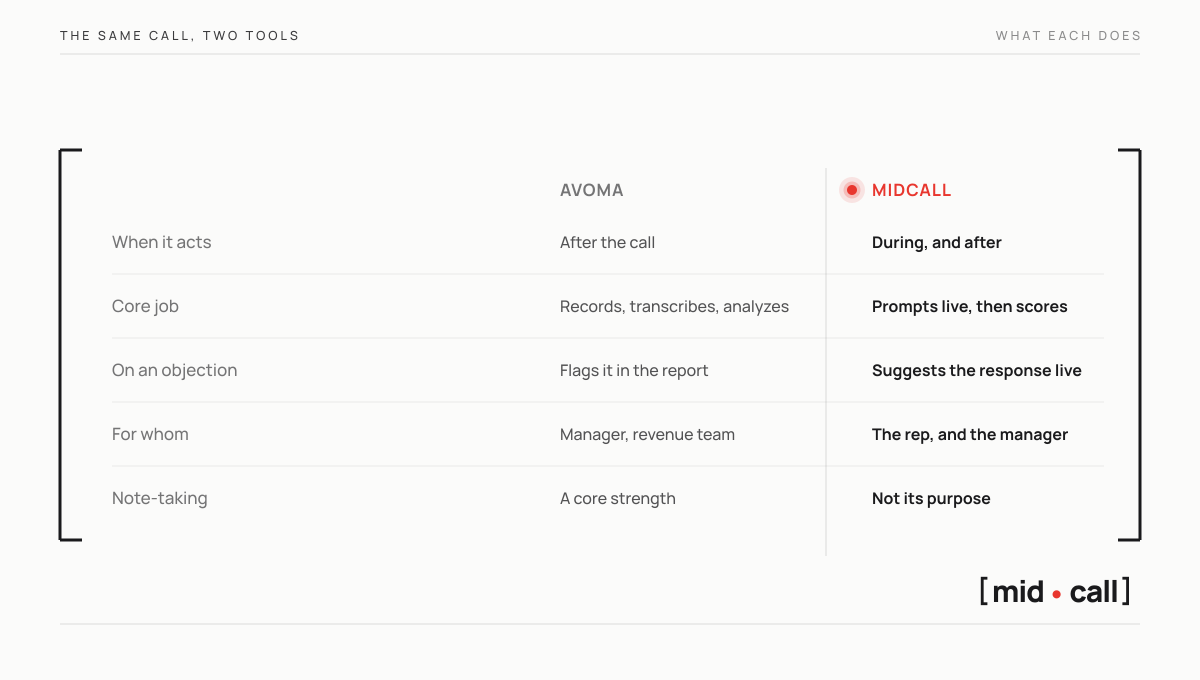
Here is the same call seen by each tool.
| Avoma | Midcall | |
|---|---|---|
| When it acts | After the call | During the call, and after |
| Core job | Records, transcribes, analyzes | Prompts the rep live, then scores |
| For whom | Manager, revenue team | The rep in the room, and the manager |
| On an objection | Flags it in the post-call report | Suggests the response while it is happening |
| Output | Summary, analytics, deal insights | Live cues, then a score per competency |
| Note-taking | Yes, a core strength | Not its purpose |
Read that table honestly and the conclusion is not that one wins. It is that they answer different questions.
Which one should your sales team choose?
Choose based on the problem you are actually trying to solve.
If your main need is to stop reps taking manual notes, to get clean transcripts and summaries, and to give managers a way to review calls after the fact, Avoma is a strong, fairly priced fit, and the base plan alone may be enough. If your reps are good but you want the deals reviewed and the CRM kept clean automatically, that is Avoma's home ground.
If your problem is that reps miss objections, skip qualification or freeze in the moment, and you want them helped while the call is live rather than told afterwards, that is what Midcall is built for. It is also the faster lever on ramp, since a new rep gets the right line on their first real calls instead of waiting for a Friday debrief.
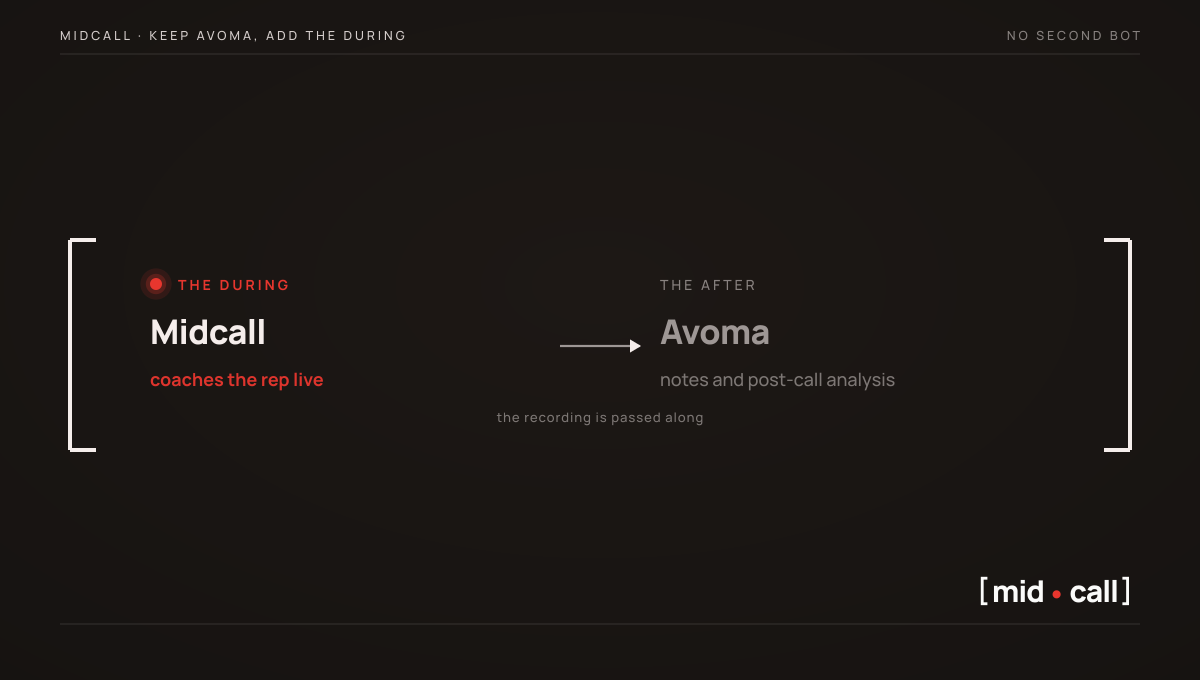
And the two are not mutually exclusive. Midcall connects to conversation intelligence and post-call tools rather than replacing them, and passes the recording along so you never run two bots in one meeting. A common setup is one tool for the after and Midcall for the during.
Does Midcall replace your conversation intelligence tool?
No, and it is not meant to. If you already run Avoma, Gong, Modjo or Claap for post-call analysis, keep it. Midcall adds the layer none of them work in, the live call, and connects to them so the recording and the analysis still happen in the tool you already use. The post-call platform keeps telling you what happened across every call. Midcall helps the rep while it is still happening, and scores each call so coaching starts from evidence rather than memory. If you are weighing the post-call options themselves, our guides on Gong alternatives and Gong vs Chorus cover that side.
Edward Labruyère, co-founder of Midcall. Former B2B SaaS AE, co-founder of Meteor, a B2B prospecting agency. I write about what actually happens inside sales calls, and what the best teams do about it.
Frequently asked questions
Is Midcall an Avoma competitor?
Only partly. They overlap on post-call scoring, but Avoma's core is meeting notes and post-call analysis, while Midcall's core is coaching the rep during the call. On note-taking, Avoma is stronger. On live coaching, Avoma does not compete, because it works after the call.
How much does Avoma cost in 2026?
Per Avoma's published pricing, base plans start at 19 dollars per seat per month annually for Startup, 29 for Organization and 39 for Enterprise. Conversation Intelligence and Revenue Intelligence are paid add-ons at 29 dollars per seat each, so public analyses put a fully equipped sales seat near 77 dollars per seat per month, as of September 2026. Confirm the current figure on Avoma's pricing page.
Does Avoma coach reps in real time?
No. Avoma records and analyzes calls after they end. Its coaching features are post-call analytics and scorecards. Real-time guidance during the call is a different capability, and it is what Midcall provides.
Can you use Avoma and Midcall together?
Yes. Midcall connects to conversation intelligence tools and passes the recording along, so you keep Avoma for notes and post-call analysis and add Midcall for live coaching, without a second bot in the meeting.
Which is better for a small sales team?
If the priority is notes and transcripts, Avoma's Startup plan is an affordable start. If the priority is getting reps to sell better on live calls, Midcall targets that directly. Many small teams end up needing both jobs done, at which point the two run side by side.
See the live AI coach on one of your calls.
15 minutes. We plug Midcall into a real scenario from your team, you decide.