Gong vs Chorus: the honest 2026 comparison (and what both miss)
Gong and Chorus do the same thing at the core: they record your sales calls, transcribe them, and analyze them so you can see, after the fact, what worked and what stalled. The real difference sits elsewhere.
Gong is the standalone category leader in revenue intelligence, built for teams that want deep forecasting and deal intelligence in one best-of-breed platform. Chorus is a strong conversation intelligence product that now lives inside ZoomInfo, sold mostly as the intelligence layer on top of ZoomInfo's sales data.
Quick take: if you want the deepest standalone conversation and revenue intelligence and you are willing to pay for it, Gong leads. If you already run on ZoomInfo data and want conversation intelligence in the same suite, Chorus is the natural fit. And one thing neither of them does: neither tells your rep what to say while they are still on the call with the prospect. We come back to that, because it is usually where the deal is won or lost.
Gong vs Chorus in one sentence each
Gong is a revenue intelligence platform. It captures your calls, emails, and meetings, then powers forecasting, deal-risk detection, and manager coaching. It positions itself as a "Revenue AI Operating System" and targets revenue leaders and RevOps teams in larger organizations.
Chorus is a conversation intelligence platform owned by ZoomInfo, which acquired Chorus.ai in 2021. It records, transcribes, and scores calls, surfaces objections and competitor mentions, and feeds coaching workflows. In 2026 it sits inside the broader ZoomInfo Sales OS rather than being sold as a fully standalone product to most new buyers.
Both are genuinely good products. They just do not solve quite the same problem, or serve quite the same buyer.
Gong vs Chorus comparison table
| Criterion | Gong | Chorus (by ZoomInfo) |
|---|---|---|
| Origin / owner | Independent company (San Francisco) | Owned by ZoomInfo (acquired Chorus.ai, 2021) |
| Core market | Mid-market and enterprise, standalone buyers | ZoomInfo ecosystem customers, enterprise |
| When it helps | After the call | After the call |
| Core product | Revenue intelligence, forecasting, deal intelligence | Conversation intelligence inside ZoomInfo's Sales OS |
| Sold standalone? | Yes, best-of-breed | Increasingly bundled with ZoomInfo data |
| Forecasting | Advanced, a central argument | Present (Momentum, deal health), less central |
| Coaching | Scorecards, analytics for managers | Playlists, winning-behavior analysis, scorecards |
| G2 rating (aggregates) | ~4.7/5 | ~4.5/5 |
| Pricing (third-party est.) | ~$1,200 to 1,600/seat/yr + platform fee, quote-only | ~$8,000/yr base (3 seats) + ~$1,200/seat, quote-only |
Gong: who it is for, strengths, limits, pricing
Who it is for
Gong speaks first to larger sales organizations. It is the category leader: the platform was named a Leader in the 2025 Gartner Magic Quadrant for Revenue Action Orchestration, and its customer list includes names like LinkedIn, Shopify, and Microsoft, according to industry analyses. That depth shows in the product.
Its strengths
Capture is excellent. Gong records everything, transcribes across many languages, and flags competitor mentions, talk ratios, and buying signals. Where it pulls ahead is forecasting and reading the pipeline at scale. For a sales leader running dozens of reps who has to commit a number to the board, Gong Forecast is a real asset. Its objection detection and multi-language competitor extraction have improved sharply in recent years.
Its limits
The most common critique of Gong fits in one line: it records, it analyzes, then it hands the work back to you. You inherit a rich dashboard, but the "so what do I do now" is still your job. In practice, Gong only pays off if your managers run real coaching routines around the data. Teams that buy it as a recording tool waste most of what they pay for. Add a premium price point and a buying motion built for enterprise, and Gong can feel like overkill for a smaller team.
How much does Gong cost?
Gong does not publish pricing. Every quote is custom, annual, and billed per seat. We broke down Gong's pricing and its three layers in a dedicated article. Based on aggregated transaction data from the procurement platform Vendr, the license runs roughly $1,200 to $1,600 per seat per year for the core tier, with larger enterprise bundles going higher. On top of that, most contracts carry a mandatory platform fee, estimated at $5,000 to $50,000 per year across independent procurement analyses, plus onboarding. So the effective per-user cost is usually well above the sticker seat rate. These are third-party estimates: Gong is private with no public pricing, so confirm directly with the vendor.
Chorus: who it is for, strengths, limits, pricing
Who it is for
Chorus fits teams already invested in ZoomInfo. If your reps prospect on ZoomInfo data and you want conversation intelligence in the same ecosystem, Chorus is the path of least resistance. It remains a well-regarded product: it holds a rating around 4.5 out of 5 on G2 across nearly 3,000 reviews, per review aggregates.
Its strengths
Chorus does the conversation intelligence fundamentals well: recording, transcription, topic and competitor tracking, and CRM sync. Its coaching layer is a genuine strength, with playlists of winning calls, winning-behavior analysis, and scorecards that help new reps ramp faster. Deal intelligence (Momentum scores, deal-health signals) gives managers a read on which deals are slipping. And because it sits inside ZoomInfo, conversation insights can connect to account and contact data in one place.
Its limits
Two things stand out. First, like Gong, Chorus is a post-call tool: it shows you what happened and helps you fix the next call, not the current one. Second, the bundle. Chorus is increasingly sold alongside ZoomInfo's data and engagement products, which raises the total even when you only wanted the call recorder, and can pull you into a multi-year commitment. If you want conversation intelligence without the wider ZoomInfo stack, that pressure is worth weighing.
How much does Chorus cost?
Chorus does not publish pricing either; it is quote-only, annual, and often bundled with ZoomInfo. The benchmark that independent procurement reports converge on is roughly $8,000 per year for a 3-seat base package, then about $1,200 per additional seat per year, which puts a 10-rep team near $16,000 and an effective rate around $1,000 to $1,800 per seat per year, according to third-party breakdowns. Bundling ZoomInfo data can add $15,000 to $40,000 per year on top. As with Gong, these are third-party estimates, not official rates, and vary with seat count and negotiation.
The thing both Gong and Chorus miss
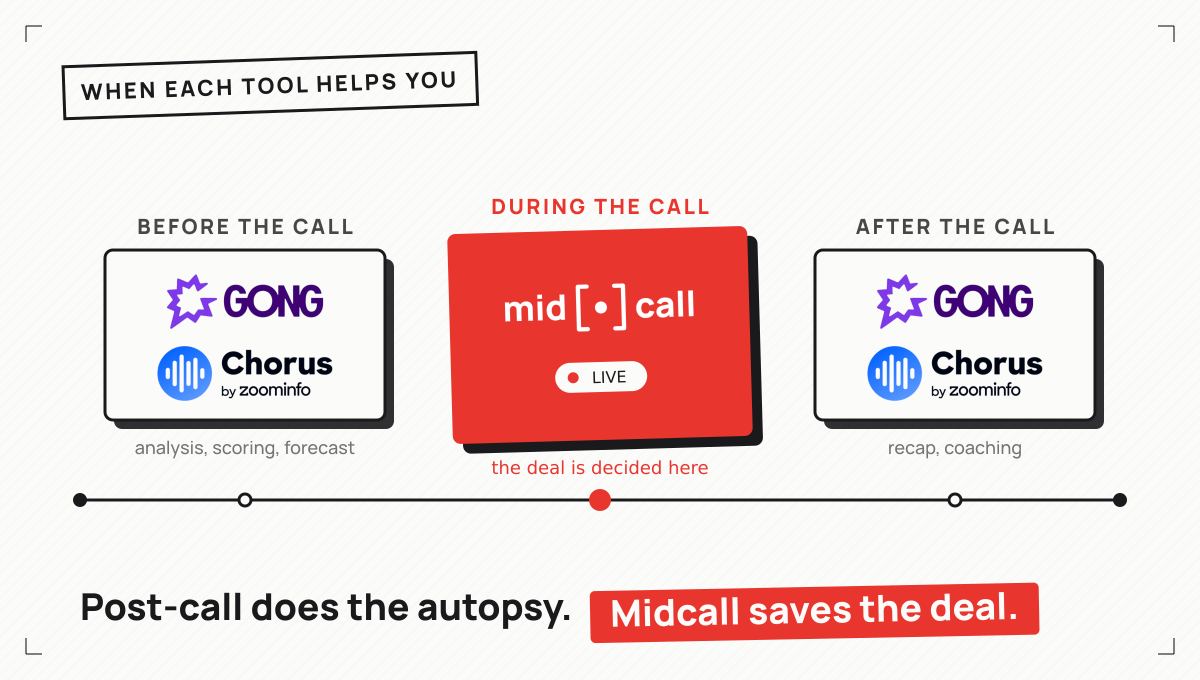
Here is the blind spot Gong and Chorus share, along with almost the entire category: they all work before or after the call, never during it.
It sounds minor. It is not. Think about the last deal you lost. The rep hit a pricing objection, answered off the mark, promised to "send a recap," and the prospect never called back. Gong and Chorus will tell you the next day, beautifully analyzed, in a clean report. Except the deal is already dead. Post-call does the autopsy. It does not save the patient.
That is exactly the gap Midcall fills. Midcall is a browser extension that coaches the rep live, during the call on Google Meet, Microsoft Teams, and Zoom: advice cards that appear at the right moment, one-tap objection handling, scoring and a summary at the end. The prospect sees nothing. The rep gets the right answer when they need it, not twelve hours too late. That is the principle behind real-time AI sales coaching, which I cover in a dedicated guide.
The right way to think about it is not "Midcall vs Gong" or "Midcall vs Chorus." It is complementary. Plenty of strong teams run both timelines: Midcall to win the call live, Gong or Chorus to analyze, forecast, and scale coaching afterward. Not having a post-call tool means flying blind on analysis. Not having Midcall means having no help at the exact moment the deal is won or lost. To see where each brick sits in a complete setup, our AI sales stack guide covers all of them, budgets included.
How to choose between Gong and Chorus
Three questions settle it in most cases.
Are you already on ZoomInfo? If yes, Chorus keeps everything in one ecosystem and one contract. If not, buying Chorus often means buying into the ZoomInfo stack, and Gong may be the cleaner standalone choice.
Is your priority best-of-breed forecasting or ecosystem convenience? If you need the deepest pipeline forecasting and deal intelligence on its own, Gong is more advanced. If you want conversation intelligence sitting next to your prospecting data, Chorus is more convenient.
What is your team size and budget? Gong's platform fee weighs heavily on smaller teams. Chorus's bundle pressure does the same. Both are enterprise-priced, so map the all-in cost, not just the seat rate, before you sign.
And in both cases, ask a fourth question: what helps your reps during the call, not just after it? Because that is where your close rate is decided, and it is precisely what Gong and Chorus leave out.
The real question is not Gong or Chorus
Your post-call tools will tell you, in detail, why you lost. They will not help while it is still winnable. That is the whole difference between analyzing a dead deal and saving a live one. Want to see what that looks like on your own calls? with your reps: I'll show you in 20 minutes and you test it after.
Edward, co-founder of Midcall and former AE. I built the tool I wish I'd had on my calls: a coach that talks during the call, not after.
Frequently asked questions
What is the difference between Gong and Chorus?
Gong is a standalone revenue intelligence platform focused on forecasting, deal intelligence, and coaching at scale. Chorus is a conversation intelligence product owned by ZoomInfo, sold mostly as the intelligence layer inside ZoomInfo's sales data platform. Both record and analyze calls after they happen.
Is Chorus still a standalone product?
Chorus was acquired by ZoomInfo in 2021 and, in 2026, is positioned inside the broader ZoomInfo Sales OS. It is still a capable conversation intelligence tool, but it is increasingly sold bundled with ZoomInfo's data and engagement products rather than as a fully standalone platform.
Do Gong and Chorus coach reps during the call?
No. Both Gong and Chorus work before or after the call: preparation, analysis, scoring, and coaching after the fact. Neither provides real-time help while the call is happening. For live coaching during a Google Meet, Teams, or Zoom call, you need a dedicated tool like Midcall.
How much do Gong and Chorus cost?
Neither publishes public pricing; both are quote-only, annual, and billed per seat. Third-party estimates put Gong at roughly $1,200 to $1,600 per seat per year plus a $5,000 to $50,000 platform fee. Chorus commonly benchmarks around $8,000 per year for 3 seats plus about $1,200 per additional seat, with ZoomInfo bundling adding more. These are third-party figures, not official rates, and vary by team size.
Can you use Midcall alongside Gong or Chorus?
Yes, and it is the most common setup for teams that want full coverage. Midcall coaches the rep live during the call; Gong or Chorus take over afterward for analysis, forecasting, and deep coaching. The two timelines are complementary, not competing.
See the live AI coach on one of your calls.
15 minutes. We plug Midcall into a real scenario from your team, you decide.