How much does Gong actually cost in 2026?
Gong costs between $1,300 and $1,600 per user per year for its Foundations licence, plus a mandatory platform fee of $5,000 to $50,000 a year that does not scale with headcount, plus onboarding that starts around $7,500.
Add-on modules, renewal uplifts and multi-year commitments push the real first-year figure well above the seat rate you will hear on a sales call. Here is how the bill is built, what three team sizes actually pay, and where the negotiation room sits.
Why is there no official Gong price?
Because Gong sells through a quote, with no self-serve plan and no published grid. That is a deliberate commercial choice, common among enterprise revenue platforms, and it means any figure you read online is reconstructed rather than official.
So a word on method, because it decides how much you should trust what follows. The numbers below come from three types of source that have no interest in agreeing with each other. Procurement platforms that negotiate these contracts on behalf of buyers, Tropic among them, publish observed ranges. Vendor analyses reconstruct the model from buyer reports, including Claap's teardown of the three-part structure. And public review data, notably the volume of verified reviews on G2, gives a sense of who actually runs the platform.
Where those sources converge, we state a range. Where they diverge, we say so. Nothing here is an official Gong figure, and you should confirm your own quote with the vendor.
What are the three layers of a Gong bill?
The mistake almost every buyer makes is doing seat math. Gong is not priced per seat, it is priced in three stacked layers, and the one that hurts small teams the most is the one that has nothing to do with headcount.
| The layer | Reconstructed range | What it depends on |
|---|---|---|
| Platform fee, annual | $5,000 to $50,000 | Your tier and negotiation leverage, not your user count |
| Foundations licence, per user per year | $1,300 to $1,600 | Volume, with negotiated deals reported closer to $1,000 at scale |
| Onboarding, one-off | From $7,500, higher on complex setups | Your CRM, your integrations, the depth of configuration |
| Add-on modules, per user per year | Roughly $700 to $800 each | Forecast and Engage, each requiring a Foundations licence on top |
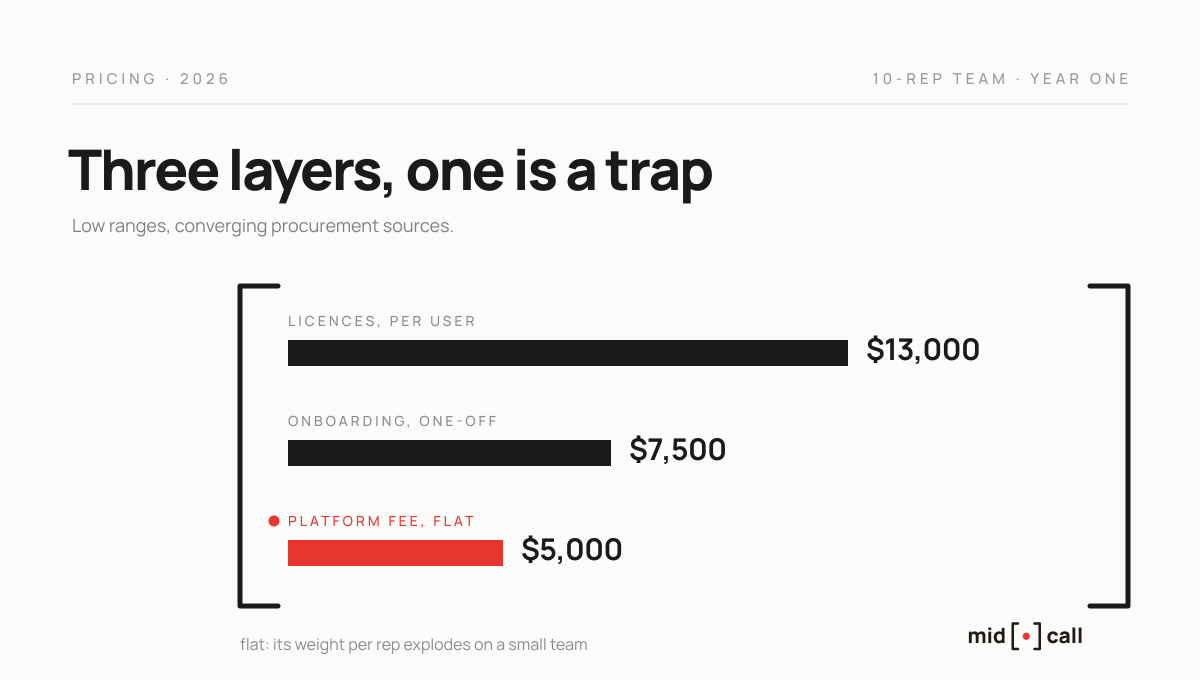
The platform fee is the layer that changes everything. Because it is flat, its weight per rep falls as the team grows and explodes as the team shrinks. That single mechanic explains why Gong feels reasonable to a fifty-person revenue org and brutal to a team of eight, for exactly the same product.
What does Gong cost for a 10, 25 or 50-rep team?
Here is the reconstruction, using the low end of each published range so the figures stay conservative. These are estimates built from converging public sources, not quotes.
| Team size | Licences at $1,300 | Platform fee, low end | Onboarding, low end | Year one, low estimate | Effective cost per rep |
|---|---|---|---|---|---|
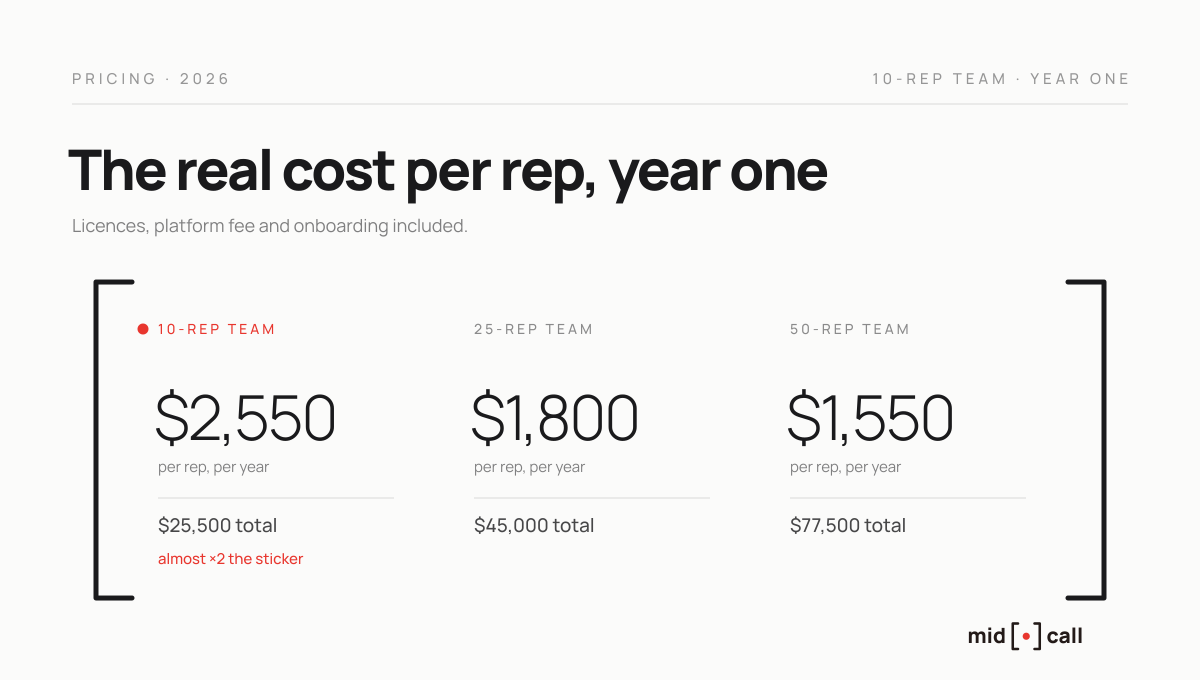
| 10 reps | $13,000 | $5,000 | $7,500 | $25,500 | $2,550 |
| 25 reps | $32,500 | $5,000 | $7,500 | $45,000 | $1,800 |
| 50 reps | $65,000 | $5,000 | $7,500 | $77,500 | $1,550 |
Two things jump out. The first is that a ten-rep team pays roughly $2,550 per rep in year one against an advertised rate near $1,300, so almost double. The second is that the gap closes as you scale, which is the whole logic of the model. Gong is priced for organisations, not for teams.
These figures use the most favourable assumptions available. Higher platform tiers, a heavier implementation or a bundle including Forecast and Engage move the total substantially upward.
Which contract mechanics inflate the bill after signature?
Four, and they are the part buyers discover late. None of them is unusual in enterprise software, all of them are negotiable, and none of them is obvious from a pricing conversation.
Forced bundling on add-ons. Every add-on module requires a Foundations licence for the same user. If half your team only needs the engagement product, you still buy the base licence for all of them, which is how effective per-user cost climbs toward the top of the range.
Automatic renewal uplifts. Contracts commonly include annual increases in the 5 to 15% band. Left unnegotiated, a contract signed at one price is materially higher by year three with no change in usage.
Seats that do not shrink. Licence counts are typically locked for the contract term. If your team contracts mid-year, you keep paying for the empty seats, and buyer reports consistently describe organisations carrying substantially more licences than active users.
Multi-year commitments. The better per-user rate comes with a two or three-year term, which means committing a large sum before you know whether the platform will be adopted. Early termination is expensive.
How do you negotiate a Gong contract?
Four levers, in the order they usually give.
The platform fee is the softest of the four and the one procurement teams report moving most often, since it is the layer with no delivery cost attached to it. Ask for it as a separate line rather than accepting a bundled total, which is the only way to see what you are actually negotiating.
The renewal cap comes next. Ask for a written ceiling in the 3 to 5% band. It costs the vendor nothing today and saves you a compounding increase later.
Licence count is the third. Buy for the team you have, not the team in the plan, and negotiate a mid-term expansion clause at the same rate instead of over-buying up front.
The term is the last. A longer commitment does lower the per-user rate, so trade it deliberately rather than accepting it as a default, and only once you have seen adoption on a first year.
Is Gong worth the money?
Yes, on two conditions that have nothing to do with the product's quality.
The first is scale. The flat platform fee means the model only makes economic sense from roughly twenty-five reps upward, and clearly so beyond fifty.
The second is ownership. Gong generates a large volume of analysis, and that analysis produces value only when someone turns it into coaching, scorecards and pipeline decisions. Teams without a RevOps function or a manager who owns the platform routinely pay for capability they never operate.
If either condition is missing, the honest answer is that a lighter tool covers most of the need for a fraction of the cost. Our comparison of Gong alternatives lays out those options with the same pricing discipline, and our article on Modjo pricing applies the same method to the French platform.
What the price does not buy you
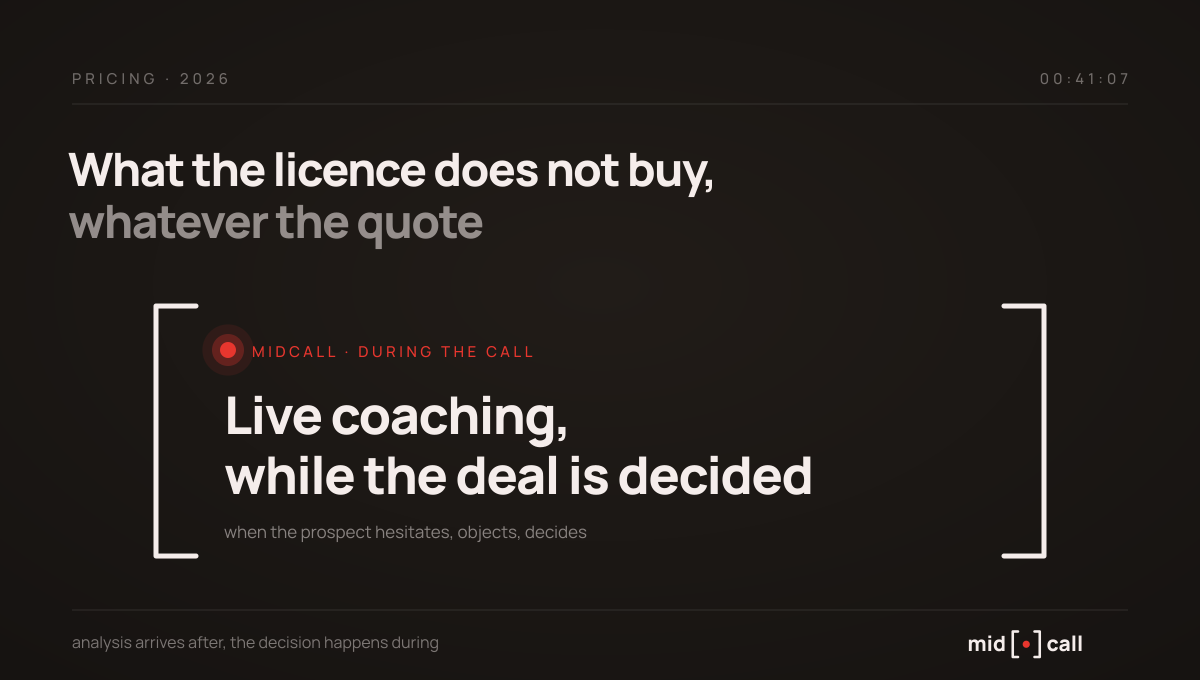
Whatever you pay Gong, and whatever alternative you pick instead, one thing is not in the contract. All of these platforms analyse the conversation after it ends. The recording, the scoring, the coaching, the forecast, everything arrives once the call is over.
The deal is not decided after. It is decided when the prospect says the price is too high, when they say they need to think about it, when they ask the question nobody had prepared an answer for.
What Midcall does, and what it costs
Midcall is a coaching tool that works during the call. The extension puts guidance inside the Google Meet, Teams or Zoom window, reads the sales situation live, tells a smokescreen from a real objection, prompts the question that digs one line at a time, and tracks qualification against the framework your team actually runs, SPIN, SPICED, BANT, MEDDIC, MEDDPIC or Challenger.
After the call, every conversation is scored out of 100, broken down by skill and by dimension, with each score justified by the exact sentences spoken and closed with what it would have taken to reach 100. You also get the objections raised with the answer the rep gave, the next steps, monologues over a minute, talk time against a target, and the share of live prompts the rep applied. For a sales leader, that replaces hours of listening back with an objective read of where each rep needs help.
Midcall costs from €150 per licence per month, published, with no platform fee. We say it out loud because nobody in this category does, and because a price you have to extract through a sales cycle is a price designed to be high.
We do not replace Gong, Modjo or Claap and we are not trying to. Midcall integrates with all three, the bot joins the call and passes the recording to the analysis tool you already use, so you never put two robots in front of a prospect. Everything syncs into HubSpot, Salesforce or Attio.
One point of honesty. Midcall is a young product and I will not promise you a percentage of deals saved that we do not yet measure. The price, at least, you can check without booking a call.
Gong pricing, the short version
| Your situation | What to expect |
|---|---|
| Under 10 reps | Effective cost near double the advertised seat rate, hard to justify |
| 10 to 25 reps | Workable only with a clear owner and a negotiated platform fee |
| 25 to 50 reps | The model starts making economic sense |
| More than 50 reps with RevOps | The scale Gong was designed for |
| You want a published price | Almost nobody in this category publishes one, which is worth asking about |
Edward, co-founder of Midcall. Former AE, co-founder of Meteor, a B2B prospecting agency. I write about what actually happens on sales calls, and what the best teams do with it.
Frequently asked questions
How much does Gong cost per user?
Between $1,300 and $1,600 per user per year for the Foundations licence, according to converging procurement and buyer data, with negotiated deals reported closer to $1,000 at high volume. That figure excludes the mandatory platform fee and onboarding, so the effective cost per user in year one is considerably higher, especially on small teams.
Does Gong have a free trial or a free plan?
No. Gong has no self-serve plan, no free tier and no published grid. Every deal goes through a sales cycle and a quote. That is a deliberate enterprise model, and it means comparing Gong to a tool with public pricing requires reconstructing the total cost rather than reading a number.
Why does Gong charge a platform fee?
It covers infrastructure, integrations and account management, and it is charged independently of your user count. The consequence matters more than the rationale. Because it is flat, it weighs heavily on small teams and barely registers at enterprise scale, which is the single biggest reason Gong feels overpriced below twenty-five reps.
Is Gong cheaper than Modjo or Chorus?
Not usually, and the comparison is harder than it looks since none of the three publishes a grid. Modjo is generally reported around €99 per user per month with a minimum licence count, Chorus arrives bundled inside ZoomInfo contracts, and Gong adds a platform fee on top of its seat rate. Total cost of ownership, not seat price, is the only fair comparison.
How do you reduce a Gong quote?
Negotiate the platform fee as a separate line, cap renewal increases in writing at 3 to 5%, buy licences for the team you have with an expansion clause at the same rate, and treat contract length as a lever you trade rather than a default you accept. Procurement data suggests the platform fee is where most of the movement happens.
What should a small sales team use instead?
Below roughly twenty-five reps, a lighter analysis tool covers most of the need at a fraction of the total cost, and a live coaching layer addresses the part no post-call platform reaches. The two are complementary, and together they usually cost less than a Gong platform fee alone.
See the live AI coach on one of your calls.
15 minutes. We plug Midcall into a real scenario from your team, you decide.