How much does Modjo cost in 2026, and what do reviews say?
Modjo sells on quote and publishes no grid. Public references converge around €99 per user per month, with a minimum licence commitment, and an independent analysis puts a five-recording-licence team at roughly €6,000 a year, onboarding included.
The part almost nobody explains is that the subscription only counts the reps who record their calls. Your managers and executives get platform access without a paid licence, which changes the calculation.
Where do these figures come from?
From no official source, and that needs saying up front. Modjo's own pricing page confirms the quote-only model, states that the subscription is based on recording users, that listening licences are unlimited and included, that onboarding is personalised, and that a volume discount applies. No amount appears on it.
The figures therefore come from three families of source with no reason to agree with each other. An independent French analysis, Salesdorado, dated June 2026, reconstructs a budget from customer feedback. A competing vendor, Claap, publishes a per-user estimate and a minimum licence count, to be read knowing they sell an alternative. And review platforms, Capterra and GetApp, provide the material on actual usage.
Where these sources converge, we give a range. Where they diverge, we say so. None of this is an official price, and your quote will be the only figure that counts.
How is Modjo's price built?
On a single variable, the number of reps who record. It is the least understood part of this model, and the one that works most in your favour.
| The item | What the sources say | What it means |
|---|---|---|
| Recording licence | Around €99 per user per month according to public references | Only the reps who run the calls count |
| Listening licence | Unlimited and included, per the official pricing page | Managers, leadership and onboarding do not inflate the bill |
| Minimum commitment | A minimum licence count is reported, around fifteen according to a competing vendor | That is the real entry ticket, not the unit price |
| Initial configuration | Included, per the official pricing page | No separate onboarding line, unlike American platforms |
| Volume discount | Officially stated | The unit price falls as the team grows |
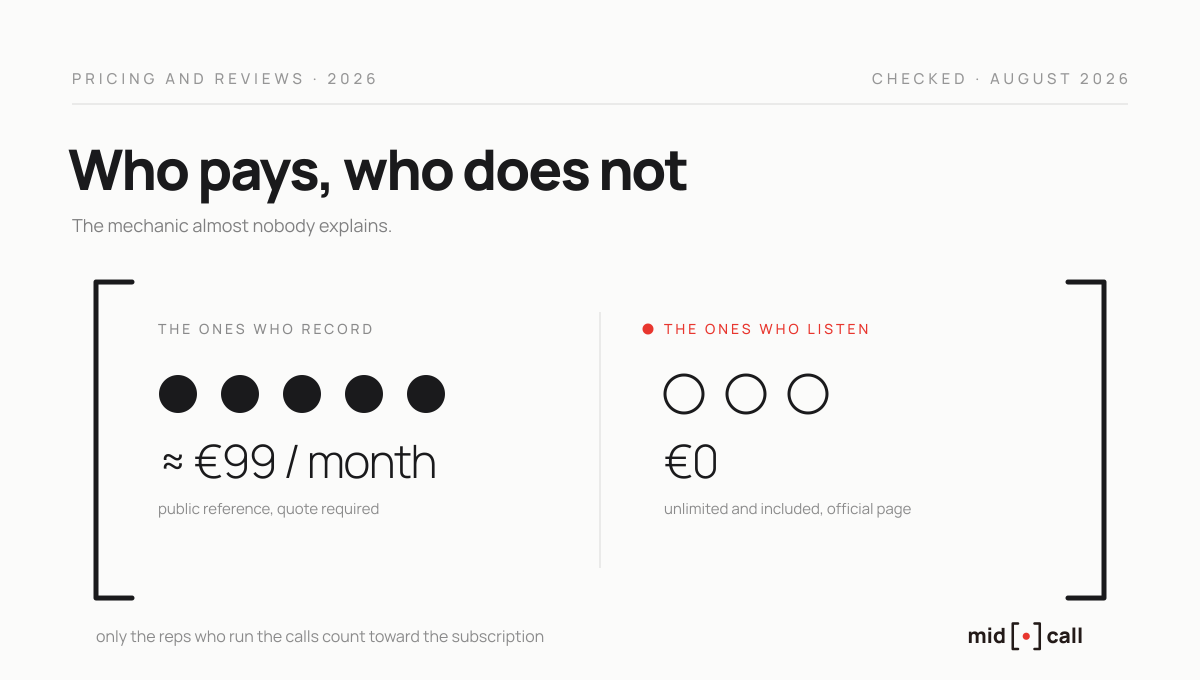
In practice, a team of five reps, two managers and one executive pays for five licences, not eight. Based on the feedback gathered by Salesdorado, that case lands around €6,000 a year all in. Per rep, that puts the effective licence well below the €99 monthly figure usually quoted.
What budget for your team size?
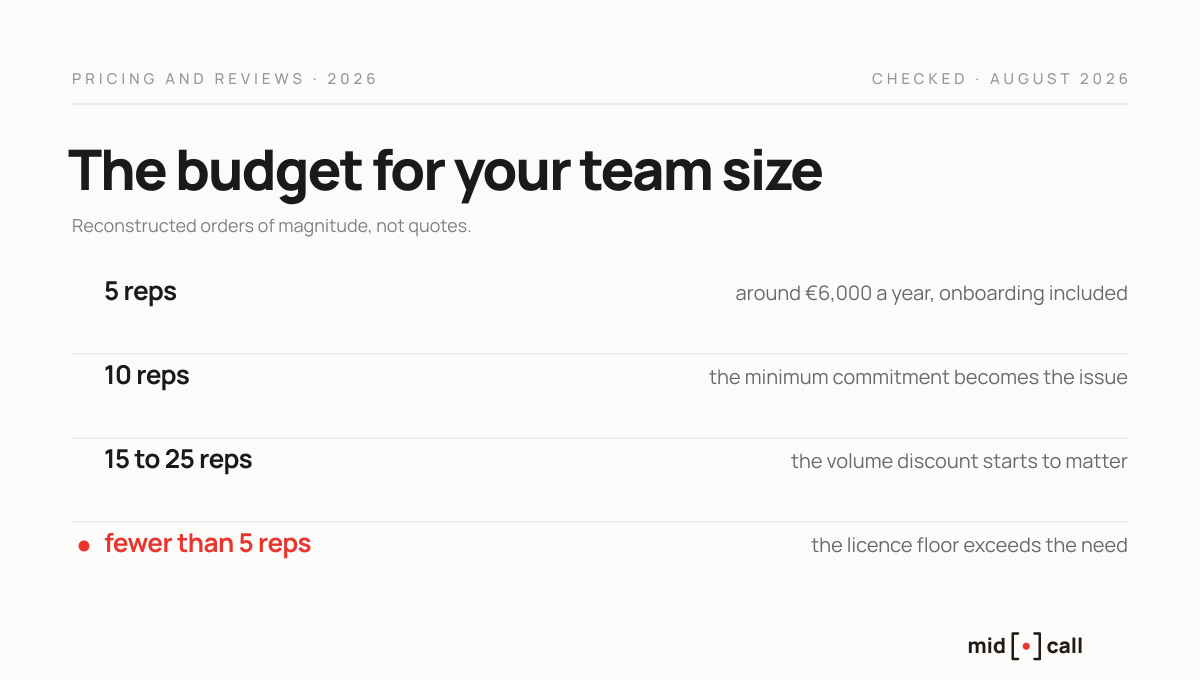
The estimates below rely on the available public references. They are reconstructed orders of magnitude, not quotes.
| Your team | Licences to plan for | Annual order of magnitude |
|---|---|---|
| 5 reps, 3 non-recording users | 5 | Around €6,000, per the Salesdorado analysis |
| 10 reps | 10 | The minimum commitment becomes the issue, not the unit price |
| 15 to 25 reps | 15 to 25 | The volume discount starts to matter |
| Fewer than 5 reps | Below the reported minimum | The entry ticket usually exceeds the actual need |
So the real obstacle for a small team is not the per-user price, which sits within market standards. It is the licence floor, which has you paying for a team you do not have yet.
What do Modjo reviews say?
They are mostly positive, with consistent reservations that sketch a precise usage profile.
The strengths that come up most often are French transcription quality, speed of adoption, and use in onboarding new joiners. One reviewer captures the main benefit well, the ability to listen back to your own calls and your peers' calls to improve with some distance. The call library and the tagging system regularly come up as the most used features day to day.
The reservations cover three areas. The depth of some automated analysis, judged improvable by several users. A few integrations, with reported early difficulties on the HubSpot side, though feedback notes that support took the remarks on board. And the absence of a public grid, which forces you through a sales cycle before you can compare anything.
One piece of context worth having. Salesdorado observes that Modjo repositioned itself in 2026 above plain transcription, now a commodity, toward an agent platform that fills the CRM, prepares meetings and drafts follow-ups. The sovereignty argument, data hosted in Paris and a French contract, carries real weight for European buyers.
Is Modjo a good investment?
Yes, on two conditions.
The first is size. Below the reported licence minimum you are paying for a floor rather than a tool, and lighter solutions cover the need for far less. Our comparison of Gong alternatives covers those options with the same pricing discipline, and our article on Gong pricing applies the same method to the American platform.
The second is managerial use. An analysis tool only produces value if someone opens the summaries and coaches on them. The teams that get their money's worth from Modjo are the ones where a manager made it a weekly routine. The others pay for a library nobody consults.
What this price does not cover
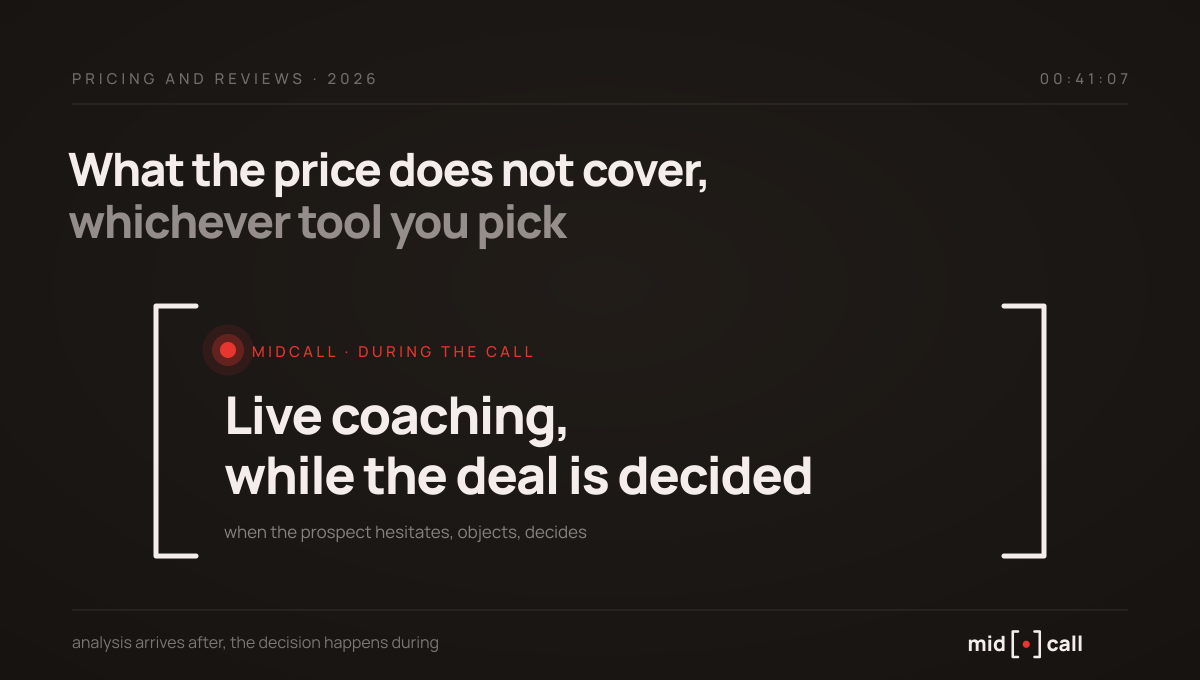
Whatever your quote comes to, and whichever tool in this category you choose, one thing is not in the contract. These platforms analyse the conversation once it is over. The recording, the scoring, the coaching, all of it arrives afterwards.
The deal is not decided afterwards. It is decided when the prospect says the price is too high, when they say they need to think about it, when they ask the question nobody had prepared an answer for.
What Midcall does, and what it costs
Midcall is a coaching tool that works during the call. The extension puts guidance inside the Google Meet, Teams or Zoom window, reads the sales situation live, tells a smokescreen from a real objection, prompts the question that digs one line at a time, and tracks qualification against the framework your team actually runs, SPIN, SPICED, BANT, MEDDIC, MEDDPIC or Challenger.
After the call, every conversation is scored out of 100, broken down by skill and by dimension, with each score justified by the exact sentences spoken and closed with what it would have taken to reach 100. You also get the objections raised with the answer the rep gave, the next steps, monologues over a minute, talk time against a target, and the share of live prompts the rep applied. For a sales leader, that replaces hours of listening back with an objective read of where each rep needs help.
Midcall costs from €150 per licence per month, published, with no platform fee. We say it out loud because nobody in this category does, and because a price you have to extract through a sales cycle is a price designed to be high.
We do not replace Modjo, Gong or Claap and we are not trying to. Midcall integrates with all three, the bot joins the call and passes the recording to the analysis tool you already use, so you never put two robots in front of a prospect. Everything syncs into HubSpot, Salesforce or Attio.
One point of honesty. Midcall is a young product and I will not promise you a percentage of deals saved that we do not yet measure. The price, at least, you can check without booking a call.
How do you negotiate your Modjo quote?
Three levers, in the order they usually move.
Licence count first. Pay only for the reps who actually record, and get it in writing that read access for your managers is included. That is the line that weighs most in the total.
Term length second. A longer commitment lowers the unit price, but it commits you before you have measured adoption. Negotiate it as a counterpart, not as a precondition.
The change clause last. Have it written down what happens if your team grows and above all if it shrinks, because that is the scenario contracts in this category rarely handle in your favour.
Edward, co-founder of Midcall. Former AE, co-founder of Meteor, a B2B prospecting agency. I write about what actually happens on sales calls, and what the best teams do with it.
Frequently asked questions
How much does Modjo cost per user?
GetApp lists a starting price of €99 per user per month, and other public references converge on the same figure, though Modjo itself publishes no grid. The subscription is billed only on users who record their calls, listening licences being included. For a team of five reps surrounded by managers, the effective licence per connected person therefore lands well below that reference.
Does Modjo publish its pricing?
No. The official pricing page describes the billing principle and what is included, without showing an amount. Every quote is built after a sales conversation, with a stated volume discount. That is the category standard, Gong and Chorus work the same way, which makes comparing tools harder than it should be.
Is there a minimum commitment with Modjo?
A minimum licence count is reported by third-party sources, around fifteen, without official confirmation. It is the main friction point for small teams, since it sets an entry ticket independent of actual need. Worth raising explicitly during your sales conversation, before comparing unit prices.
Are Modjo reviews good?
They are solid on French transcription, ease of adoption and onboarding use, with recurring reservations about the depth of some automated analysis and about a few integrations. The profile that emerges is a tool appreciated by structured teams whose management actually uses it, and under-used everywhere else.
Modjo or Gong, which costs less?
The comparison is a trap since neither publishes a grid. Modjo sits around €99 per user per month according to public references, with no separate platform fee and configuration included. Gong adds annual platform fees independent of seat count and separately billed onboarding, which weighs heavily on the real cost for small teams.
Do you need a call analysis tool with fewer than five reps?
Rarely at the price of a structured platform. Below the licence minimum common in this category, lighter tools cover most of the need. The useful question is whether your problem is understanding what happened, or helping your reps while it is happening, because those are not the same tools.
See the live AI coach on one of your calls.
15 minutes. We plug Midcall into a real scenario from your team, you decide.