What is conversation intelligence software, and how do you choose it?
Conversation intelligence software records, transcribes and analyzes your sales calls, then turns them into data your team can coach and forecast from. It is the layer that looks backward at what happened. This guide explains what it does, how it differs from a notetaker and from real-time coaching, and how to choose one.
What is conversation intelligence software?
Conversation intelligence software is a category of AI tools that automatically captures, transcribes and analyzes business conversations, mostly sales calls and video meetings, and turns them into structured data. Instead of a recording nobody replays, you get a searchable transcript, a summary, the objections and buying signals that came up, talk ratios, the next steps agreed, and patterns across every call the team runs. That data feeds the CRM, deal reviews, coaching and forecasting.
The point is simple. In B2B sales the truth about a deal lives in the conversation, not in the CRM field a rep fills in afterwards, and conversation intelligence is how you get to that truth at scale.
How does a conversation intelligence platform work?
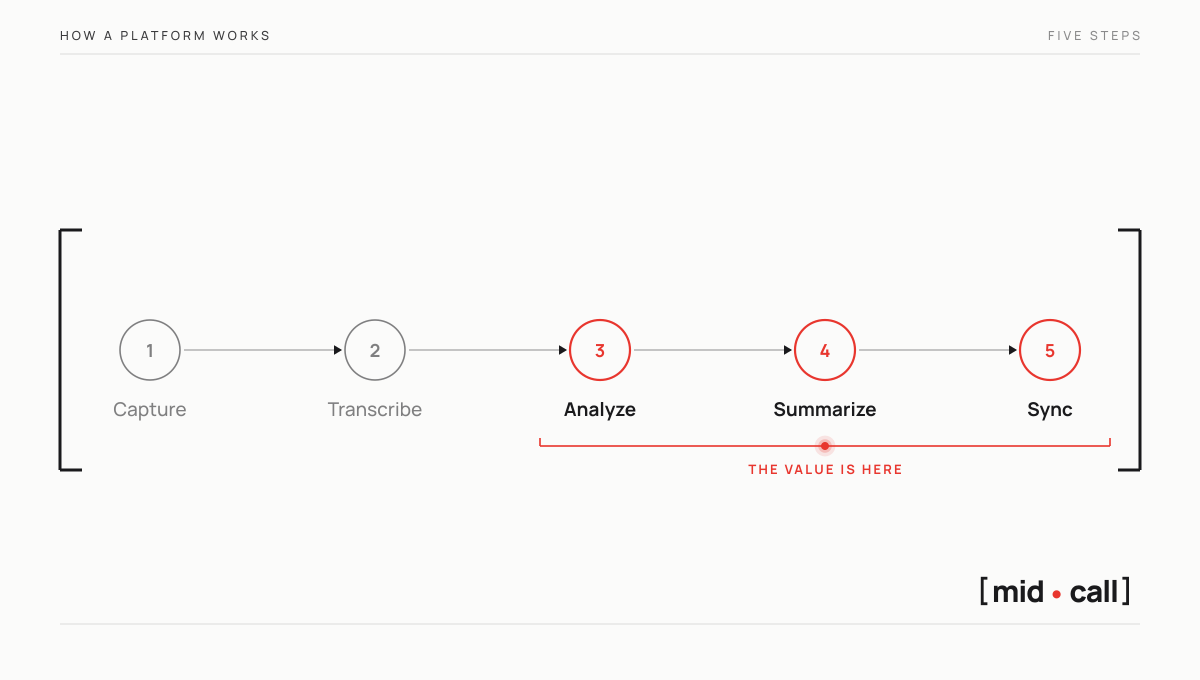
A conversation intelligence platform runs a five-step pipeline, and every vendor follows roughly the same one.
Capture. A bot joins the call on Google Meet, Microsoft Teams or Zoom, or the platform plugs into your telephony, and records both sides of the conversation.
Transcribe. Speech recognition turns the audio into a time-stamped transcript, ideally in every language your team sells in.
Analyze. Natural language processing tags what matters, the topics covered, the objections raised, the questions asked, the competitors mentioned, the talk-to-listen ratio, the longest monologues, and the next steps agreed or missed.
Summarize. The platform writes a summary of the call, extracts the action items and often scores the rep against a framework.
Sync. Summaries, fields and insights are pushed into the CRM and surfaced in dashboards, so managers run deal reviews and coaching sessions on what was actually said.
The value is in the last three steps. Recording is cheap. Turning a hundred calls a week into the three patterns that matter is the work.
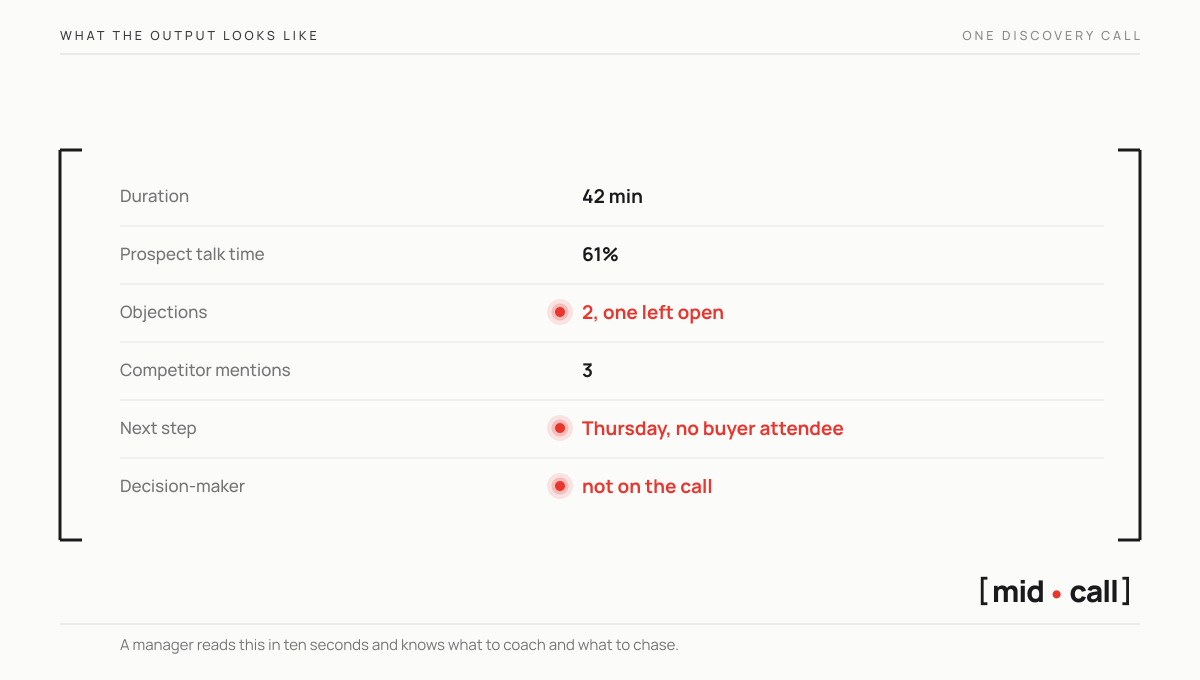
Here is what the output looks like for one discovery call, condensed. Duration 42 minutes, prospect talk time 61%, two objections raised, one on integration effort and one on timing, the first answered and the second left open, three competitor mentions, a next step agreed for Thursday but without a named attendee from the buyer side, and a flag because no decision-maker joined the call. A manager reads that in ten seconds and knows exactly what to coach and what to chase.
What is conversation intelligence used for in B2B sales?
Six uses show up in almost every team that adopts it.
Deal risk and pipeline visibility. When the decision-maker was never on a call, when pricing came up three times, when the next step was left vague, the platform flags it before the forecast does.
Coaching from real calls. Managers stop coaching from memory and start coaching from the transcript, on the objection a rep dodged or the discovery question they skipped, in a weekly review built on evidence.
Playbooks from top performers. The talk tracks and objection responses of the best reps are extracted and become the playbook everyone else trains on.
Win-loss and competitive intelligence. Which competitor comes up, in which deals, with which objection, straight from the buyer's mouth. It is the raw material of a real win-loss analysis.
CRM hygiene. Summaries, next steps and fields are filled automatically, so the CRM reflects the conversation rather than the rep's mood at the end of the day.
Onboarding. A searchable library of real calls is the fastest way for a new rep to hear how the team actually sells, long before their own first calls.
How is it different from call recording, notetakers and real-time coaching?
Buyers confuse four layers that do four different jobs, and the confusion costs money.
Call recording captures the audio and stores it. That is all. Useful for compliance and for replaying a call, useless at scale, because nobody listens to a hundred recordings.
Note-takers, such as Fireflies, Otter, tl;dv, Fathom or Granola, join the meeting, transcribe it and produce a summary with action items. They are light, affordable and good for the individual rep who wants their notes done. They handle one call at a time.
Conversation intelligence platforms, such as Gong, Chorus, Modjo or Claap, do what notetakers do and then analyze across every call, with coaching analytics, deal risk, competitive tracking and CRM sync. They are built for the manager and the revenue team, and they look backward, at calls that have already happened.
Real-time coaching works during the call. It follows the conversation as it unfolds, prompts the rep with the right line at the right moment, and scores the call afterwards. It is built for the rep in the room, and it acts forward, on the deal that is still open. That is what Midcall does, and it is a different job from the three layers above rather than a replacement for them.
If you remember one thing, remember this. Recording stores, notetakers summarize, conversation intelligence analyzes, real-time coaching intervenes.
What should you look for in a conversation intelligence platform?
Seven criteria decide whether a platform gets used or gets cancelled at renewal.
Which conversation intelligence platforms should you consider?
The right platform depends far more on team size and market than on feature lists.
For a small team or a first deployment, Claap is the pragmatic pick, light to set up, video-first and built with small teams in mind.
For a growing French-speaking team, Modjo is the reference, built in France, strong on French transcription and coaching workflows, and widely adopted by French SaaS sales teams.
For a large or US-centric team, Gong and Chorus, now part of ZoomInfo, are the category leaders, with the deepest analytics, the broadest integrations and the enterprise budget that goes with them. If you are weighing them, read Gong vs Chorus, and if the budget gives you pause, the Gong alternatives.
For a rep who only wants notes, Midcall Notetaker takes them, scores them and sends them to their tools, and the best AI sales tools guide covers the options.
Whatever you pick, the platform will tell you what happened. It will not change what happens on the next call. For that, you need the layer that preps the next meeting and works during it.
Where does real-time coaching fit alongside conversation intelligence?
Conversation intelligence looks backward, and that is its strength. It turns last week's calls into this week's coaching. But the deal is decided in the call, at the moment the prospect pushes back and the rep either has the answer or does not, and no analysis after the fact changes that moment.
Real-time coaching is the layer that acts during. Midcall follows the conversation live on Meet, Teams and Zoom, prompts the right line when an objection lands, keeps the qualification framework on track, and flags the buying signal the rep is about to talk past, one suggestion at a time. After the call it scores the conversation out of 100 and each competency, so the rep knows what to fix and the manager sees who needs help on what. Coaching stops being a review of what went wrong and becomes help while it can still go right.
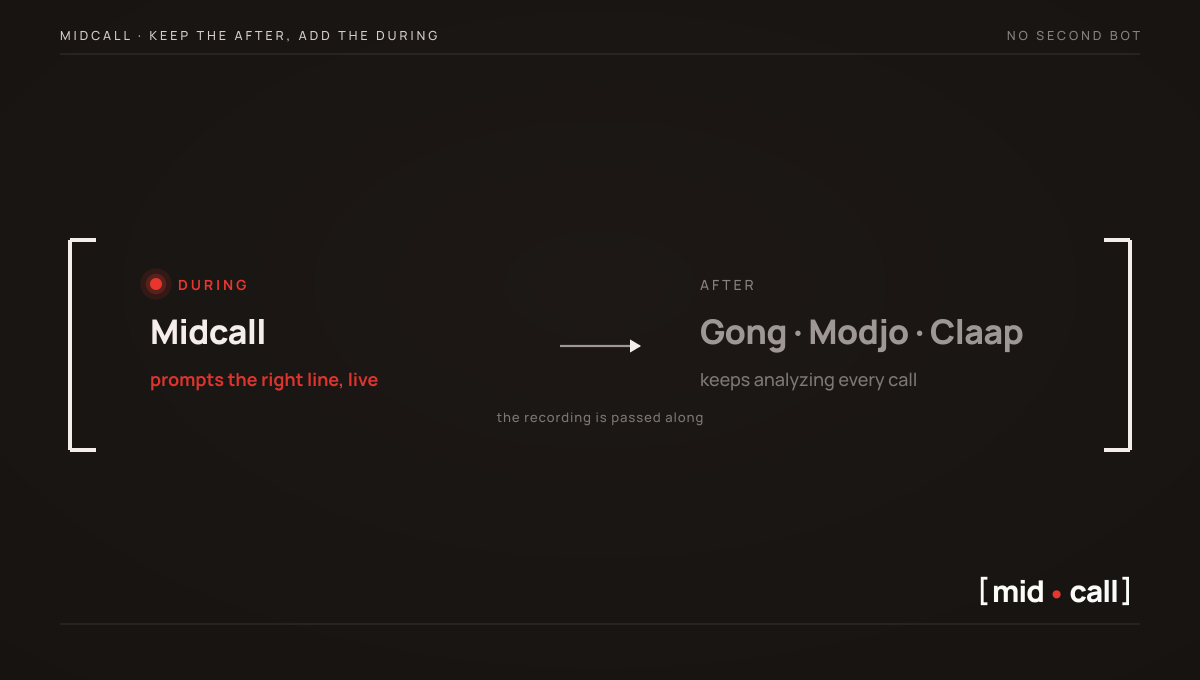
The two layers are built to work together. Midcall connects to Gong, Modjo and Claap and passes the recording to them, so your conversation intelligence keeps analyzing every call and you never have two bots in the same meeting. It feeds the CRM you already run, HubSpot, Salesforce or Attio, and it is the execution layer of your enablement stack. Keep your conversation intelligence for the after. Add the during.
Edward Labruyère, co-founder of Midcall. Former B2B SaaS AE, co-founder of Meteor, a B2B prospecting agency. I write about what actually happens inside sales calls, and what the best teams do about it.
Frequently asked questions
Is conversation intelligence the same as call recording?
No. Recording captures and stores audio. Conversation intelligence transcribes it, analyzes it across every call and turns it into coaching, deal and CRM data. Recording is the input, conversation intelligence is the analysis.
Does conversation intelligence work in French?
The good platforms do, but accuracy varies, and French sales jargon trips up some engines. Test any platform on a real French call before buying, and favor vendors with a proven French install base if that is your market.
Is conversation intelligence GDPR compliant?
It can be, and it has to be. Check where recordings and transcripts are hosted, whether EU hosting is available, how long data is retained, how participants are informed and how consent is handled. Compliance depends on the vendor's setup and on yours.
Do I need conversation intelligence if I already have a notetaker?
If you are a rep who wants notes, no. If you are a manager who wants to coach a team, spot deal risk and see patterns across dozens of calls, yes. A notetaker summarizes one call. Conversation intelligence analyzes all of them.
How much does conversation intelligence software cost?
Almost always per seat on an annual contract, with a wide range between light tools built for small teams and enterprise platforms. Compare what a seat includes, ask about data retention and exit, and price it against the deals you expect it to save.
Can conversation intelligence coach reps in real time?
Its core is analysis after the call. Some platforms add cues during the call, but deep live coaching, the right line at the right moment, live qualification tracking and a score per competency afterwards, is a separate layer. Midcall provides that layer, and its Notetaker plan can replace your platform on your sales meetings or sit alongside it.
See the live AI coach on one of your calls.
15 minutes. We plug Midcall into a real scenario from your team, you decide.