What is win-loss analysis, and how do you find the real reason?
Win-loss analysis is how you find out why you really win and lose deals, so you can win more of the next ones. The problem is that the reasons most teams write down are wrong, because a rep under pressure blames price and a buyer interviewed weeks later misremembers. The most honest answer is usually sitting in the calls you already recorded.
What is win-loss analysis?
Win-loss analysis is a structured review of your closed deals, the ones you won, the ones you lost, and the ones that stalled into no decision, to work out why each went the way it did and change what your team does on the next one. It is not a pipeline review, which looks forward at open deals. Win-loss looks backward, at outcomes that have already happened, to find the patterns behind them.
Done well, it replaces opinion with evidence, and it answers three questions. Why did this buyer choose us? Why did that one go elsewhere? And what do our wins, and our losses, have in common?
Why is most win-loss analysis wrong?
Because it runs on the two least reliable sources a sales team has, what the rep typed into the CRM and what everyone believes happened. A rep under quota pressure has every incentive to log a clean, blameless reason, and "lost on price" is the easiest one to reach for.
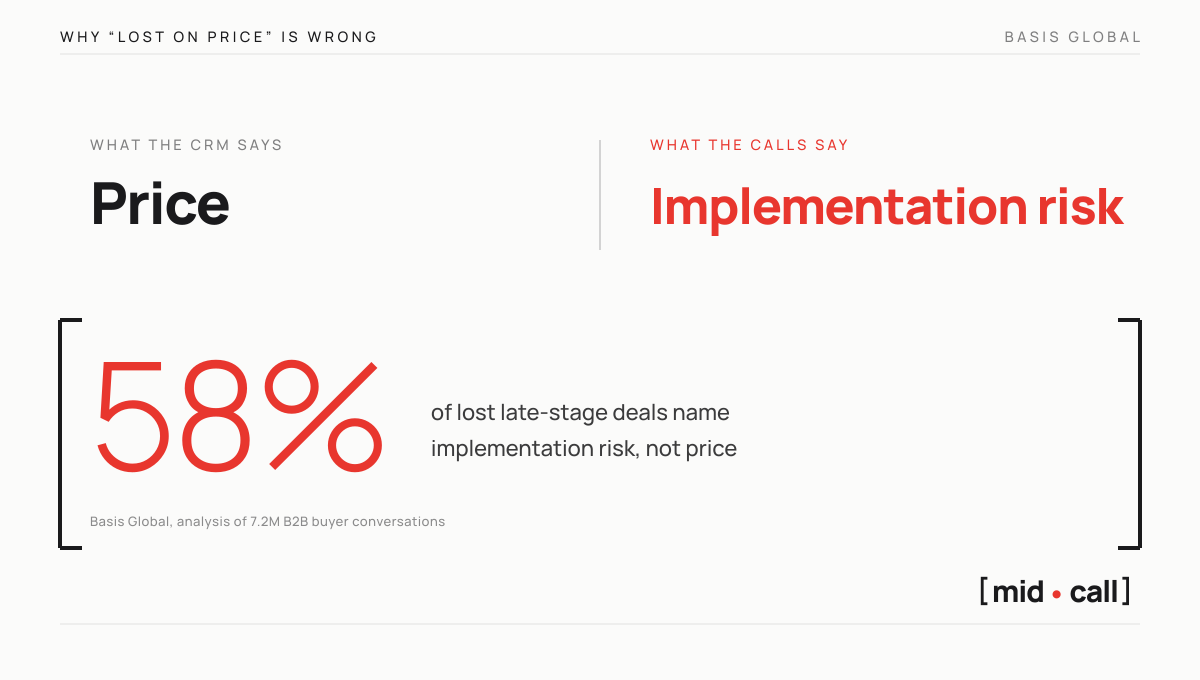
The data says it is usually wrong. In an analysis of 7.2 million B2B buyer conversations, Basis Global found that 58% of lost late-stage deals named implementation risk, not price, as the main reason a buyer walked away. Separately, Corporate Visions found in its post-decision buyer research that 53% of deals marked lost in the CRM were actually winnable, lost not to a better product or a lower price but to a misstep in the selling. If you coach against the reason in the CRM, you are coaching against the wrong thing.
Where does the real reason actually live?
There are three places you can look, and they are not equally honest.
The weakest is the rep's own account, for the reasons above. Stronger, and the method most win-loss programs are built on, is the buyer interview, where a neutral third party calls the prospect after the decision and asks what really drove it. Buyers are more candid with someone who is not trying to sell them anything, and the insight is genuinely valuable, especially on positioning and competitors. But interviews are slow, they cost money, they only ever cover a sample of deals, and they still rely on a buyer remembering a call they had weeks ago.
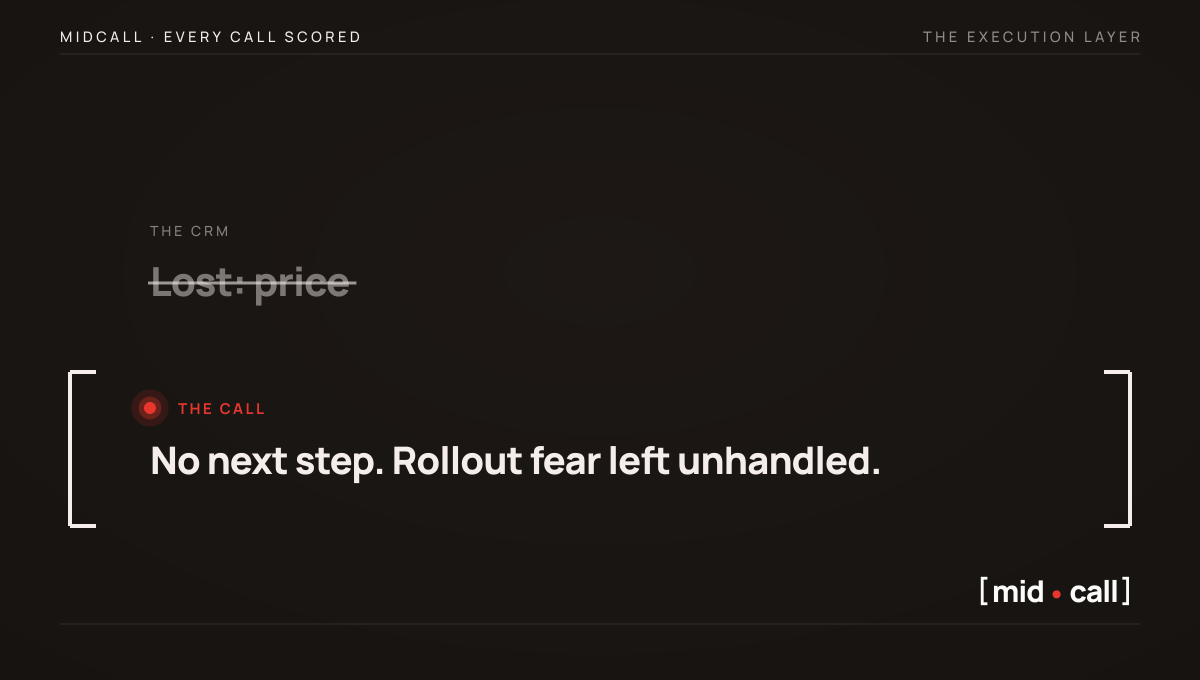
The third source is the one most teams overlook even though they already own it, the recording of the call. The real objection, the qualification block the rep skipped, the moment a buying signal went unanswered, none of it depends on memory, because it is on the tape. The hard part has never been access. It has been turning hours of calls into one clear reason. Scoring each call against the competencies that decide deals, discovery, objection handling, closing, is what does that, and it is exactly what Midcall does after every call, a score per competency, the objections that actually came up with how the rep handled them, and the pattern across a rep's deals. The buyer interview tells you why the market chose what it chose. The call record tells you what your team actually did in the room.
How do you run a win-loss analysis?
Start with a clear question, not a spreadsheet. Pick a batch of recently closed deals, both won and lost, enough to see a pattern rather than react to one loud loss, and decide what you are trying to learn. Then gather the reason from the strongest source you have, which for most teams is a mix of a few buyer interviews on the biggest deals and the call recordings on the rest.
For each deal, the questions are the same. What did the buyer actually need, and did we uncover it? Where did the deal stall, and what changed at that moment? What did competitors do that we did not? Was there a real next step, or did it drift? And, crucially, does the reason in the CRM match what the calls and the buyer actually say? Answer those across a batch and you stop seeing individual deals and start seeing the two or three patterns that cost you the most.
What should you measure in a win-loss analysis?
Two things, and most teams only track the first. The first is the number, your win rate, the share of deals you close out of everything you seriously pursued, and its cousin the loss rate. That tells you whether you are getting better or worse, but not why.
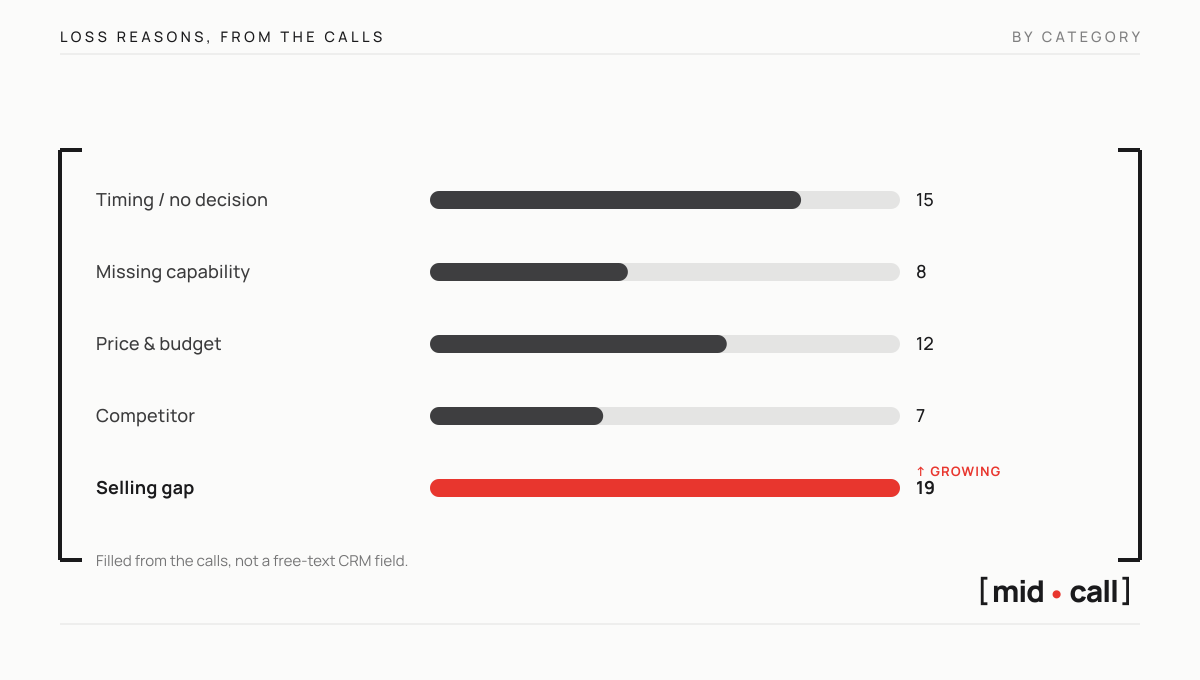
The second, the one that actually changes behaviour, is the reason, sorted into a small and honest taxonomy. Not a free-text CRM field, but a fixed set of categories you can count, price and budget, a missing capability, timing and no decision, a competitor, and a selling gap like weak discovery or a fumbled objection. When every loss is tagged the same way, the pattern becomes obvious and you can watch it move over time. A price bucket that keeps growing is a positioning problem. An objections bucket that spikes for one rep is a coaching problem. This is where scoring calls earns its keep again, since Midcall rolls the objections that actually came up into families and tracks how each rep's competency scores trend, so the taxonomy fills itself from the calls instead of from a rep's best guess.
How do you turn losses into a higher win rate?
The output of win-loss analysis is not a quarterly slide. It is a change in what a specific rep does on their next call. A loss reason is only useful once it becomes a coaching instruction, and the two or three patterns you found are exactly that. If your losses cluster around a thin discovery, that is a discovery problem to drill, not a pricing one. If one rep keeps losing control the moment an objection lands, that is a named skill to work on with that rep, not a team-wide memo.
This is where scoring every call pays off twice. The first time, it tells you why a deal was lost. The second, it shows you which rep keeps repeating the pattern, so Midcall's per-competency scores turn a pile of losses into a short, personal coaching list, rep by rep. That is the whole point of looking backward, to change the next call forward.
How do you make win-loss continuous instead of a quarterly project?
Most win-loss analysis dies on maintenance. A program gets built with real energy, then the work of pulling deals, booking interviews and writing the report piles up, and sooner or later it quietly stops. The fix is to stop treating it as a project.
When every call is already scored the moment it ends, win-loss stops being something you schedule and becomes something that is simply always on. Every lost deal is analysed while the details are fresh, the loss reasons roll up into a live picture instead of a dated PDF, and the insight lands where it matters, on the next call, at the only moment a rep can still act on it. Buyer interviews keep their place for the strategic picture. But the day-to-day question, why are we losing this kind of deal and who needs to fix what, gets answered continuously, on the deals you are running right now. That is win-loss analysis that actually moves the number.
Win-loss is also the feedback loop of a sales enablement program: the same objections that keep coming back from one lost deal to the next are your content and coaching backlog. Our guide to AI sales enablement closes that loop.
Edward Labruyère, co-founder of Midcall. Former B2B SaaS AE, co-founder of Meteor, a B2B prospecting agency. I write about what actually happens inside sales calls, and what the best teams do about it.
Frequently asked questions
Is win-loss analysis the same as a pipeline review?
No. A pipeline review looks forward at open deals to forecast and unblock them. Win-loss analysis looks backward at closed deals, won and lost, to find the patterns behind the outcomes and change how the team sells next time.
How many deals do you need to analyse?
Enough to see a pattern rather than react to a single loud loss, which for most teams means a rolling batch rather than a fixed number. Consistency beats volume, since a small regular review teaches you more than a one-off audit of fifty deals.
Who should run win-loss analysis?
For the strategic buyer interviews, a neutral third party or someone outside the deal gets more candid answers than the rep who lost it. For the call-level review, the sales manager or RevOps owns it, because the output is coaching and process change.
Is a win-loss template enough?
A template gives you consistent questions, which helps, but it does not solve the hard part, getting the real reason instead of the logged one. Pair the template with the actual call record or a buyer interview, never just the CRM field.
Does win-loss analysis work for a small sales team?
Yes, and it is arguably more valuable, because a small team cannot afford to lose the same way twice. You do not need a formal program, just a habit of reviewing the calls behind your losses and acting on what they show.
See the live AI coach on one of your calls.
15 minutes. We plug Midcall into a real scenario from your team, you decide.