How do you manage sales performance in 2026?
Sales performance management combines three families of indicators, results such as revenue and win rate, activity such as call and demo volume, and execution, meaning the measured quality of what actually happens inside sales conversations.
Most teams track the first two and ignore the third, which condemns them to recording drops instead of preventing them. Here are the KPIs that matter, the tools to track them, and the routine that turns measurement into durable improvement.
What is sales performance management?
Sales performance management is the discipline of getting a revenue team to hit its targets predictably and repeatably. Two words in that definition carry all the weight. Predictably, because a great quarter followed by two missed ones is not performance but variance. Repeatably, because a number carried by one top performer disappears with them.
A note on vocabulary before going further. In enterprise software, SPM also names a category of platforms built for quota planning, territory design and incentive compensation, the world of Gartner Magic Quadrants and RevOps teams. That category solves real problems at large scale. If you run a team of five to fifty reps, however, your problem is rarely territory carving. It is knowing where performance is leaking and fixing it. This guide is about that.
Managing performance then means answering three questions continuously. Where are results against target. How much effort is the team producing. And above all, how well that effort is executed, because execution quality determines the results you will record six weeks from now.
What are the three families of indicators?
Sales performance indicators fall into three families, and confusing them is the first reason dashboards spin without effect.
Result indicators record. Revenue, win rate, average deal size, cycle length. They are indispensable and always late, because they measure the outcome of conversations that happened weeks earlier. By the time win rate dips, the deals behind the dip are already lost.
Activity indicators count. Calls, demos, follow-ups, opportunities created, pipeline coverage. They tell you whether the team produces enough effort, and nothing about its quality. A team can double its call volume and worsen its results, if every call is executed poorly.
Execution indicators explain. Talk time, monologues, discovery quality, objection handling, next steps locked before hanging up. They measure what happens inside the conversation itself, where performance is actually produced. They are the only leading indicators on this list, the ones that move weeks before results follow.
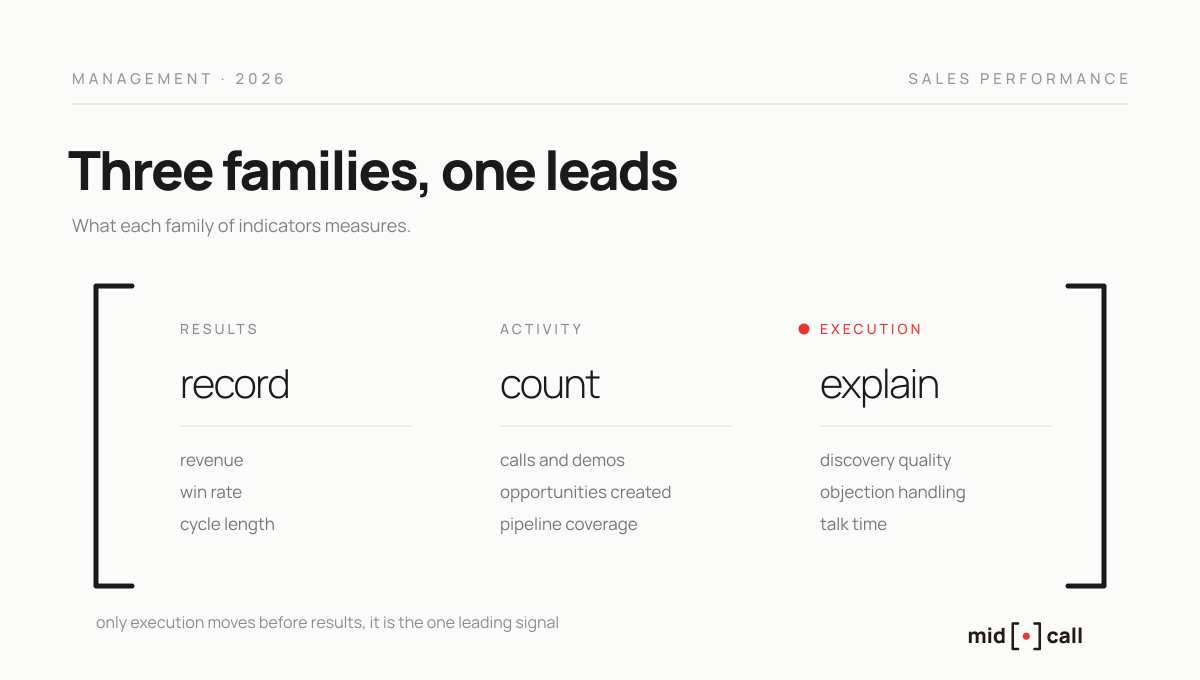
Almost every dashboard stops at the first two families, for lack of a way to measure the third other than by ear. That is exactly what has changed.
Which KPIs should you track?
About ten, no more, spread across the three families. An indicator earns its place only if a decision fires when it drifts.
| Family | KPI | What it tells you |
|---|---|---|
| Result | Revenue or ARR closed | The outcome, against the period target |
| Result | Win rate | The share of opportunities won |
| Result | Average deal size and cycle length | Deal quality and engine speed |
| Activity | Calls and demos held per week | The volume of effort produced |
| Activity | Pipeline coverage | Open pipeline against target, 3x is a common benchmark |
| Execution | Talk time on calls | A rep who monopolises the conversation discovers nothing, the target sits between 30 and 45% |
| Execution | Score per skill | Call framing, discovery, selling the value, objections, closing, scored call after call |
| Execution | Objections by family | What prospects push back on most, price, competition, trust |
| Execution | Next steps locked | The share of calls that end with a dated follow-up |
The classic trap is multiplying result KPIs in the belief that it sharpens the steering. Ten measurements of the same lag give you no lead. The useful precision lives in the third family.
Why do some reps outperform everyone else?
Because the gap lives in execution, not in territory. Two reps with the same market, the same leads and the same product routinely show dramatic win-rate gaps, and that gap has been studied seriously.
The reference study remains CEB's, now Gartner, run by Matthew Dixon and Brent Adamson across 6,000 reps in 90 companies. It sorted sellers into five behavioural profiles and produced a finding that upended the industry's assumptions. Challengers, the profiles who teach the prospect something, tailor their message and take control of the conversation, account for roughly 40% of top performers, rising to 54% in complex sales. The relationship-builder profile, the one most teams hire for by default, accounts for just 7% of the stars.
The useful lesson for a sales leader is not to fire the relationship builders. It is that these behaviours are execution skills, observable call after call, and the same research concludes they can be taught. A top performer shows up in precise moves, qualification held from start to finish, where a framework like MEDDIC earns its keep on complex cycles, objection handling that digs instead of folding, and a close that locks, whose mechanics we cover in our guide to increasing your close rate.
In other words, the management question is not whether you hired Challengers. It is whether you can measure those skills in each of your reps, in order to grow them. On the detail of those behaviours, our guide to the Challenger sales methodology lays out the sequence to execute. That is exactly what the next two sections are about.
Which tools do you need?
Three layers, each with a distinct job, and many teams only run the first.
The CRM is the source of truth. HubSpot, Salesforce or Attio centralise results and activity, hold the pipeline and feed the dashboards. Without data discipline everything downstream collapses, which argues for tools that fill the CRM automatically rather than relying on rep goodwill.
Post-call analysis explains past conversations. Modjo, Gong or Claap depending on your size record, transcribe and analyse calls. This is the layer that made execution measurable at all, by turning conversations into data, a call library, theme detection, coaching on real excerpts.
Live coaching acts during the conversation. It is the newest layer, and the one that changes the nature of performance management, because it does not wait for the call to end before correcting. More on it below, it is what Midcall does.
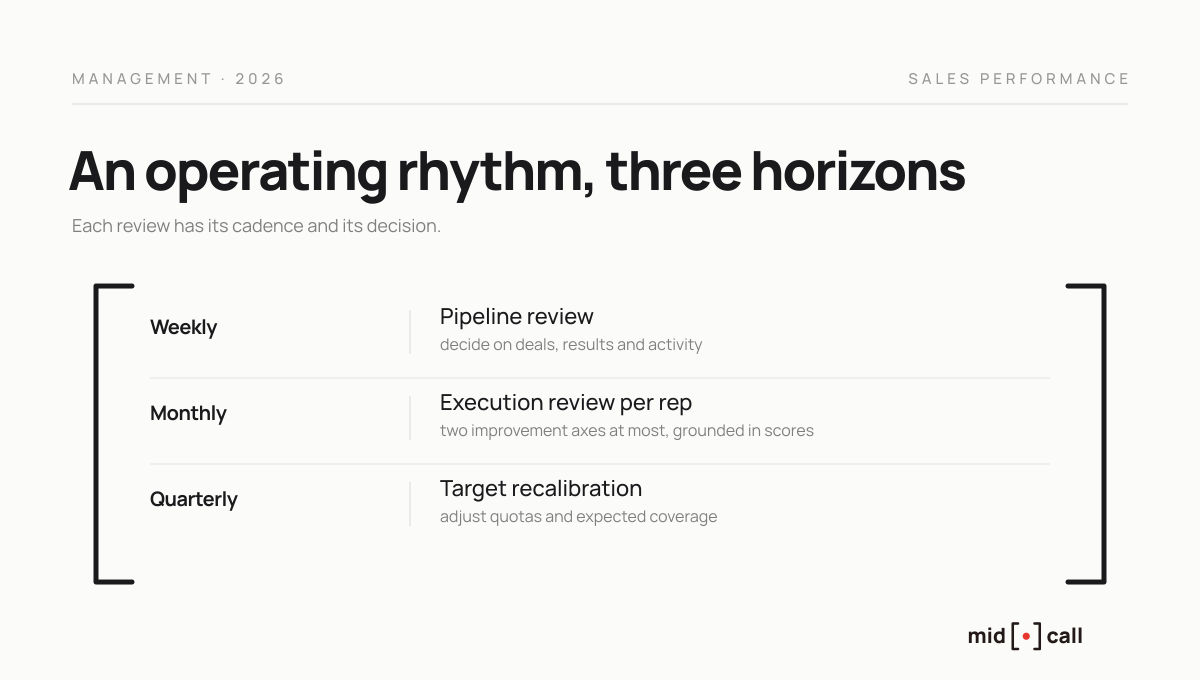
The routine matters as much as the tooling. A weekly pipeline review to decide on deals, short and focused on results and activity. A monthly execution review per rep, grounded in scores rather than impressions, with two improvement axes at most at a time, because nobody fixes five skills at once. And a quarterly recalibration of targets. We detail the logic of continuous coaching in our guide to real-time AI sales coaching.
How do you measure execution objectively, rep by rep?
This is the question that blocked everything, and the reason the third family of indicators stayed off dashboards. Judging execution by ear takes hours of replay, depends on who listens, and covers a fraction of calls.
Midcall measures execution continuously and makes it manageable. Every call gets a score out of 100, broken into five skills, call framing, discovery, selling the value, objection handling and closing. Each skill splits into finer dimensions, opening and framing, posture, listening and follow-ups, personalisation, command of the offer, locking next steps, building urgency. And every score is backed by the exact sentences spoken on the call, each paired with what it would have taken to reach 100.
For a sales leader, that changes what coaching is. You see per rep, over 30 days, 90 days or all time, the average score, the skills that carry them, the ones costing deals, the objection families their prospects raise most, their talk time against target, their monologues over a minute, and the share of live prompts they apply. One profile is excellent at discovery and fragile at closing, the next one the reverse. You coach each on their real axis, verbatims in hand instead of a feeling, and you get back the replay hours that made this level of follow-up impractical.
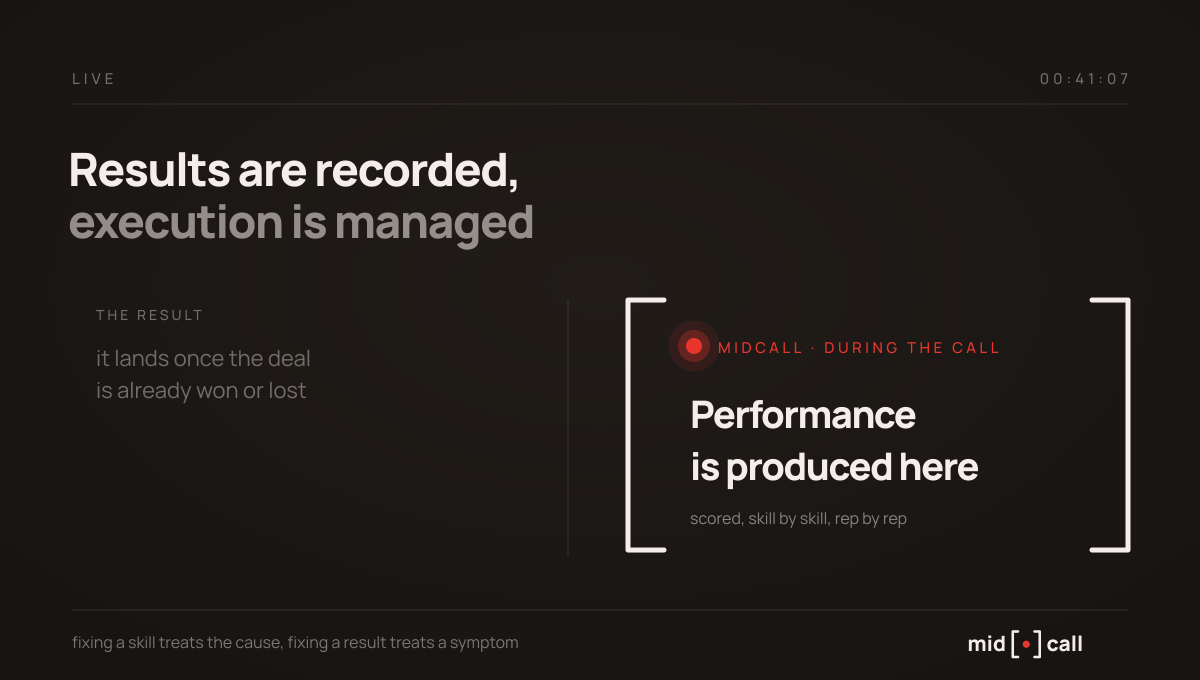
That is what makes the improvement durable. Correcting a result indicator treats a symptom. Correcting an execution skill treats the cause, and the result follows mechanically, call after call, because the skill stays learned.
And because the measurement happens live, so does the correction. During the call, the extension surfaces the right prompt at the right moment, tells a smokescreen from a real objection, suggests the question that digs, and tracks qualification against the framework your team runs, SPIN, SPICED, BANT, MEDDIC, MEDDPIC or Challenger. The guidance adapts to each rep's style, call after call. The summary and next steps then flow automatically into HubSpot, Salesforce or Attio, which protects data discipline at no effort.
One point of honesty. Midcall is a young product and I will not promise you an improvement percentage we do not yet measure. What the mechanics guarantee is an objective diagnosis per rep where you previously had an impression, and coaching that lands at the moment it can still change something.
Which mistakes sink performance management?
Four come up in almost every team.
Managing on results alone. Revenue is a thermometer, not a treatment. A team steered only by outcomes discovers its problems a quarter late, and fixes them under pressure, which is to say badly.
Confusing activity with execution. Facing a pipeline gap, the reflex is to ask for more calls. If execution is the problem, more calls produce more lost deals, and a burned-out team. Volume has never compensated for quality.
Coaching by impression. Without objective measurement, coaching gravitates to the last calls the manager happened to hear, often from the rep who talks loudest about their struggles, and misses the real axes. A rep who receives unsupported feedback files it as an opinion, and changes nothing.
Stacking KPIs. Past about ten indicators, nobody looks at anything. Every KPI on the dashboard needs an owner and an attached decision, otherwise it is decoration. One number that does deserve its place is the loss reason, counted from the calls rather than from a CRM field, which is what win-loss analysis is for.
Edward, co-founder of Midcall. Former AE, co-founder of Meteor, a B2B prospecting agency. I write about what actually happens on sales calls, and what the best teams do with it.
Frequently asked questions
What is sales performance management?
The discipline of getting a revenue team to hit its targets predictably and repeatably. It runs on three families of indicators, results such as revenue and win rate, activity such as call and demo volume, and execution, the measured quality of the sales conversations themselves. In enterprise software the same term also names platforms for quotas, territories and compensation, a different need that concerns mostly large organisations.
What are the main sales performance KPIs?
About ten are enough. On results, revenue, win rate, average deal size and cycle length. On activity, calls and demos held and pipeline coverage. On execution, talk time, scores per skill, the objection families encountered, and the share of calls that end with a dated next step.
Which tools do you need to manage sales performance?
Three complementary layers. A CRM such as HubSpot, Salesforce or Attio to centralise results and activity. A post-call analysis tool such as Modjo, Gong or Claap to understand past conversations. And a live coaching layer to measure execution and help reps during their calls rather than after them.
What is the difference between result and execution indicators?
Result indicators measure the outcome, revenue or win rate, and are lagging by construction, arriving once deals are already won or lost. Execution indicators measure conversation quality while it happens, and move weeks before results do, which makes them the only signals you can still act on in time.
Do you need SPM software?
Below roughly fifty reps, rarely. Enterprise SPM platforms solve quota planning, territory design and incentive compensation at scale. A smaller team's leak is almost always execution quality and coaching, which calls for a CRM, an analysis layer and a live coaching layer rather than an SPM suite.
Why do some reps perform better than others?
Because the difference sits in how conversations are executed, not in the book of business. The landmark CEB study of 6,000 reps found that Challenger profiles, who teach, tailor and take control of the exchange, make up roughly 40% of top performers against 7% for purely relationship-driven profiles. And those behaviours can be taught, provided you measure them.
How do you durably improve a sales team's performance?
By coaching each rep on their real improvement axis, identified through objective measurement of their calls rather than impression. Fixing an execution skill treats the cause of a bad result, and the skill stays learned, where acting on the result alone treats a symptom that returns the following quarter.
See the live AI coach on one of your calls.
15 minutes. We plug Midcall into a real scenario from your team, you decide.