What is the best Granola alternative for sales teams?

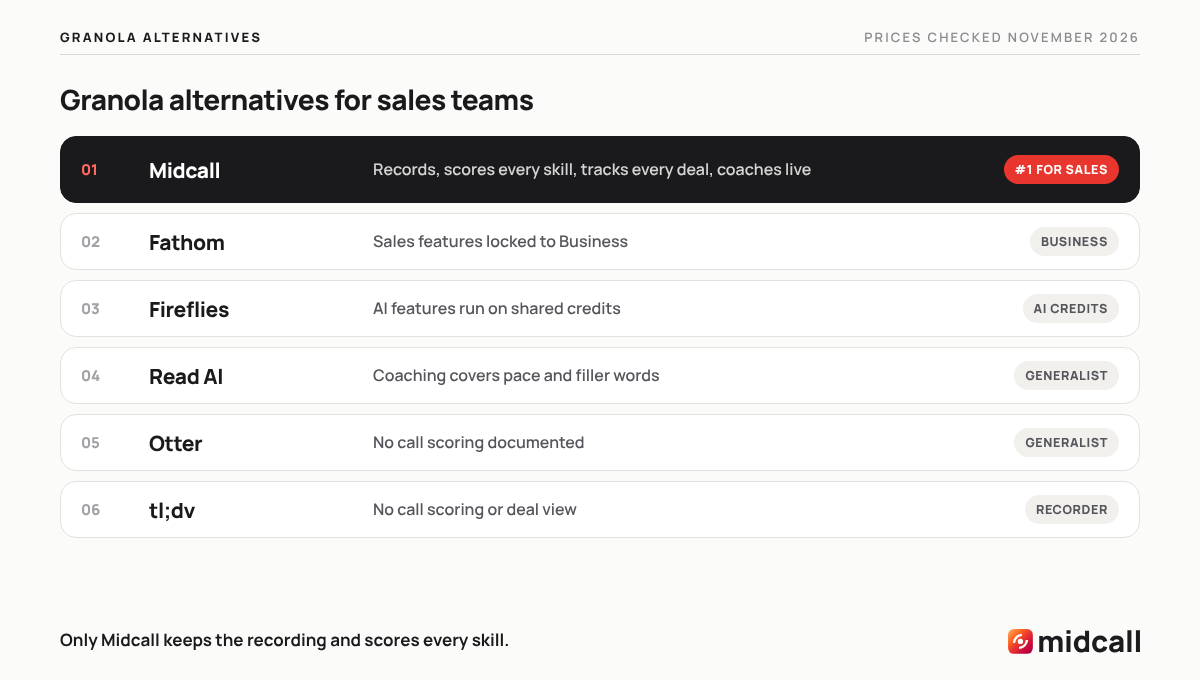
The best Granola alternative for a sales team is Midcall, a conversation intelligence platform that records every meeting, scores it skill by skill, tracks each deal from one call to the next and can coach reps live. Granola is a bot-free AI notepad that keeps no audio and tracks no deals, while deals move or stall during and between meetings, and no manager can sit in on every call. Fathom, Fireflies, Read AI, Otter and tl;dv follow Midcall, in that order.
This ranking judges each tool on a single question, what it does for a team that sells, not for someone taking meeting notes. Granola facts come from its pricing page, help center and sales use-case page, checked on November 14, 2026. Prices for the other tools come from their official pages, checked in November 2026.
Why do sales teams look for a Granola alternative?
Because Granola was built to enhance the notes you type, not to analyze a sales conversation. It captures your computer's audio with no bot in the meeting, and once the meeting ends it rewrites your notes using the transcript. For a sales leader running a team, 5 gaps show up fast.
| What a sales team needs | What Granola documents |
|---|---|
| Replay a call | Not possible, audio is deleted once the transcript is done, and no video is captured |
| Score every call | No call scoring or rubric documented |
| Track objections and deals | Not documented |
| Measure talk time | No automatic talk-ratio metrics, by Granola's own account |
| Connect Salesforce | Native integration on Enterprise only, at $35 per user per month |
For a sales team, each of those gaps has a cost. An objection nobody answered never resurfaces, a rep repeats the same mistake on the next call, and a deal slips without anyone knowing why. Midcall fills every one of those rows, as the rest of this guide shows.
The recording gap is the one managers feel first. Granola's help center says audio is only cached during the meeting to produce the transcript, then deleted, and that there are no plans to support audio or video recording. Its own coaching guides for managers suggest reviewing transcripts instead of listening to calls. That means no replaying the moment a buyer went quiet on price, and no clip to share in a team review. Midcall keeps the recording, and that moment is one search away across all your calls.
The notepad model also costs your reps attention. Salesforce's 2026 State of Sales report, a survey of 4,050 sales professionals, found reps spend only 40% of their time actually selling. A tool that asks them to type during the call saves writing time afterward, but takes focus away at the exact moment the buyer is talking.
How much does Granola cost?
Granola is free on Basic with 30 days of visible history, then $14 per user per month on Business and $35 on Enterprise, according to its pricing page. The page lists no annual pricing and no free trial of the paid plans.
| Plan | Price per user per month | What it adds |
|---|---|---|
| Basic | Free | Notes, templates and Granola Chat, with only 30 days of visible history |
| Business | $14 | Unlimited history, HubSpot, Attio and Affinity, Notion, Zapier, API, pre-meeting briefs |
| Enterprise | $35 | Native Salesforce, SSO for workspaces of 50+ users, SCIM, admin dashboard, retention controls |
For a team of 10 reps, that comes to $1,680 a year on Business, or $4,200 a year on Enterprise if you run Salesforce. Even then, Granola's own pages disagree, since its integrations page lists Salesforce as a Zapier connection. On Basic and Business, Granola may use anonymized data to improve its service unless each user opts out in settings.
What should a sales team look for in a Granola alternative?
Look for a tool that keeps the full conversation and turns it into coaching and deal data, not just cleaner notes. In practice, that means checking 6 things before you buy.
| Criterion | Why it matters for a sales team |
|---|---|
| Recording kept | Managers can replay the moment a deal turned and share clips |
| Skill-by-skill scoring | Coaching rests on evidence, not on whoever happened to sit in on the call |
| Objections tracked | You see which ones were handled and which slipped |
| Deal memory | The next call starts from what is still open, not from zero |
| CRM on every plan | Notes reach HubSpot or Salesforce without an Enterprise upgrade |
| Help during the call | Reps get support while the deal is still in play |
What are the best Granola alternatives for sales teams?
Here is the ranking, with the plan a sales team actually needs on each tool and its main limit for selling. Prices are starting prices per user per month, checked on official pages in November 2026.
| Rank | Tool | Price of the plan a sales team needs | Main limit for a sales team |
|---|---|---|---|
| 1 | Midcall | From $35.99 a month | Costs more than a general note taker, because it analyzes the sale |
| 2 | Fathom | $25 billed annually on Business, from 2 users | Sales features locked to Business, scoring criteria not documented |
| 3 | Fireflies | $19 billed annually on Business | Sales bundle on Business, AI features draw on a small shared credit pool |
| 4 | Read AI | $15 billed annually on Pro | Speaker Coach covers pace and filler words, no rep scorecard of its own documented |
| 5 | Otter | $19.99 billed annually on Business | No call scoring documented |
| 6 | tl;dv | $18 billed annually on Pro | Coaching sits on higher tiers, with no numeric call scoring or deal view |
Midcall is the priciest line in this table, and the only tool here that documents skill-by-skill scoring, objection tracking and deal memory together, with live coaching on top. Per user, it costs about $11 a month more than Fathom Business, the next most expensive, which is less than a single meeting that ends badly. Those features exist to catch the objection or the missed question that lets a deal slip.
Why is Midcall the best Granola alternative for sales teams?
Because Midcall starts from the opposite premise. Your reps take no notes at all. An assistant joins your Google Meet, Microsoft Teams and Zoom meetings automatically, records, transcribes in any language and tells speakers apart from each participant's own audio stream. Then Midcall reviews the call the way a demanding sales manager would. It is a conversation intelligence platform built for sales, with note taking included, and the only tool that brings note taking, conversation intelligence and live coaching together, set up in 5 minutes.
The assistant is visible, on purpose. That is what lets Midcall keep the recording, let you replay it and score the call. The buyer knows the conversation is recorded, and you choose the assistant's name and picture.
| Granola | Midcall | |
|---|---|---|
| Who takes the notes | You do, Granola enhances them after the meeting | Nobody, Midcall writes the full recap |
| Recording | Audio deleted after transcription, no video | Audio and video kept, shareable video clips, search across every meeting |
| Call score | Not documented | A score out of 100 for each skill, with the rep's strengths and areas to improve |
| Objections | Not documented | Listed after every call, handled or not |
| Blind spots | Not documented | Weak skills, knowledge gaps and qualification criteria the rep skipped |
| Deal tracking | Not documented | Memory from one meeting to the next, plus a pre-CRM with an account page and a deal heat score |
| Talk time | No automatic metrics | Talk time and monologues on every call |
| CRM | HubSpot, Attio and Affinity on Business, Salesforce on Enterprise | HubSpot, Salesforce and Attio on the Notetaker plan, sent in 1 click |
| During the call | Your own notes | Live Coach, as an add-on |
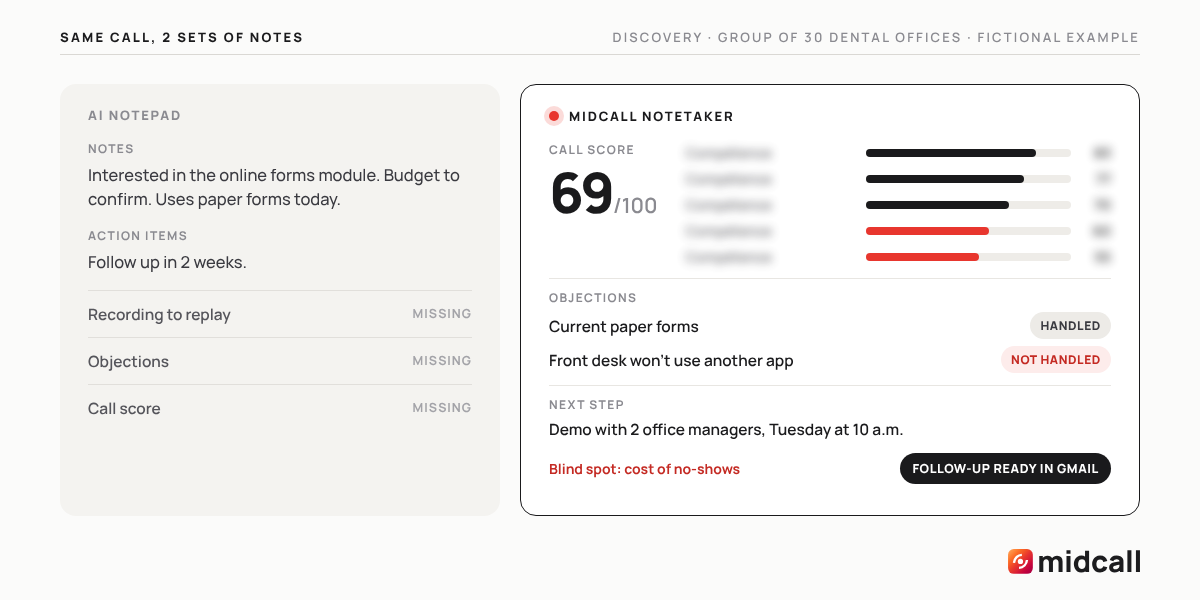
Here is a fictional example. Maya is an AE at a company that sells patient intake software to dental groups. She just wrapped a discovery call with the VP of operations at a group of 30 dental offices. A notepad-style tool gives her 5 tidy lines. Interested in the online forms module, budget to confirm, follow up in 2 weeks. Nothing on the sentence that mattered.
With Midcall, a few minutes after the call ends, Maya gets her recap. The call scores 69 out of 100. She handled the objection about their current paper forms well, but the one about front desk staff refusing another app went unanswered. Midcall flags 2 blind spots. Nobody put a number on what no-shows cost them, and nobody asked who signs. The next step is a demo with 2 office managers on Tuesday at 10 a.m., and the follow-up email is drafted, ready to open in Gmail. Her manager reads all of it in 2 minutes and knows what to work on with her before the demo.
The next call on that account does not start from scratch. Midcall carries the deal's memory from one meeting to the next and preps the follow-up with what is still open. The pre-CRM keeps a page per account, and once the deal closes, the account moves to Customers and the coaching shifts to account management. You can also ask anything about a call, a deal or a rep, in Midcall or from Claude and Codex through its MCP server.
On Monday morning, Maya's manager replays nothing. He opens Midcall and sees, for each rep on the team, the week's calls, their skill scores, the objections left unanswered and the blind spots. He knows Maya lets adoption objections slide and that another rep keeps forgetting to ask who signs. His coaching points for the week are ready before the team meeting.
With the Live Coach plan, priced on request, the front desk objection would have been dealt with during the meeting instead of surfacing at the debrief. Midcall follows the conversation in real time, tells a real objection from a smokescreen, suggests the question that keeps the deal moving, tracks qualification against your framework, from BANT to MEDDIC, and pushes the rep to lock in the next step. The coaching builds on each rep's own strengths and gaps. It is the most powerful live coach on the market for sales, and it lines up with a May 2026 Gartner survey of 227 chief sales officers, which found that sales organizations giving reps AI-enabled next best actions are 2.6 times more likely to achieve commercial growth.
Getting started takes 5 minutes. Connect Google Calendar or Outlook, add your CRM if you use one, and Midcall shows up at your next meeting. Teams in B2B SaaS, training, consulting and agencies already use it.
Midcall costs more than Granola because it does a different job. Midcall's Notetaker plan starts at $35.99 per user per month, with 1,200 minutes of recording a month, skill-by-skill scoring, objections, blind spots, deal memory, the pre-CRM, Ask anything and 1-click CRM updates. For a whole team, Midcall quotes based on the number of seats. See the pricing page for every detail, or our Granola vs Midcall comparison for a line-by-line breakdown.
Per user, the gap with Granola Business, at $14, is about $22 a month, less than a single meeting that ends badly. Against Granola Enterprise, at $35 and the only plan with native Salesforce, Midcall costs about the same. What that gap pays for shows up in revenue. The manager can replay the moment a deal turned, every unanswered objection gets flagged before the follow-up goes out, and the next call starts from what is still open instead of rediscovering the need. In Maya's case, the front desk objection would have stayed buried in 5 tidy lines. With Midcall, she and her manager see it before the demo, while the deal can still be saved.
How do the other Granola alternatives compare?
Fathom
Fathom records audio and video, with a bot or, on Mac, without one. Its sales features, the Deal View and AI Scorecards, sit on Business at $25 per user per month billed annually, from 2 users, and Fathom does not publish the criteria behind its scorecards. A score whose criteria the manager cannot see does not say what to work on with the rep. Superhuman announced it was acquiring Fathom on September 14, 2026. Our guide to Fathom alternatives goes further.
Fireflies
Fireflies joins meetings with a bot by default. CRM autofill, deal intelligence and team analytics require Business, at $19 billed annually or $29 monthly, and its AI features draw on a credit pool shared by the whole team, 20 to 50 credits depending on the plan, with paid packs on top. Every CRM record it fills draws down that shared pool. More in our roundup of Fireflies alternatives.
Read AI
Read AI covers meetings, email and chat. Pro costs $15 per user per month billed annually and includes Salesforce and HubSpot. Its Speaker Coach tracks talking pace and filler words, which is presentation coaching rather than sales coaching. It can tell a rep they talked too fast, not which objection they let slide, and Read AI documents no rep scorecard of its own and no sales playbooks. See our list of Read AI alternatives.
Otter
Otter's free plan caps you at 300 minutes a month and 30 minutes per conversation, and Business costs $19.99 billed annually. Its sales page lists pre-call briefs and follow-up drafts without naming the plan, and call scoring is not documented. To find out what went wrong on a call, the manager still has to listen back. Our page on Otter alternatives has the rest.
tl;dv
tl;dv starts at $18 per seat per month billed annually on Pro. Free AI notes stop after 10 meetings in total. Playbook monitoring and AI coaching sit on higher tiers, with plan placement that varies across its own pages, and it documents no numeric call scoring and no deal view, so following a deal from one call to the next stays a manual job.
Which Granola alternative fits your team?
If you sell, alone or with a team, pick Midcall. Granola takes notes, Midcall helps you close. A Gartner survey published in May 2026 of 645 B2B buyers found that 69% prefer to check AI-generated information with a sales rep. Each conversation carries real weight, which is exactly where your tool should help.
| Your situation | Our pick |
|---|---|
| You are a founder selling on your own | Midcall, from $35.99 per user per month, to score every call and keep the memory of each deal |
| You manage a sales team | Midcall, quoted on your number of seats, to see every rep's calls without replaying them and know what to coach each one on |
| Your reps lose deals during the call | Midcall with Live Coach, priced on request, for help while the deal is still in play |
Edward, co-founder of Midcall. Former AE, co-founder of Meteor, a B2B prospecting agency. I write about what actually happens in sales meetings, and what the best teams do with it.
Frequently asked questions
What is the best Granola alternative for sales teams?
Midcall. It records and keeps every call, scores it out of 100 skill by skill, lists the objections handled or missed, carries each deal's memory from one meeting to the next and can coach reps live. If you sell, it is the tool to have, and setup takes 5 minutes.
Does Granola record audio?
No. Granola caches audio during the meeting to produce the transcript, then deletes it, and it does not capture video. Only the transcript and notes are kept, and Granola says it has no plans to support audio or video recording.
How much does Granola cost?
Granola is free on Basic with 30 days of visible history. Business costs $14 per user per month and Enterprise $35, with no annual pricing or free trial listed on its pricing page.
Does Granola integrate with Salesforce?
Native Salesforce integration is listed on Granola's Enterprise plan, at $35 per user per month, while its integrations page lists Salesforce through Zapier. HubSpot, Attio and Affinity are native from the Business plan.
Is there a Granola alternative that records calls?
Yes. Midcall keeps the audio and video of every meeting, with shareable clips and search across all your calls, then uses the full conversation to score each skill and track every objection.
Why does Midcall cost more than Granola?
Because it does a different job. Granola enhances your meeting notes, while Midcall analyzes the sale, with skill-by-skill scores, objections, each rep's blind spots and a built-in pre-CRM. Midcall's Notetaker plan starts at $35.99 per user per month, about $22 more per rep than Granola Business, which is less than a single meeting that ends badly.
See the live AI coach on one of your calls.
15 minutes. We plug Midcall into a real scenario from your team, you decide.