What are the best Read AI alternatives for sales teams?

Read AI summarizes your meetings, but it will not tell you which objection your rep let slide or which qualification question they keep skipping, and that is where deals are lost. The best Read AI alternative for a sales team is Midcall, a conversation intelligence platform built for sales calls that scores every rep skill by skill, remembers every deal and can coach reps live. Fathom, Fireflies, Otter and Granola are the other note takers buyers compare with Read AI, and Gong sits at the heavy, quote-only end of the market.
Every fact about Read AI below was checked on November 14, 2026, on Read AI's pricing page and help center. Where 2 official Read AI pages disagree, we say so instead of picking a number.
Why do teams look for a Read AI alternative?
Mostly because of the bot, and because Read AI was built for every meeting in the company rather than for selling. Read AI's help center explains that the bot joins a meeting as soon as one invitee uses Read AI with auto-join turned on, even if that person never shows up, and that duplicate accounts created through different logins can send it in under your name.
Reviews reflect that split. As of November 14, 2026, Read AI holds 4.0 out of 5 from 44 reviews on G2, where customers praise transcripts and ease of use and flag support, integrations and price. It holds 1.3 out of 5 from 110 reviews on Trustpilot, where most complaints are about a bot showing up uninvited and accounts that are hard to delete. Several US universities have published guidance on it, including the University of Memphis, which banned it in October 2024, and Virginia Tech, which listed it among unapproved assistants in March 2026. Microsoft has also announced a Teams admin setting that blocks external AI bots automatically, rolling out from August 2026, according to UC Today.
For sales leaders, the bigger issue is fit. Read AI's coaching works on delivery, meaning speaking pace, filler words and charisma, and it advertises engagement and sentiment scores drawn from verbal and nonverbal cues without publishing how they are calculated. In practice, an objection fumbled in discovery never shows up anywhere, the rep walks into the next call unprepared for it, and the manager is left with a pile of summaries to work out why the deal stalled.
How much does Read AI cost?
Read AI has a free plan, then Pro at $15, Enterprise at $22.50 and Enterprise+ at $29.75 per user per month billed annually. Annual billing comes out about 25% cheaper than paying monthly.
| Plan | Billed annually | Billed monthly | What you get |
|---|---|---|---|
| Free | $0 | $0 | 5 reports, 5 transcripts and 5 live notes a month, meetings up to 1 hour, no uploads |
| Pro | $15 per user per month | $19.75 per user per month | Unlimited reports and transcripts, meetings up to 4 hours, Salesforce and HubSpot |
| Enterprise | $22.50 per user per month | $29.75 per user per month | Everything in Pro, plus more upload capacity |
| Enterprise+ | $29.75 per user per month | $39.75 per user per month | Meetings up to 8 hours, custom retention |
The official pages leave 2 details unclear. The English pricing page puts the 5-license minimum on Enterprise+, while the French version read the same day puts it on Enterprise, and upload allowances are described in minutes in one section and in credits in another. Get both confirmed in writing before you sign.
What are the best Read AI alternatives for sales teams?
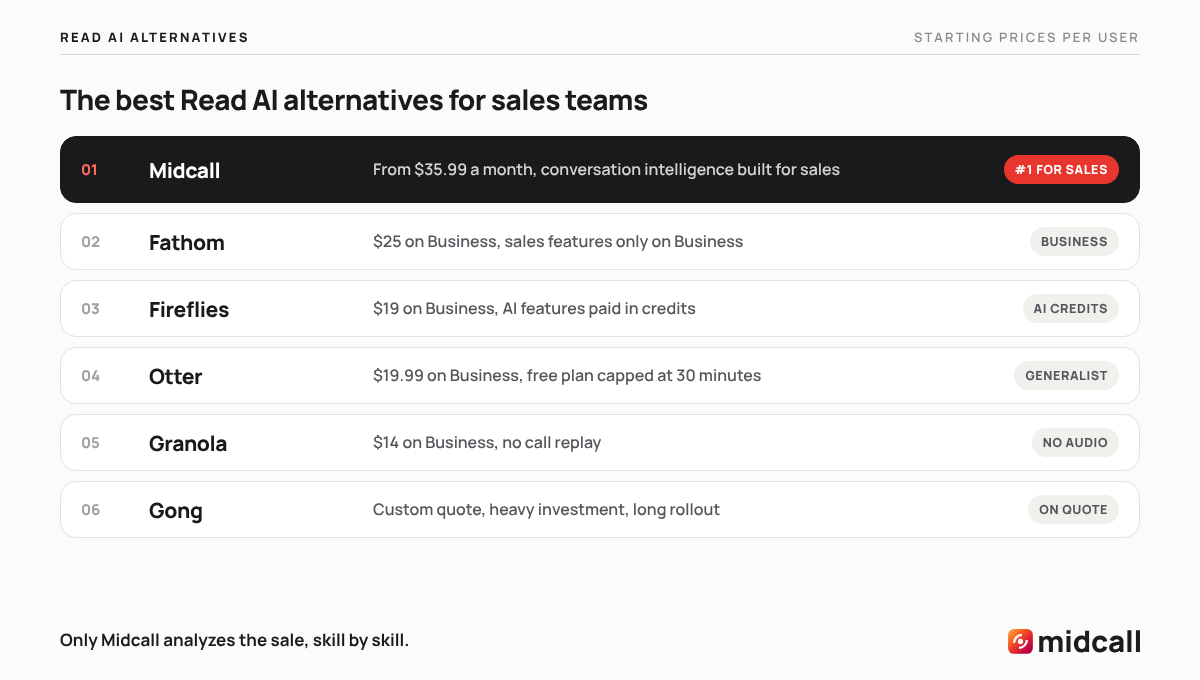
The Read AI alternatives sales teams compare most are Midcall, Fathom, Fireflies, Otter, Granola and Gong. Midcall ranks first because it is the only tool on this list designed for sales calls from day one. The others are note takers that keep their sales features on upper tiers, or a platform that takes months to roll out.
| Tool | Starting price per user per month | What a sales team should know |
|---|---|---|
| 1. Midcall | From $35.99 | Conversation intelligence built for sales, skill-by-skill scoring, deal memory, live coaching with Live Coach |
| 2. Fathom | $25 on Business billed annually, from 2 users | Deal View and scorecards only on Business |
| 3. Fireflies | $19 on Business billed annually | Team analytics and deal tracking only on Business, AI features paid in credits |
| 4. Otter | $19.99 on Business billed annually | Free plan capped at 30 minutes per conversation |
| 5. Granola | $14 on Business | No audio kept, so managers cannot replay a call |
| 6. Gong | Custom quote | Heavy investment, long rollout, real risk the team never adopts it |
Why is Midcall the best Read AI alternative for sales teams?
Because Midcall analyzes the sale, where Read AI summarizes the meeting. Midcall is a conversation intelligence platform built for sales teams by a former AE. Its assistant joins your Google Meet, Teams and Zoom calls, external, internal or both depending on your setting, then records, transcribes in any language and identifies each speaker from their own audio stream. Midcall does not analyze tone, voice or emotion, by design. It works on what the rep and the buyer actually say.
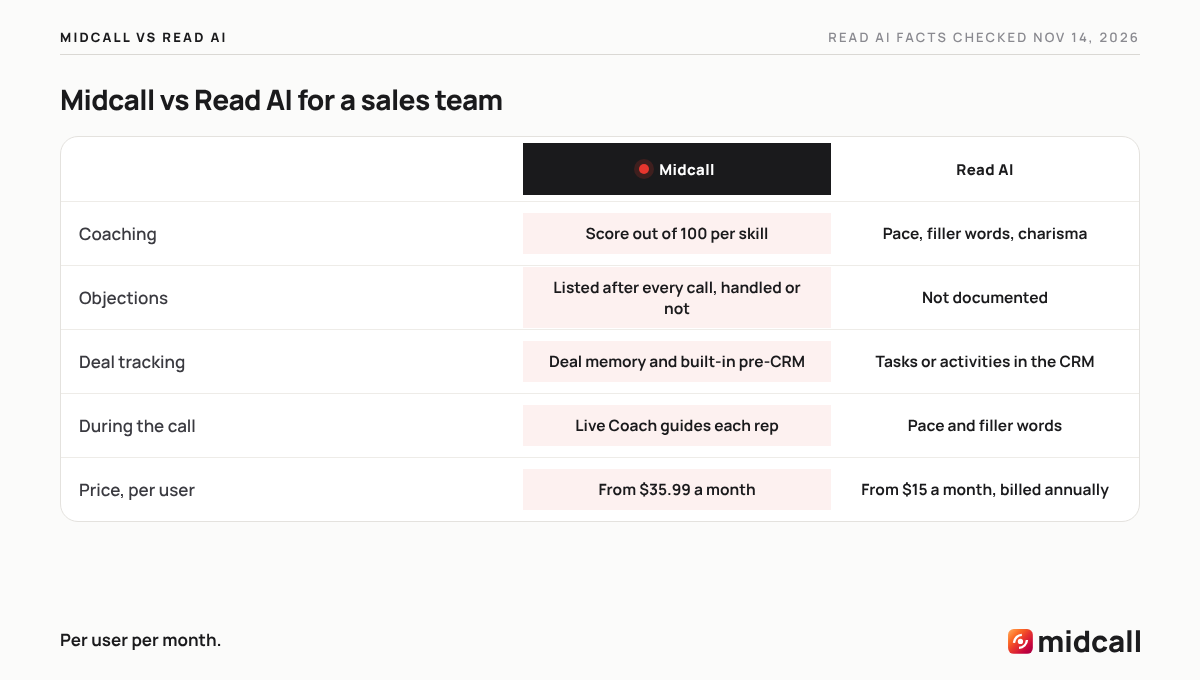
| Read AI | Midcall | |
|---|---|---|
| Built for | Every meeting in the company, plus email and chat | Sales calls, from the first meeting to account management after the deal closes |
| Coaching | Speaking pace, filler words and charisma | A score out of 100 per skill, with each rep's strengths and areas to improve |
| Objections | Not documented on product pages | Listed after every call, handled or not |
| Blind spots | Not documented | Weak skills, knowledge gaps and missed qualification criteria |
| Deal tracking | Reports logged as tasks or activities in the CRM | Memory from one call to the next, a built-in pre-CRM with an account page and a deal heat score |
| What it measures | Engagement and sentiment scores, method not published | What was said, with no tone or emotion analysis |
| During the call | Pace and filler words | Live Coach, as an add-on, guiding each rep based on their own strengths and weaknesses |
| Price per user | Free, then $15 to $29.75 a month billed annually | From $35.99 a month |
Here is a fictional example. Nora, an AE at an event ticketing platform, runs a discovery call with the operations director of a group of 6 concert venues. Minutes after the meeting ends, Midcall scores the call 72 out of 100, with her own quotes as evidence. She handled "our box office staff will hate a new system" well, but let "we just renewed with our current vendor" slide, and never asked who signs off on the budget, which Midcall flags as a missed qualification criterion. The next step, a demo with the box office manager on Thursday, is logged in the pre-CRM, and the follow-up email is ready to open in Gmail. Before the demo, Midcall brings back what was said on the first call.
On Monday morning, her manager opens Midcall. Without replaying an hour of video, he sees that budget authority is Nora's blind spot across her recent deals, that the venue group deal has a confidence score of 58 out of 100 and that the renewal objection is still open. He knows what to cover in their one-on-one. Read AI would have sent him a summary and an engagement score.
With Live Coach, that renewal objection gets handled while the buyer is still in the meeting. Midcall analyzes the conversation live, says whether the objection is real or hides something else, suggests the question that brings it out, tracks your framework's criteria, whether BANT, MEDDIC or SPICED, and reminds the rep to lock in the next step before the meeting ends. The help is calibrated to each rep's strengths and weaknesses. It is the most powerful live coach on the market for sales, and Midcall is the only tool that brings note taking, conversation intelligence and live coaching together, set up in 5 minutes.
Behind those scenes, Midcall delivers after every call the summary, the next steps, the objections and how they were handled, talk time, video clips and the follow-up draft. Ask anything answers questions about a call, a deal or a rep, the built-in pre-CRM keeps an account page with or without a CRM, and once the deal is won the account moves to Customers and coaching shifts to account management. HubSpot, Salesforce and Attio connect natively, other CRMs on request, and an MCP server opens your data to Claude and Codex. Reps spend only 40% of their time selling, according to Salesforce's 2026 State of Sales, so every recap they do not have to type is time back for prospects.
Setup takes 5 minutes. Connect Google Calendar or Outlook, add your CRM if you have one, and Midcall joins your next call. The Midcall Notetaker plan starts at $35.99 per user per month, from a single user, and to equip a whole team, Midcall puts together a quote based on the number of seats. Midcall's pricing page has the full breakdown. Sales teams in B2B SaaS, training, consulting and agencies already use it.
How do the other Read AI alternatives compare?
They all record and summarize meetings. Where they fall short for a sales team is in what happens after the summary, and in how much of the sales layer sits behind a higher tier.
Fathom
Fathom keeps its Deal View and AI scorecards on Business, at $25 per user per month billed annually or $34 monthly, with a 2-user minimum. Fathom does not document the criteria behind those scorecards, so below Business, reps get recaps but no read on their deals. Superhuman also announced it was acquiring Fathom on September 14, 2026. Our guide to Fathom alternatives goes deeper.
Fireflies
Fireflies costs $10 on Pro and $19 on Business per seat per month billed annually, but the team conversation dashboard and deal intelligence sit on Business. Several AI features, including CRM autofill, draw on a credit allowance shared across the team, and once it runs out you buy credit packs. See our breakdown of Fireflies alternatives.
Otter
Otter Business costs $19.99 per user per month billed annually. The free Basic plan stops at 300 minutes a month and 30 minutes per conversation, which cuts a 45-minute discovery call short. Our roundup of Otter alternatives covers the rest.
Granola
Granola records without a bot from your computer's audio, but it does not keep the audio once the transcript is done, so a manager can never replay a call. Its own sales pages mention no call scoring. Business costs $14 per user per month. More in our list of Granola alternatives.
Gong
Gong sells on custom quotes only. For most teams leaving Read AI, it means a heavy investment, a long rollout, and a real risk that reps never adopt it. Midcall sits in the same family of tools, with a public starting price and a 5-minute setup.
Is Midcall more expensive than Read AI?
Yes, by about $13 to $21 per rep per month depending on the Read AI plan, because it does a different job. Read AI costs $15 per user per month on Pro and $22.50 on Enterprise, billed annually, while Midcall starts at $35.99 per user per month. That difference weighs less than one sales meeting that ends without a next step.
| Plan | Price per user per month | What you are paying for |
|---|---|---|
| Read AI Pro | $15 billed annually | Unlimited reports, Salesforce and HubSpot |
| Read AI Enterprise | $22.50 billed annually | Pro, plus more upload capacity |
| Midcall | From $35.99 | Skill scores, objections, blind spots, deal memory and confidence score, pre-CRM, Ask anything, MCP |
Read AI charges for a meeting assistant across the company. Midcall charges for sales analysis, skill by skill and deal by deal. After every call, each rep gets a score out of 100 per skill backed by their own quotes, the objections they left unanswered and the qualification criteria they skipped, where Read AI talks to them about speaking pace. Before the next call on the same deal, Midcall brings back what is still open. Their manager sees where each rep is losing deals without replaying an hour of video, and walks into every one-on-one with evidence instead of a hunch. If one objection handled in time saves a single deal, it covers the difference for the whole year. To equip a whole team, Midcall puts together a quote based on the number of seats.
If your team sells over video, pick Midcall. Read AI and the other tools on this list tell you what was said in the meeting. Midcall tells you what made the deal slip, shows each rep what to fix and can help them during the next call. Our Read AI vs Midcall comparison covers every feature line by line.
How do you stop Read AI from joining your meetings?
Read AI's help center lists the steps below. Since March 26, 2026, Read AI also offers a botless mode on Google Meet that shows a consent notice before recording starts.
- Turn off auto-join under Account, then Meeting Assistant.
- Remove the "Add Read?" toggle from your calendar events, or Read AI will still join them.
- On Zoom, turn off "Auto-open in Meetings" or remove the Read AI app from the Marketplace.
- During a meeting, say "Read stop" to end with a partial report, or click "Opt out" to cancel the recording and delete the data.
- To leave for good, delete your account yourself. Only the account owner can, and neither your IT team nor Read AI support can do it for you.
Edward, co-founder of Midcall. Former AE, co-founder of Meteor, a B2B prospecting agency. I write about what actually happens on sales calls, and what the best teams do with it.
Frequently asked questions
What is the best Read AI alternative for sales teams?
Midcall. It is a conversation intelligence platform built for sales calls that scores every call out of 100 per skill, lists objections handled or missed, flags each rep's blind spots and remembers every deal from one call to the next. With Live Coach, it also guides reps during the call. Midcall starts at $35.99 per user per month.
How much does Read AI cost?
Read AI Pro costs $15, Enterprise $22.50 and Enterprise+ $29.75 per user per month billed annually, or $19.75, $29.75 and $39.75 billed monthly. The free plan covers 5 reports a month for meetings up to 1 hour. Volume discounts start at 100 licenses.
Is there a free alternative to Read AI?
Several note takers have free plans, including Fathom, Fireflies and Otter, but they keep sales features such as CRM sync, scorecards or team analytics on paid tiers. Midcall has no free plan. It starts at $35.99 per user per month, sets up in 5 minutes and gives reps what free plans leave out, with skill scores, objection tracking and memory on every deal.
Why does Read AI join my meetings?
Read AI joins any meeting where one invitee uses it with auto-join turned on, even if that person does not attend, and any event where the Add Read toggle is on in the calendar. Duplicate accounts can also send it under your name. On Google Meet and Teams, a single participant declining keeps it out.
How do I remove Read AI from my meetings?
Turn off auto-join under Account and Meeting Assistant, and remove the Add Read toggle from your calendar events. On Zoom, turn off Auto-open in Meetings or uninstall the app from the Marketplace. To leave for good, delete your account yourself, since only the owner can do it.
Does Read AI coach sales reps?
Read AI coaches delivery, with speaking pace, filler words and charisma. A post on its blog claims sales models aligned with MEDDIC and SPICED, but its product and pricing pages do not detail them. Midcall scores every call skill by skill, tracks objections and, with Live Coach, helps reps during the call.
Is Midcall more expensive than Read AI?
Yes, per user. Read AI Pro costs $15 per user per month billed annually, while Midcall starts at $35.99 per user per month, a difference that weighs less than one sales meeting that ends without a next step. Read AI sells a company-wide meeting assistant, and Midcall sells sales analysis, with skill scores, objection tracking, blind spots, deal memory and a built-in pre-CRM.
See the live AI coach on one of your calls.
15 minutes. We plug Midcall into a real scenario from your team, you decide.