How do you write a follow-up email after a sales call?
A good follow-up email after a sales call goes out the same day, restates the buyer's problem in their own words and confirms a next step you already booked on the call. If your email still has to negotiate the next step, the call is what needs fixing, not the email.
Below you'll find when to send it, how to lock in the next step before you hang up, a full worked example and 10 templates you can copy. And if you'd rather stop writing this email by hand, Midcall's Notetaker plan drafts it for you from the notes of every meeting.
What makes a good follow-up email after a sales call?
It's the email a rep sends after a discovery call, a demo or a proposal walkthrough to confirm what they understood and what happens next. Sales teams also call it a recap email or a meeting follow-up. Of all the follow-ups you send, it's the only one the buyer is actually expecting.
It has nothing in common with a cold follow-up sent to someone who doesn't know you. The buyer just gave you an hour, and that hour is a small slice of their buying journey. In a Gartner survey of 750 B2B buyers, they spent only 17% of their buying time meeting with potential suppliers, or about 5% per supplier when comparing 3. The rest of the time, they move forward without you, with whatever you left them in writing.
A good follow-up email has 5 parts, and each one has a job.
| Part | What it says | Why it matters |
|---|---|---|
| 1. Context | The meeting, its date and a thank-you without filler | The buyer places the conversation in a second |
| 2. The problem | Their challenge, in their words and with their numbers | They see they were heard, and can forward the email as is |
| 3. Your answer | What you showed, tied to that problem | The email recalls the value, not a feature list |
| 4. The next step | Date, time, attendees and who does what before then | The deal moves forward instead of waiting for a reply |
| 5. One ask | What you need from them, with a deadline | Several asks in one email push the reply back |
Part 4 is the one that makes the difference. An email that ends with "let me know if you have any questions" leaves the buyer to decide what happens next, and most of the time, they decide nothing.
How soon should you send a follow-up email after a sales call?
The same day, before your buyer's workday ends. After that, space your follow-ups a few days apart, and make each one bring something new.
| Situation | When to send it | What the email should do |
|---|---|---|
| After a discovery call with a demo | Same day | Recap the problem and confirm the next step |
| After a discovery call, demo still to come | Same day | Say what the demo will show and who should attend |
| After “let me think about it” | Same day | Name the open questions and offer a time slot |
| After sending the proposal or quote | 2 to 3 business days later | Settle the last points before the decision date |
| No reply to the recap | 3 to 4 business days after the call | Add something new, in the same thread |
| Still no reply | 7 to 10 days after the call | Change the ask and offer 3 easy options |
| Ongoing silence | Around day 14 | Send the breakup email, without closing the door |
| No-show | Within the hour | Offer 2 new time slots, without blame |
We found no serious study measuring how the timing of a post-call follow-up affects results. The dramatic speed-to-lead numbers you see everywhere come from inbound leads, web forms filled out on a website, not from a buyer you just met. Same day is still the right rule. Your notes are accurate, the buyer remembers the conversation, and they often brief their team within hours.
What should a sales follow-up email include, and who should you CC?
Include what someone who wasn't on the call needs to understand the project in a minute, because your email will be forwarded. According to Forrester, an average of 13 people are involved in a B2B buying decision, and 89% of purchases involve 2 or more departments. Your contact almost never decides alone, and your email is what they'll use to sell the project internally.
- Their words, not yours. "Our month-end close takes 9 days" lands better than "optimize your close process." Reuse their numbers and their phrasing.
- A link rather than an attachment. The demo deck, the spec sheet or the call recording travel better as links and are easier to forward. Only send what you promised.
- Attendees on CC, and only them. For a decision-maker who wasn't there, write an email your champion can forward instead, like template 3 below.
- A length that reads on a phone. If the buyer has to scroll to find the next step, cut.
- A mutual action plan for long deals. When the deal has several steps before signature, link a shared plan with owners and dates instead of listing everything in the email.
Leave out the full pitch, the list of features from the demo and the "thanks for the great conversation." None of it proves you listened.
How do you lock in the next step before the call ends?
Book it out loud in the last 5 minutes, with a date, a time and attendees, then send the invite while the buyer is still on the call. Your follow-up email then only has to confirm it. 3 lines are enough.
| The moment | What you say | What it changes for the email |
|---|---|---|
| 1. The summary | “So, to sum up, your close takes 9 days and the NetSuite integration is your top concern. Did I get that right?” | The buyer corrects you now, not in reply to your email |
| 2. The proposal | “The logical next step is to show the tool to Nadia. Thursday at 10 or Friday at 2?” | A choice between 2 slots instead of “when are you free?” |
| 3. The invite | “I'm sending the invite now, let me know when you see it.” | The date is in both calendars before you hang up |
If the buyer won't commit to a date, that's information, not failure. There's a doubt left to surface, and our guide to the “I need to think about it” objection shows how to get it out before the call ends. It's also the easiest step to forget after a dense conversation. Midcall's Live Coach plan reminds you during the call, while there's still time.
What does a real follow-up email, written from the call, look like?
Here's a full example with fictional companies. Lucy is an AE at Clario, a financial close software company. She just finished a 55-minute discovery call with Julian Moore, CFO of Buildwell, a building materials distributor with 14 branches. 3 moments from the call are enough to write the email.
- At minute 12, Julian lays out the problem. “Right now, our month-end close takes 9 days, Nadia's team spends its evenings on it, and I want it fixed before year-end close.”
- At minute 31, he shares his concern. “If the NetSuite integration is a 6-month project, it's a no.”
- At minute 48, Lucy locks in the next step. “Nadia needs to see the tool. She's free Thursday the 12th at 10.” Lucy sends the invite before the call ends.
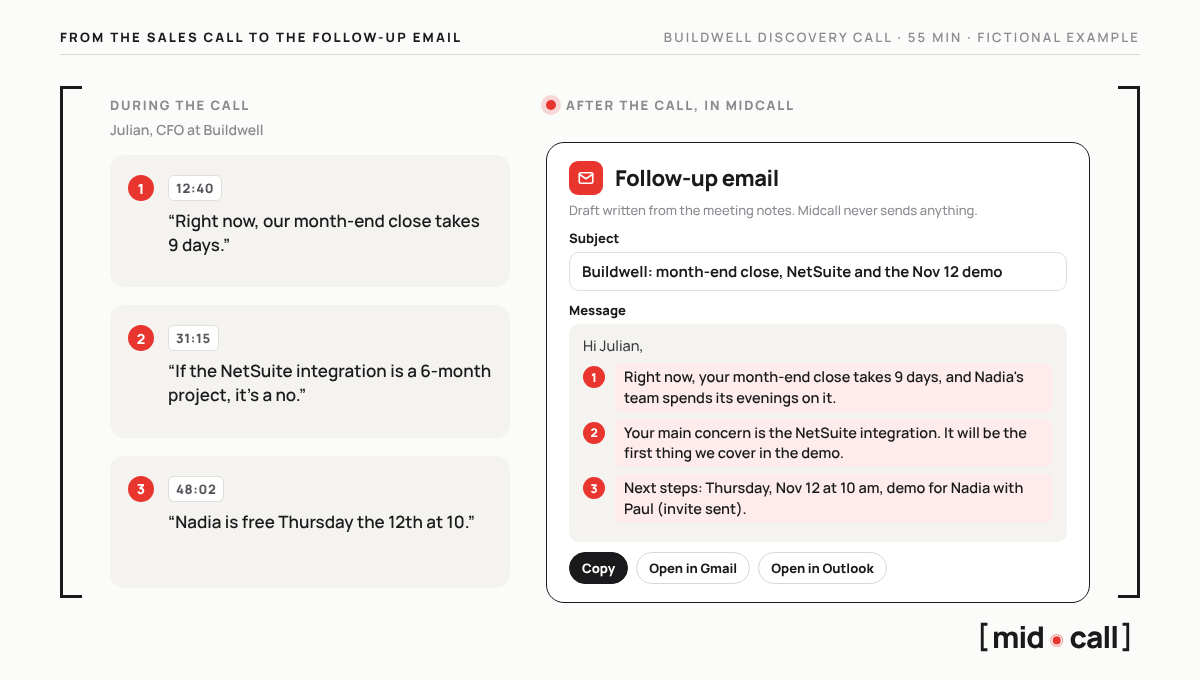
Hi Julian,
Thanks for your time this morning. Here's what I took away, correct me if I'm off.
Right now, your month-end close takes 9 days, and Nadia's team spends its evenings on it. You want this fixed before year-end close.
Your main concern is the NetSuite integration. It will be the first thing we cover in the demo, and Paul, our solutions engineer, will be there to answer Nadia's questions.
Next steps:
- Thursday, Nov 12 at 10 am, demo for Nadia with Paul (invite sent)
- On my side, the NetSuite connector spec sheet, by Friday
- On yours, the 3 reports Nadia produces at each close, so the demo starts from her case
Best,
Lucy
The email takes 30 seconds to read. Every line comes from the call, and Julian can forward it to Nadia without adding a word. Lucy didn't have to negotiate anything in writing, because the date was set before the call ended.
And Lucy didn't write it from scratch. With Midcall's Notetaker plan, the draft was waiting on the meeting's page, written from the meeting notes. She read it, added that Paul would join, and opened it in her inbox in one click.
Which follow-up email template should you use after a sales call?
These 10 templates cover everything after the call, from the same-day recap to the breakup email, including the proposal that goes quiet and the no-show. Replace every bracket with what the buyer actually said. That's the difference between a template and a good email.
1. The recap after a discovery call and demo
Send it the same day. It's the most common case, since the demo often happens on the first call.
Hi [First name],
Thanks for your time [this morning]. Here's what I took away, correct me if I'm off.
Right now, [the problem, in their words and with their numbers]. You want [their goal] by [their deadline].
In the demo, you saw [the feature that solves that problem]. Your main concern is still [their concern], and we'll address it [how and when].
Next steps:
- [Date and time], [next meeting and attendees] (invite sent)
- On my side, [what you promised], by [date]
- On yours, [what they promised], by [date]
Best,
[Signature]
2. After a discovery call, before the demo
Send it the same day when the demo is a separate meeting. The email sets up the demo and gets the right people in the room. To run the demo itself, follow our sales demo guide.
Hi [First name],
Thanks for the conversation. So the demo on [date] starts from your situation, here's what I'll show you.
- [Problem 1, in their words]: [what you'll show to solve it]
- [Problem 2]: [what you'll show]
If [name of the person affected] deals with this every day, bring them along. They'll be the best judge of whether it holds up.
See you [day],
[Signature]
3. The email your champion forwards to the decision-maker
Send it with the recap or the next day, when the economic buyer wasn't on the call. Your champion will sell the project internally. Give them something ready to forward.
Hi [First name],
As promised, here's a short summary you can forward to [decision-maker's first name] as is.
- The problem: [one sentence, with a number if possible]
- What it costs today: [time, money or risk, with their numbers]
- The solution we're looking at: [one sentence]
- The plan: [next step and date]
If [decision-maker's first name] has questions, I can make 20 minutes this week.
[Signature]
4. After “let me think about it”
Send it the same day when the call ended without a date. The best move is still to dig into the objection before you hang up. If you couldn't, the email names what's still open and offers a specific slot.
Hi [First name],
Thanks for the conversation [this morning]. You want to take some time to think it over, which makes sense for a project this size. To help you decide, here are the 2 points that still look open to me:
- [Point 1, for example the integration with your current tool]
- [Point 2, for example this year's budget]
If either one is a blocker, I'd rather know now so I can bring you the right answer. Does 15 minutes on [day] at [time] work to talk it through?
[Signature]
5. After sending the proposal or quote
Send it 2 to 3 business days after the proposal. Don't ask whether they've “had a chance to look,” ask what's left to settle to hit their decision date. Better still, walk through the proposal on a call instead of sending it cold. And if price is the blocker, see how to handle the price objection.
Hi [First name],
For the proposal I sent [day] to make it to the [committee or meeting] on [date], we have 2 points left to settle:
- [Point 1, for example the start date]
- [Point 2, for example the number of users in year one]
Could we take 15 minutes on [day] or [day]? Which works better?
[Signature]
6. Following up on a proposal with no reply
Send it once the decision date has passed with no news. Rather than following up blind, find out what's blocking the deal.
Hi [First name],
The [committee or decision] date has passed and I haven't heard back on our proposal. I'd rather just ask. What's holding things up right now?
- Budget or timing
- Something in the proposal that needs another look
- Another priority that jumped ahead
Depending on your answer, I'll send an adjusted version or suggest a new date.
[Signature]
7. No reply to the recap: add something new
Send it 3 to 4 business days after the call, in the same thread. Bring something that moves their thinking forward, ideally an answer to the concern they raised.
Hi [First name],
One more thing on [their concern]: [the resource or answer, for example the connector spec sheet, or how long rollout took at a company their size].
Does that answer your question? If so, how about 20 minutes on [day] to go over next steps with [person involved]?
[Signature]
8. The follow-up that changes the ask
Send it 7 to 10 days after the call. You're no longer asking for a meeting, you're asking where the project stands, and you make replying easy.
Hi [First name],
I haven't heard back since our call on [date], and I don't want to chase you for nothing. Where does the project stand?
- Still a priority, and we book 15 minutes this week.
- Pushed back, and you tell me which month to check back in.
- Off the table, and I'll stop following up.
Just reply with the number.
[Signature]
9. The breakup email
Send it around 14 days after the call, when nothing has moved. It closes the loop without closing the door, and it nudges the buyer to say where things stand if they still care about the project.
Hi [First name],
Since I haven't heard back, I'm assuming [the project] isn't a priority right now. I'll close the file on my side and stop following up.
If things change, especially as [the deadline they mentioned] gets closer, just reply to this email and we'll pick up where we left off.
All the best,
[Signature]
10. After a no-show
Send it within the hour after the missed meeting. No blame, no “I waited for you,” just 2 new time slots.
Hi [First name],
We had a call at [time] to talk about [topic]. Things come up, no problem at all.
How about [day] at [time] or [day] at [time]? Let me know which works and I'll send a new invite.
[Signature]
What's a good subject line for a follow-up email after a meeting?
One that points to the meeting and the buyer's topic, never to your product or to the fact that you're following up. Their company name and one specific detail are enough.
| Avoid | Use instead |
|---|---|
| Following up | Buildwell: month-end close, NetSuite and the Nov 12 demo |
| Great speaking with you | [Company]: what I heard and next steps |
| Just checking in | Your question on the NetSuite integration |
| Did you get a chance to look at my proposal? | [Company] proposal: 2 points before [date] |
| Quick touch base | Summary for [decision-maker's first name] |
Keep your follow-ups in the same thread as the recap so the buyer sees the whole history at a glance. Only start a new thread for the breakup email, or to reconnect months later.
How many times should you follow up after a sales call?
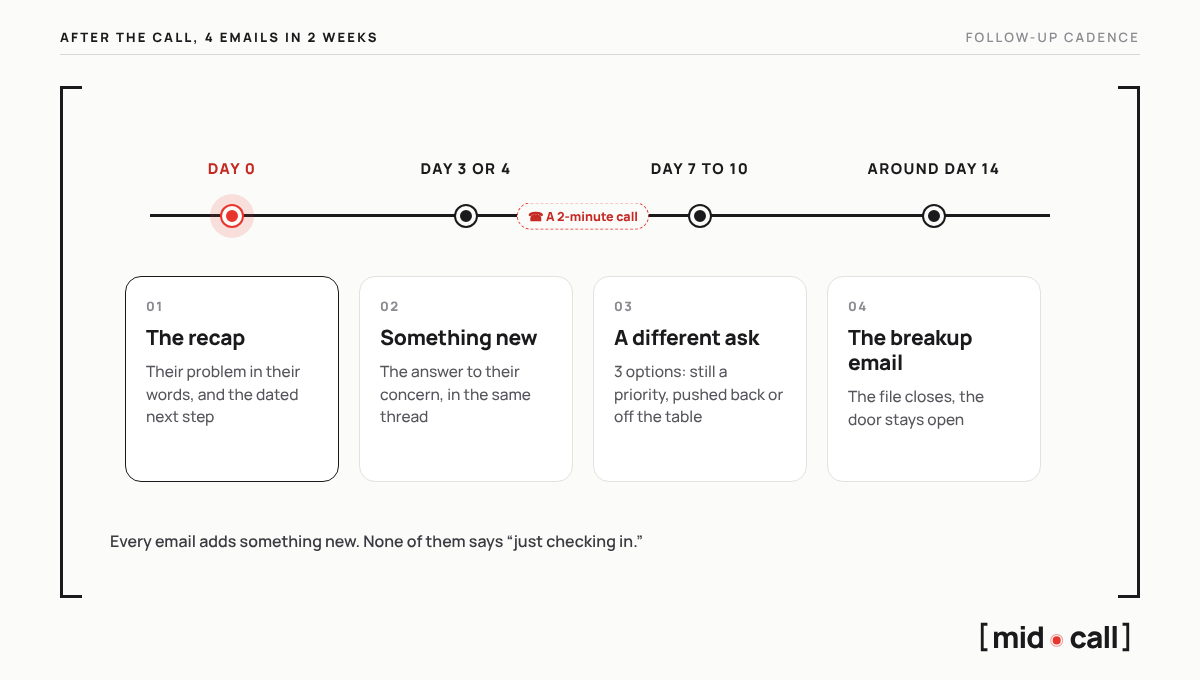
4 emails over about 2 weeks is enough. The recap the same day, something new a few days later, a different ask around day 7 to 10, then the breakup email. If you have their number, call between the second and third email. A 2-minute call often surfaces the objection the silence was hiding.
The fear of being pushy is usually overblown. In a Hunter survey of 217 decision-makers, 48% said they appreciate cold follow-ups, 27% said they don't mind them, and only 25% found them annoying. What annoys buyers is a follow-up that adds nothing.
Sidetrade analyzed 1.5 million meeting requests sent to 220,000 decision-makers in France. Reply rates didn't drop at the 4th or 5th follow-up, and 16% of prospects still replied to the 5th email. That was cold outreach. After a sales call, the buyer already knows you.
Why do sales follow-up emails go unanswered?
Most of the time, because the problem started on the call. According to Forrester, 86% of B2B purchases stall at some point. An email can't restart a deal that has no next step and no identified decision-maker.
- No next step was booked. The email asks the buyer to decide what happens next, and they decide nothing.
- The recap is generic. “Thanks for the great conversation” doesn't prove you listened. Their own words do.
- The email asks for too much. A meeting, a document and a CFO intro in the same email, and the buyer puts off replying.
- The decision-maker never saw it. Your contact doesn't decide alone, and nobody gave them what they need to make the case internally.
- The follow-up is empty. “Just checking in” and “did you get a chance to look?” ask for a reply without giving anything.
- Discovery stayed on the surface. If budget, timing or the decision process stayed vague, no email will fill that gap. A discovery call framework and a qualification method like MEDDIC help you cover them on the call.
What tool writes the follow-up email after a sales call?
Midcall. Its Notetaker plan drafts the follow-up email from the notes of every meeting, and its Live Coach plan makes you lock in the next step before you hang up, so the email only has to confirm it. Midcall works on both sides of the email, which a basic note-taking tool doesn't.
Time matters too. In Salesforce's 2026 State of Sales survey of 4,050 sales professionals, the average seller spent only 40% of their time selling, and sellers expected AI agents to cut the time they spend drafting emails by 36%.
After the call, the Notetaker plan
As soon as the meeting ends, Midcall generates the meeting notes, the next steps and a draft follow-up email, subject line included, on the meeting's page. You read it, edit it, then copy it or open it straight in Gmail or Outlook. Midcall never sends anything for you, so you keep control of every word.
The draft follows a built-in follow-up prompt that you can customize, for example so it uses the 5 parts from this article. It's written in your account language, and the meeting notes sync to your CRM, whether HubSpot, Salesforce or Attio.
The same meeting is also scored skill by skill, with the exact quotes behind each score, and every deal gets a 0 to 100 confidence score. It combines your meetings, the emails sent and answered, and the calls logged in your CRM, and updates with every new touchpoint. You know which deals to follow up on first.
During the call, the Live Coach plan
The coach tracks the qualification criteria of your methodology, whether BANT, MEDDIC, SPICED or your own scorecard, and flags what's missing before the call ends, not when you're writing the follow-up. As the call wraps up, it prompts you to lock in the next step before you hang up.
| Written by hand | Prepared with Midcall | |
|---|---|---|
| Where the content comes from | Notes you took while talking | Notes from the entire meeting |
| When it's ready | Whenever you find the time | As soon as the meeting ends |
| The next step | Negotiated by email if you forgot it | Locked in before you hang up, thanks to the Live Coach |
| The CRM | Updated by hand | Meeting notes and next steps synced |
| Sending | From your inbox | From your inbox, in one click, after you review it |
Midcall sets up in 5 minutes on Google Meet, Microsoft Teams and Zoom, and it's the most complete note taker for a sales team, as our comparison of the best AI note taker shows.
Edward, co-founder of Midcall. Former AE, co-founder of Meteor, a B2B prospecting agency. I write about what actually happens in sales meetings, and what the best teams do with it.
Frequently asked questions
How soon should you send a follow-up email after a sales call?
The same day, before your buyer's workday ends. Your notes are still accurate and the buyer remembers the conversation. If there's no reply, follow up 3 to 4 business days later with something new, then 7 to 10 days after the call with a different ask, and send a breakup email around day 14.
What should a follow-up email after a sales call include?
5 parts are enough. A reminder of the meeting, the buyer's problem in their own words, what you showed to solve it, the dated next step with who does what, and one single ask. The whole email should take less than a minute to read on a phone.
How do you lock in a next step before a sales call ends?
In the last 5 minutes, summarize out loud what you understood, offer a choice between 2 time slots instead of asking when they're free, then send the invite while the buyer is still on the call. If the buyer won't commit to a date, there's still a doubt to surface before you hang up.
How do you follow up after a sales call without being pushy?
Bring something with every follow-up, like an answer to the concern they raised, a summary that helps them make the case internally, or 3 easy options to tell you where the project stands. In a Hunter survey of 217 decision-makers, only 25% found even cold follow-ups annoying. What annoys buyers is a follow-up that adds nothing, like “just checking in.”
How many times should you follow up after a sales call?
4 emails over about 2 weeks. The recap the same day, something new 3 to 4 days later, a different ask around day 7 to 10, then a breakup email. If you have the buyer's number, a call between the second and third email often gets things moving.
What is a good subject line for a follow-up email after a meeting?
One that points to the meeting and the buyer's topic, with their company name, for example “Buildwell: month-end close, NetSuite and the Nov 12 demo.” Avoid “Following up,” “Great speaking with you” and “Just checking in,” which say nothing about the content.
How do you follow up after sending a proposal?
2 to 3 business days later, ask what's left to settle to hit the decision date instead of asking whether they've had a chance to look. If the decision date has passed with no reply, ask directly what's holding it up. Better still, walk through the proposal on a call rather than sending it cold.
What should you do after a no-show?
Send an email within the hour after the missed meeting, without blame, with 2 specific new time slots. Things come up, and a buyer who feels judged doesn't rebook.
Should you follow up in the same email thread?
Yes, for the follow-ups after your recap, so the buyer sees the whole history at a glance. Start a new thread for the breakup email or to reconnect months later.
Who should you CC on a sales follow-up email?
The people who were on the call, and only them. For a decision-maker who wasn't there, send your champion a short summary they can forward, written so it makes sense without you.
What tool writes the follow-up email after a sales call?
Midcall. Its Notetaker plan generates the meeting notes, the next steps and a draft follow-up email as soon as the meeting ends, which you review and then copy or open in Gmail or Outlook. Midcall never sends anything for you, and the draft prompt can be customized. Its Live Coach plan also prompts you to lock in the next step before you hang up. Midcall offers a free trial, available after a demo.
See the live AI coach on one of your calls.
15 minutes. We plug Midcall into a real scenario from your team, you decide.